This Mailbag is Too Complicated for a Headline. Just Read It.
The etymology of "play-action pass." Batted-pass statistics. A length-of-games study. NFL players as Beatles. You know: the typical stuff you expect to read about in a Friday mailbag.
This is Part 3 of NFL Week 9 Mailbag. Part 1 discussed the Colts, Patriots, Seahawks and Steelers. Part 2 covered Eagles anxieties, Cowboys silliness and some thoughts on the NBA’s gambling scandal. Part 3 covers … EVERYTHING.
Thanks again for all of your questions! Sorry I could not get to them all. But as you can see, I tried.
Mike, over the last few weeks I have noticed a surprising number of tipped passes at the line of scrimmage. Bo Nix stands out as someone with far too many tipped balls, but Jaxson Dart, Caleb Williams and others all seem to have more of them than other players. Besides the obvious explanations (short qbs have more passes tipped), are there any through lines among QBs with lots of tipped passes? Or is it largely random/opponent specific that will even out as the year stretches on? — Andrew Coyner
There have been 168 batted passes in 242 team games through Week 8: 0.694 batted passes per team per game. (Source: Pro Football Reference.)
There were 373 batted passes in 544 regular-season team games in 2024: 0.686 batted passes per team per game. That doesn’t look statistically significant.
Football Outsiders researched batted passes a zillion years ago and determined that the primary variable is not height, but experience. Young quarterbacks and backups lock in on their primary targets and run predictable plays, both of which make it easier for defenders at the line to know when and where they will throw the ball. Height and the quality of offensive line play are secondary factors, and the level of randomization/noise on the tiny sample sizes is high.
Here are the batted pass leaders for 2025, through Week 8:
- Caleb Williams: 12
- Dak Prescott: 9
- Bo Nix: 8
- Patrick Mahomes, Sam Darnold, Justin Fields, Kyler Murray: 7
That’s an eclectic mix, but the still-young Williams and Nix are in it. Cam Ward has six batted passes.
Aaron Rodgers has not been charged with a batted pass in 2025. Matthew Stafford has just one. Lil’ Bryce Young only has one; he’s more likely to sail a pass too high or scramble away than have one batted. Jared Goff two.
Bo Nix suffered 16 batted passes in 2024, second to only Cooper Rush with 17. It’s an area of his game that needs improvement.
Do you have any idea how a fake handoff came to be called “play-action”? I get that it’s a play that has action in it, but so is an end around, and we don’t call that “play-action.”— Tom Nawrocki
I enlisted the owner-operator of the Quirky Research social media feed for help answering this question. You should ALL be following that feed!
Quirky Research provided some remarkable primary-resource screenshots like this one, from 1962:
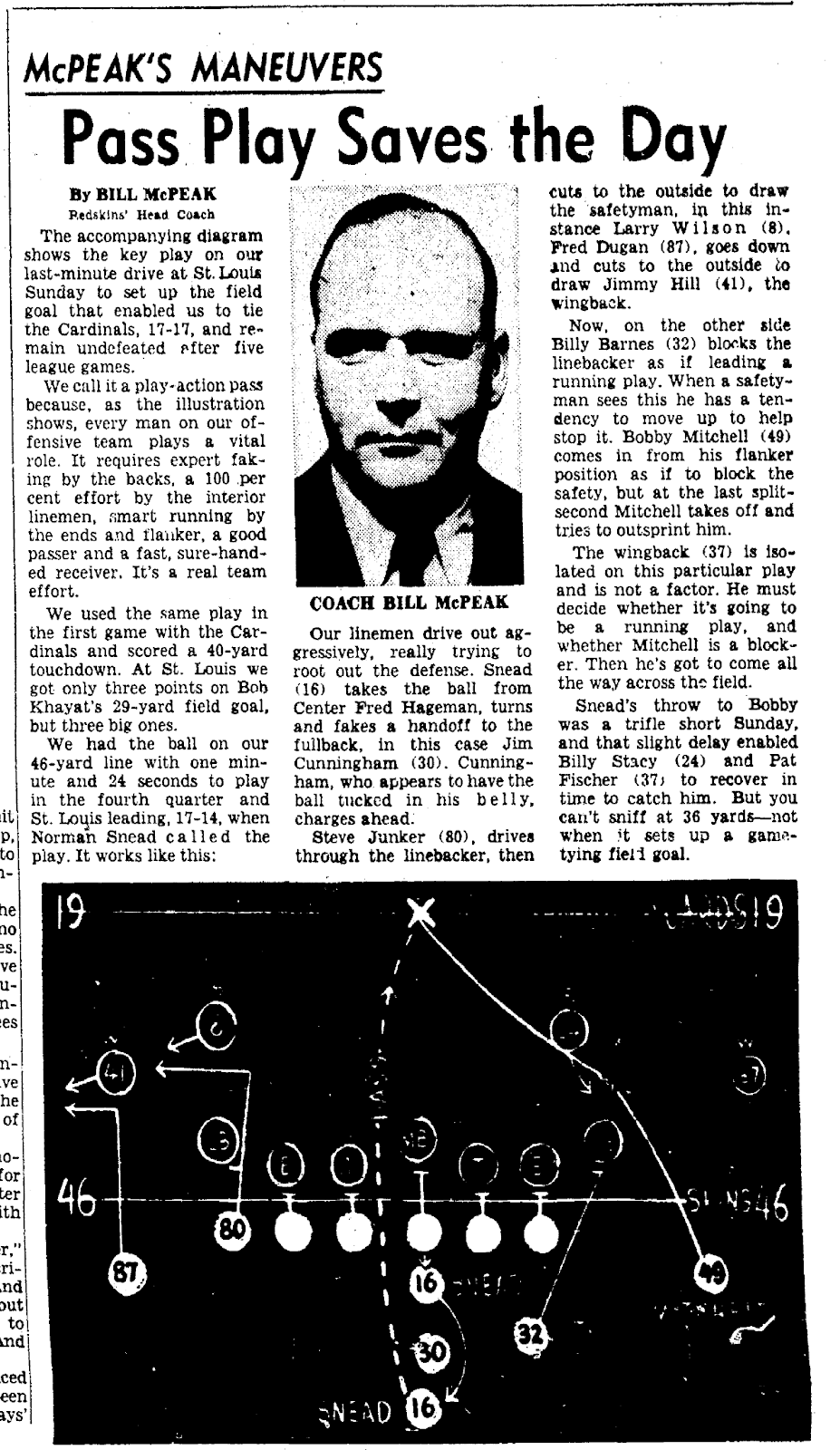
Note how proud Coach McPeak is of that tie! Here’s another from 1962:
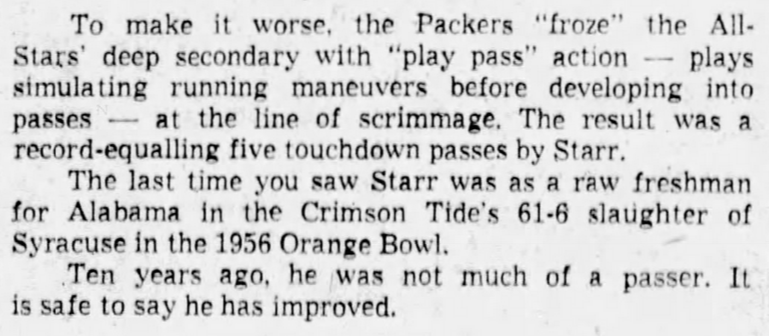
So we have Washington head coach Bill McPeak explaining play-action in detail like it’s a new concept, while another writer calls it “play-pass” action.
Yet here is L.A. Times legend Bob Oates discussing a “play-action” or “play-number pass.”
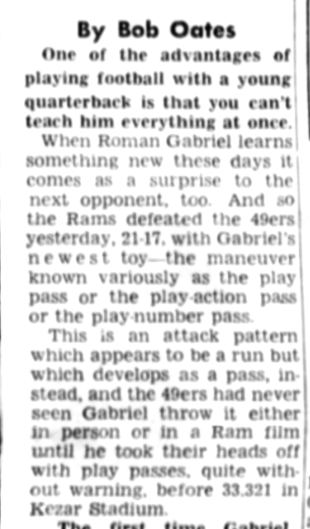
Quirky Research also found variations like “Run Play Number Pass” and just “Action Pass” in sources from the 1960s.
Fake handoffs followed by pass plays are as old as the forward pass. They were a staple of George Halas’ T-formation. Oates is referring to the play as “Gabriel’s newest toy,” but that might have something to do with the design of the 1960s version of the play-action pass, which was more like the modern version than the million-ball-fakes tactics of the Halas era.
The proliferation of early-1960s sources probably also corresponds with increased interest in pro football: more knowledgable reporters in more cities asking more coaches more in-depth questions. The tactic’s name probably evolved and branched out for several decades across college and pro playbooks, like Latin turning into French/Spanish/Italian. Eventually, broadcasters chose “play action” from among the similar choices above, perhaps because of simplicity and brevity.
Similar things are happening to terminology now. “Edge Rusher” was not a common term about 10 years ago. “Dagger” (an outside receiver running a deep out while the slot guy runs a fly to clear the safety) probably had a dozen different names in various playbooks, but “dagger” is the one tape experts found the most familiar and expressive.
Thanks again to the mysterious purveyor of Quirky Research!
In remarking that the current Commanders-Chiefs game had a quick-moving first half, Joe Buck reminded me what I have been thinking in the back of my head for awhile now: that NFL games have been quicker moving in general than they were 10-15 years ago. Is this true? Is there any way to know this is true? If it is true, what do you suspect is the primary cause of it? — Justin
Several readers responded to this question. So in the interest of providing outstanding customer service, I performed a short study.
The average NFL game in Week 8 lasted 179.7 minutes. The figure for Week 5 was 182.2 minutes, not counting one overtime game. The figure for Week 6 (I was just grabbing midseason samples) was 183.6 minutes. Week 8 featured more short games than a typical week; blowouts have far fewer late-game stoppages, and one team is actively trying to melt the clock.
The average game in Week 7 of 2015 took 188.9 minutes to complete. The average Week 8 game took 191.8 minutes. Overtime games were omitted from those samples. Games, even blowouts, were noticeably longer.
The NFL tweaked several rules to speed up play in 2017. They reduced the number of commercial breaks, but made those breaks longer. The league shortened the time between the extra point and the next kickoff. Referees were given tablets to speed up replays and told to go straight to the replay booth without making some theatrical announcement.
Those tweaks had an impact. Remember extra point, then commercial break, then kickoff, then commercial break? Shaving 30 seconds per touchdown off of that process made a difference.
Expedited reviews from NFL headquarters are probably also speeding up games. What used to be four minutes of milling around to overturn an obvious call now takes more like a minute.
The NFL wants three-hour games that fit snugly in its television windows. It’s happy with blowouts that wrap up quickly so the broadcast can cut away to fourth-quarter chaos elsewhere. It is probably pretty happy with the pace of play right now.
Historically how weird is the special teams stuff this year with the insane field goal lengths and the amount of field goal blocks we have seen this year? – Don
The sudden rise in field goal lengths are certainly noteworthy, though I am not sure how “weird” they are. Field goal accuracy and length have been increasing for decades. The sudden acceleration in that increase is surprising. My gut tells me that there will be some “settling” in the sheer number of 60ish-yard attempts, at least in non-end-of-half/game situations, once coaches refamiliarize themselves with the consequences of a miss.
The blocked field goal storyline, on the other hand, is turning into a boondoggle.
There have been nine blocked field goals/PATs this season, at least according to the Stathead play finder. The goddamned Gemini AI lists 16 blocked kicks when it offered some unsolicited results, but that includes punts. The AI, as you might imagine, isn’t particularly fussy when it comes to scraping its data.
After the Week 3 flurry of game-deciding blocked field goals, The Athletic’s Brooks Kubena and Mike Jones were sent on a 3,000-word odyssey to determine the root cause of this alarming new trend. Kubena and Jones solicited many expert opinions and insights. It was very interesting and carefully researched/reported. But never send journalists to do a math teacher’s job! I could have saved them a lot of trouble by saying IT’S RANDOM. But who wants to read that?
I found only two blocked field goals/PATs in the month of October. Maybe alert kickers and coaches adjusted since Week 3. Or maybe IT’S RANDOM.
Kubena and Jones cited examples of multi-blocked-kick weekends from 2019 and 2022. Perhaps there’s lots of adjustments and counter-adjustments at work. Sure. But also IT’S RANDOM.
The Athletic reporters noted that there were 22 blocked kicks in 2022 and 33 in 2003, isolated data spikes with no clear explanations. (I am not sure if punts are lumped into these figures.) Maybe fickle gods are playing dice with blocked kicks. Or maybe IT’S FREAKIN RANDOM C’MON PEOPLE THIS IS LITERALLY WHAT RANDOM DATA ALWAYS LOOKS LIKE ARGH ARGHHHHHHHHH