Five Signature Moments from Tampa Bay Buccaneers History
Featuring Tom Brady, Mike Alstott, Ronde Barber and (like it or not) Hugh Culverhouse.
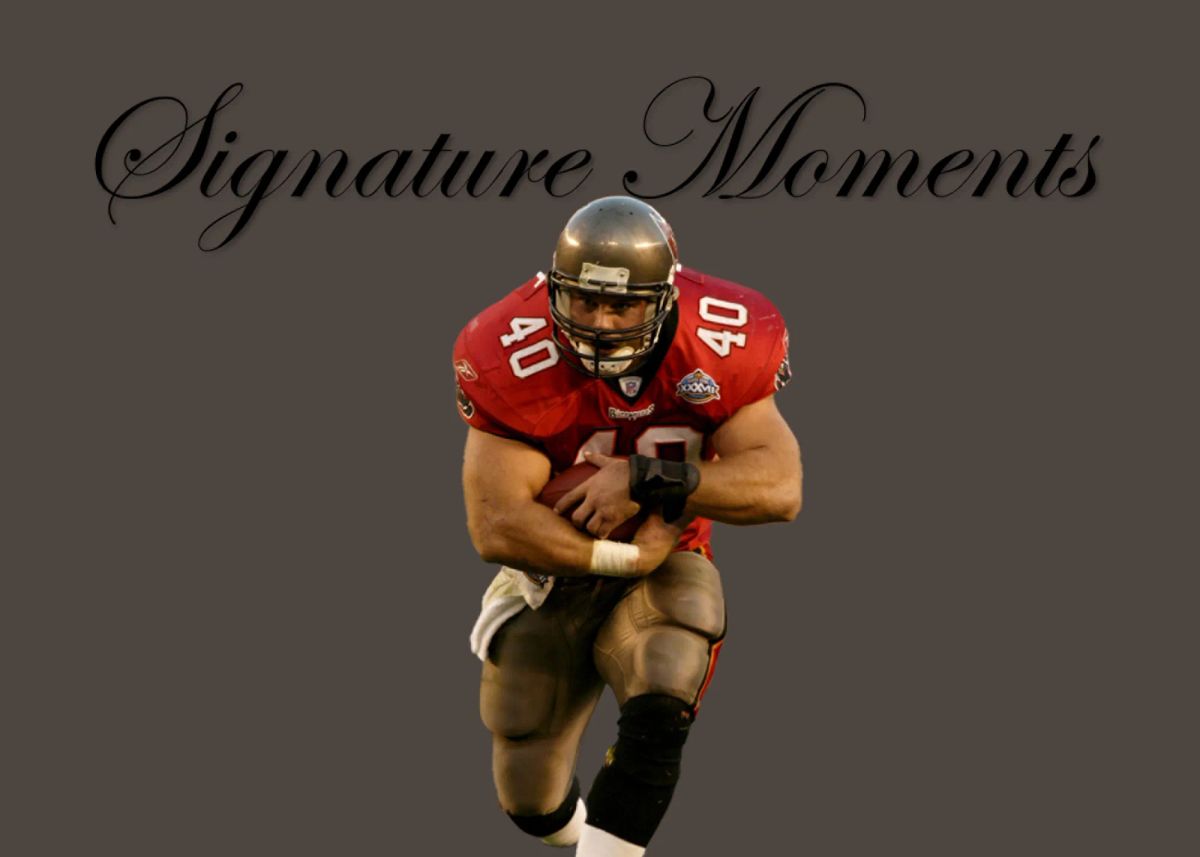
The following countdown of Tampa Bay Buccaneers signature moments contains ZERO highlights from Super Bowl XXXVII or Super Bowl LV.
No Dwight Smith pick-6’s. No Shaq Barrett sacks. No retellings of the (still disputed) tale of how the Buccaneers defense knew the Raiders’ offensive signals in the Super Bowl.
Oh, the 2002 and 2020 Buccaneers are represented in this countdown. So is Tom Brady. Some legendary defensive plays by all-time greats are featured. But “Signature Moments” are not the same as “Greatest Moments.” Signature Moments provide snapshots into a team’s full history. They are the plays, trades, quotes, decisions and (sometimes) crimes of passion that represent all that was great and terrible about a franchise, at its best and worst, in the broadest possible brushstrokes.
(That’s a poetic way of saying that I like to keep these countdowns unconventional, and therefore more interesting.)
So let’s give Smith, Derrick Brooks and the other defensive heroes of Super Bowl XXXVII a warm Honorable Mention.
Now we can talk about some of the plays, players and moments who spring to mind more readily when we look back on Buccaneers history.
5. Mike Alstott Shuts the Door on the Vikings
Fullback Mike Alstott scored on a 31-yard run early in the third quarter, a run on which tacklers bounced off him like toys. It was the longest run in Tampa Bay playoff history and made the score 20-0.
‘’I love it when guys try to tackle me high,’‘ Alstott said. ‘’The crowd today was special. It was electric. They came early and stayed late. They had new cheers. Our guys were feeding off of that.’‘ – Thomas George, New York Times, December 29th, 1997.
“There were so many spectacular three and four-yard runs that ended up being big plays for us and big touchdowns,” said Dungy, trying to pinpoint his favorite Alstott moment. “But I guess the play that I will always remember was the touchdown he scored against Detroit in 1997 in our first playoff win to ice the game. It was so symbolic of Mike, a run up the middle, breaking three tackles and then having the speed to take it all the way. It really showed all of the things that he could do. It was a big play in a big game for us, but it seemed like he always made big plays in big games.” – Buccaneers team website, February 1, 2008.
Alstott was the last of the old-school all-purpose fullbacks. He was also among the last of the NFL’s unironic white-guy wish-fulfillment figures. He was a “throwback” and a “fan favorite” in the most eye-rolling euphemistic senses. But he also really was a throwback to a different tactical era. And he was a favorite of fans like me because he looked like fans like me. We loved Chris Berman’s silly sound effects over Alstott’s (sometimes rather routine) highlights. It was a simpler time.
Alstott was also a very good player for a very long time for some excellent Buccaneers teams. Alstott ranked eighth in the NFL in rushing DYAR in 2001. He ranked third among running backs in receiving DYAR in 1996. Alstott and rookie Warrick Dunn gave the Bucs thunder and lightning in the same backfield at the same time in 1997. It was a dying strategy, but an effective one. And a beautiful one.
Alstott’s touchdown against the Vikings sealed the Bucs’ first playoff victory in 15 years. It kicked off a six-year period of success under Dungy and Jon Gruden, culminating in a victory in Super Bowl XXXVII. Alstott, along with Dunn and Dungy’s defense, ushered in the modern era of Buccaneers football.
So yes, there were better players on those Dungy-Gruden Buccaneers than Alstott. But when you close your eyes and think of the Bucs of that era, who do you see? More appropriately, what do you hear? I’ll bet it’s Berman making boom-bang-pow grunting noises over an Alstott run.
4. Lee Roy Selmon sacks the Eagles
Don’t laugh, but the Tampa Bay Buccaneers are one victory away from the Super Bowl.
The four‐year‐old expansion team that no one seemed to believe in — including, at times, its coach, players and fans — upset the Philadelphia Eagles, 24‐17, today behind a recordbreaking performance by Ricky Bell and before a record‐breaking crowd of 71,402 in Tampa Stadium.
The National Football League’s greatest contribution to national humor, a team that lost its first 26 games and gained more punch lines than yards, qualified for the National Football Conference championship game next week against the winner of the Los Angeles Rams‐Dallas Cowboys playoff tomorrow at Irving, Tex.
After Philadelphia closed within 17-10 in the third period and had moved to a first down on the Tampa Bay 38, the Buc defense, one of the best in the league, established supremacy. Lee Roy Selmon, the first player selected by what was only a paper franchise back in 1976, sacked Ron Jaworski, the Eagles’ quarterback, on two consecutive plays, and the Bucs, after taking over, marched to another touchdown, this one on a 9‐yard pass from Doug Williams, who has his own collection of jokes, to Jimmy Giles.
“I just hope we proved to America, not just Philadelphia, we have a ball club,” said David Lewis, one of the four fine linebackers (along with Lee Roy’s brother Dewey, Richard Wood and Cecil Johnson) in the Bucs’ 3‐4 defense. “We’re not a team of 0‐26 players.” –Excerpted from Michael Katz, New York Times, December 30th, 1979.
Lee Roy Selmon recorded 28.0 sacks for the Buccaneers from 1976 through 1978. But few fans ever saw him play; the Buccaneers were almost never on national television in those years. Heck, few fans knew how many sacks he recorded: sacks would not become an official sack until 1982. Most NFL fans only knew of Selmon as the lone player on the Buccaneers roster with any dignity.
The 1979 season was different. Doug Williams gave the Bucs offense a wisp of credibility. The Bucs started out 5-0, in large part because of their Selmon-led defense. They merited a Sports Illustrated cover which featured Dewey Selmon tackling Lawrence McCutcheon. Lee Roy forced two fumbles in the game in which that photo was taken; I like to believe that even SI editors weren’t familiar enough with the Bucs to tell one Selmon from another. The Bucs clinched the NFC Central and their first playoff berth by beating the Chiefs 3-0 in the Monsoon Game, a turnover-filled slip ‘n’ slide spectacle that sent 1970s football out in style.
The Bucs’ divisional victory over the Eagles was simultaneously an introduction and a coming out party for both Selmon and his team. Many fans saw the punchlines-turned-heavy-hitters in an actual game for the first time that day. Ricky Bell delivered the signature performance of his short, tragic NFL career in that game, rushing for 142 yards and two touchdowns. Selmon’s sacks ended the Eagles’ best second-half rally, punctuating a Defensive Player of the Year season.
The Buccaneers would never win another playoff game with Selmon. In fact, they would not win another playoff game for 17 years. Selmon’s playoff sacks aren’t very well remembered anymore. But Selmon is. This signature moment commemorates the years he spent dragging the expansion Buccaneers franchise to legitimacy through sheer determination.
3. Bo Chooses Baseball
Bo Jackson eluded hundreds of defenders in four glorious years at Auburn. He now faces the relentless charge of a 67-year-old tax expert.
Tampa Bay owner Hugh Culverhouse, who has never failed to sign a draft pick, said Tuesday he plans to entice Jackson to the Buccaneers with the ‘top offer in NFL draft history.’ In New York, the Heisman Trophy winning running back continued his wait-and-see attitude. – Ira Kaufman, UPI, April 29, 1986.
As recently as three weeks ago, there had been talk that Jackson would keep the Tampa Bay Buccaneers from falling off the earth’s crust. When Jackson announced on June 21 that he had opted for baseball, Tampa Bay owner Hugh Culverhouse was all but left standing at the lectern with his checkbook and without the running back. So Culverhouse did the only sensible thing.
He quoted Dionne Warwick: “Keep smiling, keep shining, that’s what friends are for.” – Gary Pomerantz, LA Times, July 6th, 1986.
Hugh Culverhouse mismanaged the Buccaneers in ways no modern NFL owner can really mismanage a franchise. He was cheap, meddlesome, shortsighted and often accused of racism in an era when it took an awful lot of racism to get noticed. Culverhouse refused to hire a general manager. He made players buy drinks from vending machines before and after practices. Culverhouse did things that would provide Pro Football Talk with months of free content.
The Culverhouse-Jackson saga could fill an entire book. The details are reminders that the past often looks like a different planet. Jackson lost college eligibility because the Bucs gave him a plane ride to a physical; boosters can now give SEC superstars enough money to buy private jets. Culverhouse tried to sign an already-wary Jackson to a contract full of fine print; as you read this, first-round picks are signing their boilerplate contracts.
The outline of the Bucs-Jackson saga, however, is simple enough. Culverhouse’s actions and reputation rankled Jackson. Culverhouse selected Jackson with the first pick in the draft anyway, then tried to lowball or bait-and-switch him during contract negotiations. So Jackson, the most famous two-way athlete in modern college sports history, signed with baseball’s Royals instead.