Hunter X Hunter II: Revenge of the Sunk Cost Fallacy
The Jaguars plan to resume the Travis Hunter two-way experiment. It's a terrible idea, born more from James Gladstone's arrogance than from common sense.
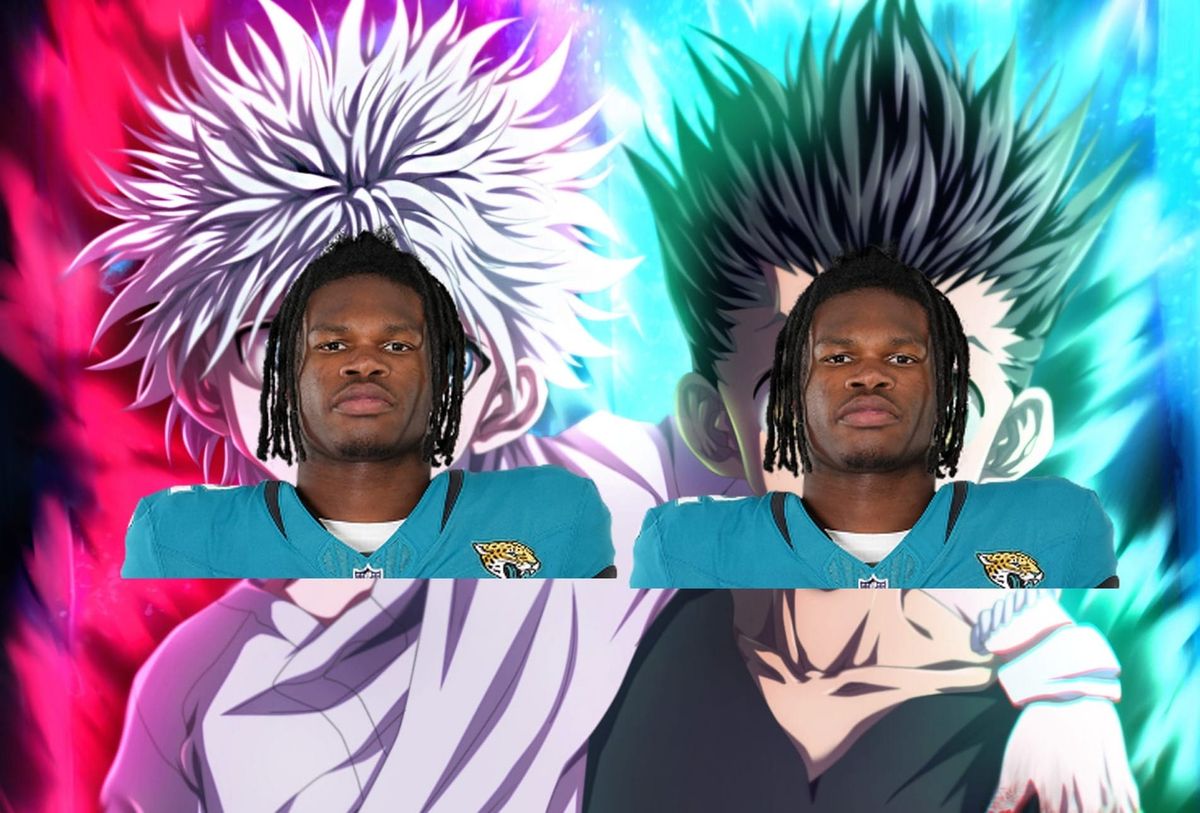
Travis Hunter will never be a high-impact two-way starter in the NFL.
My source for that daring assertion is the last 66 years of NFL history. There have been no regular two-way NFL starters since 1960. No, not even Deion Sanders, who only started at both cornerback and wide receiver for a handful of games in 1996, abandoning his offensive role before the season ended. Something which hasn’t happened in decades is unlikely to happen again unless circumstances change. Really, really wanting it to happen doesn’t change the circumstances.
If anyone is capable of becoming a star on both offense and defense, it’s Hunter, who won the 2024 Heisman Trophy by excelling at both cornerback and wide receiver for Colorado. Hunter looked to me like a future Pro Bowl-caliber cornerback who could play a useful role as a gadget receiver, like Sanders or Charles Woodson.
When the Jaguars began experimenting with Hunter as a full-time two-way player, rotating his practice schedule so he could learn the complete Jaguars offense and defense, I was skeptical. After all, Hunter was trying to learn twice as much as the typical rookie in half as much time! Still, the experiment itself was so exciting, and Hunter was/is such an outstanding prospect, that I was optimistic. Maybe the Jaguars were using an entirely new process to turn Hunter into something we have never seen before.
Then Hunter took the field, looked kinda lost on offense, was limited to a package role on defense, suffered an LCL injury in an October 30th practice and was lost for the season. The real-world experiment disproved the thought experiment. Everyone said, Welp, that was fun. Time for Hunter to focus on either defense or offense.
Well, not quite everyone. Initial offseason murmurs out of Jacksonville suggested that the Jaguars’ braintrust had come to its senses. But men of James Gladstone’s daring insouciance might not even have senses. Both Gladstone and Jaguars coach Liam Coen now insist that Hunter will play on both defense and offense in 2026.
That’s fine: Hunter looks like a future Pro Bowl-caliber cornerback who could play a useful role as a gadget receiver. The messaging out of Duval sounds so emphatic, however, that we’re probably not talking about a cornerback and package receiver.
"The plan has not changed at all,” Coen said at the start of OTAs. “He's going to play both sides of the football just as we drafted him to do, and just as we have the same vision for him in terms of being able to give him those opportunities."
It sounds like we are in for another summer of Hunter at cornerback on Monday and Tuesday and receiver on Wednesday and Thursday, or something like that. The Jaguars are going to repeat the same behaviors and hope for the exact opposite results. That’s the definition of genius. Right?
Hunter the Defender
Let’s take a deep-ish dive into Hunter’s truncated 2025 to see what we are dealing with. We will start on defense.
When healthy, Hunter was the Jaguars’ third cornerback last year. He usually lined up at left corner in their nickel package, with Montaric Brown or Jourdan Lewis moving inside. The Jaguars swapped out Tyson Campbell for Greg Newsome at right cornerback via trade early in the season. Hunter was rarely in the slot, but he started playing more often on the right side in his final games before the injury.
His usage pattern suggests that Hunter was playing a simplified role on defense. There’s nothing unusual about a rookie cornerback drawing scaled-down assignments. We’re just gathering data and creating a snapshot here.
Per Sports Info Solutions, Hunter played 112 coverage snaps, allowing 11 catches for 117 yards on 17 targets. He committed one pass interference penalty and broke up three passes. Pro Football Focus lists similar coverage data. These numbers are solid, if not noteworthy.
Hunter was only on the field for 42 running plays. He did nothing worth detailing, good or bad, as a run defender. He blitzed zero times, which is a little bit interesting.
I remember hearing criticism of the finer points of Hunter’s technique and coverage decisions last year. I’ve seen rookie cornerbacks stop just short of wandering into the parking lot after a pump fake, so whatever.
Hunter appeared to be improving as a coverage cornerback as the season progressed. The Rams targeted Hunter just once in Week 7, on a deep pass up the left sideline to Davante Adams. It looked like Adams had a half step on Hunter, but the pass sailed a bit, giving Hunter time to force an incompletion. The Seahawks isolated Hunter against Jaxon Smith-Njigba a few times in Week 6. Hunter only allowed one 12-yard catch by JSN on a short stop route.
Hunter played only 22 snaps on defense against the Seahawks and just 14 against the Rams. Both teams use multi-tight end sets to keep opponents in their base defense; they weren’t trying to keep Hunter off the field, but it just worked out that way.
In fact, the 35-7 Rams victory over the Jaguars marked the start of the “13 Revolution.” The Rams were without injured Puka Nacua and leading for most of the game, so Sean McVay deployed three tight ends – something he had rarely done before – and downshifted into caveman tactics. The rest is history.
The 13 Revolution has little to do with Hunter. Or does it?
Hunter the Offender
Hunter caught 28 passes for 298 yards and one touchdown in seven games as a receiver last year. His DVOA was -17.9%. He recorded -17 DYAR. He graded out as worse than replacement level as a receiver, though the sample size is far too small to use as a bully pulpit.
Hunter caught 20 passes for 197 yards and zero touchdowns in six games if we exclude the Rams blowout. He caught 25 passes for 223 yards and zero touchdowns in 6.75 games if we only exclude the fourth quarter of the Rams blowout.
In other words, any evaluation of Hunter as a receiver pivots on the Rams game. His 8-101-1 performance could be interpreted as a breakout or as a blip caused by some garbage time production.
I lean toward the blip.
Hunter caught zero passes on three targets in the first half of that blowout. On the first target, Hunter ran a deep out route from a funky “quads” formation, but the trajectory of Trevor Lawrence’s pass suggested that he expected Hunter to run a corner route.
Lawrence threw a fastball over the middle on the second target; Hunter, running a shallow cross, barely got his head around, and the ball whizzed past him.
With the Jaguars in the red zone on third down late in the second quarter, Lawrence tried to connect with Hunter on a quick out, but the throw was outside, and Hunter could only flail at it.
It was 21-0 in the third quarter when Hunter caught his first pass. Hunter caught three passes for 71 yards and one touchdown against some high-thread-count coverage schemes after the Rams took a 28-0 fourth quarter lead.
Does that really sound like a breakout game?
Hunter’s film is full of what look like miscommunications with Lawrence. Jaguars early-season film, it should be noted, often looks like one long miscommunication with Lawrence. Dyami Brown doesn’t appear to ever know what he is doing. Brian Thomas might as well be on Jupiter. The Jaguars offense got smoother, and better, when Jakobi Meyers arrived and Parker Washington took on an increased role. That’s not a damning indictment of Hunter. But he sure looked like someone who had been practicing wide receiver on a part-time basis for an offense that wasn’t properly installed until sometime in October.
Lawrence threw nine screen passes to Hunter, who caught eight of them for 10 yards. That’s 1.25 yards per catch. Opponents saw the Hunter screens coming from orbit; it looked like 12 Seahawks gang-tackled him on one Week 6 screen.
Hunter was the target of eight short outs. He caught two for 29 yards.
One of the outs, against the 49ers, really stuck in my mind. It was 2nd-and-13 in the third quarter of a tight game. Hunter lined up in the right slot, with Upton Stout in off man coverage. Hunter ran one of the dipsy-noodlest stems I have ever seen, releasing to his left, then drifting back toward Stout, then head-faking and stutter-stepping before finally darting toward the sideline. Stout was faked out by none of it. Lawrence appeared to be a little crossed-up, however: he threw to where Hunter might have been had he run a crisper route, and the pass sailed toward the sideline. The red-zone out route against the Rams which I mentioned earlier had a similar “no one knows the time signature” vibe.
Hunter caught a 28-yard laser up the seam earlier in that 49ers game. It was a tremendous leaping highlight. But there was another miscommunication-type incompletion early in the game. And Fred Warner poked a fumble away from Hunter after a completion over the middle late in the third quarter of a still-close game; fortunately, the Jaguars recovered.
Hunter did some positive things as a receiver before getting hurt. Sports Info Solutions credits him with 10 eluded tackles on 28 catches: a very high figure. Hunter caught a bomb from a scrambling Lawrence against the Chiefs to go with his deep catches against the Rams and 49ers. He can make acrobatic catches and juke defenders. He could develop into an outstanding wide receiver if he perfects his route-running and timing with his quarterback. Complete that thought on your own.
One final note: Hunter played 67 offensive snaps against the Rams, his highest figure of the year. Remember, he played just 14 defensive snaps in that game, because the Rams used lots of heavy personnel in a blowout. What would have happened if the game was closer and the Jaguars needed Hunter on defense in the second half?
Hunter played 81 total snaps against the Rams, more than any player on either team. He played 81 total snaps against the Seahawks, more than any teammate. The Jaguars appeared to be ramping up his workload. Then he suffered a soft-tissue non-contact practice injury.
Again: complete that thought on your own.
The Costs are Sunk. Let’s Sink More.
A pretty good argument can be made for continuing with the two-way Hunter experiment. Hunter showed promise on both sides of the ball. He’s probably a starting-caliber cornerback right now. Given another offseason of practice at receiver, he can become a more precise route-runner and develop better chemistry with Lawrence. Hunter only really needs to become a solid WR3/WR4 with Washington and Meyers in the fold anyway, so why abandon the experiment?
My counter-arguments:
- More snaps = more fatigue = more injury risk. That’s a problem which was illustrated last year and will never go away.
- Hunter’s snap counts will always be dictated by his opponent and the game situation. If he’s gassed in the fourth quarter of a 35-35 shootout in the Florida heat, opponents will go after him (or his replacement) on defense.
- Learning two positions may be impeding his progress at each of them.
- The part-time receiver routine may keep throwing off the timing of the Jaguars offense.
That last bullet point is surely the weakest. But I keep going back to the Jaguars’ September-October offense and wondering why everything was so out-of-sync. Was shuffling Hunter back and forth throwing things off in practice? Causing confusion in meetings? Were other receivers not getting as many practice reps or targets as they needed?
Counter-arguments aside, we may be getting bogged down in semantics. I think Hunter should be a starting cornerback who sees 5-to-10 offensive snaps as a package guy. Proponents of the two-way experiment probably see him as a starting cornerback who sees 20-25 snaps on offense, or maybe vice versa. Does anyone, even Coen or Gladstone, really think Hunter can play 100 snaps per game at the NFL level?
I won’t dare speak for Gladstone, because I never earned an MBA in gobbledy-gook. John Shipley took up the banner for the Jaguars’ two-way experiment in an SI feature. Here are the three subheaders of his argument, with brief annotation by me.
The Jaguars Still Need Hunter at Both Positions. This is a variation on the Sunk Cost Fallacy.
This is How the Jaguars Recoup Value. This is very literally the Sunk Cost Fallacy.
This is What Makes Hunter Special. This is a corollary to the Sunk Cost Fallacy.
Shipley is one of the best Jaguars voices out there, and I don’t want to beef with him. Nor with Jaguars fans; heaven knows I cannot afford to fight on multiple fronts right now. But if the Jaguars are continuing the two-way experiment because Gladstone needs to prove a point and used the 2026 draft to double down, well, that’s more of an argument against the plan than for it.
Gladstone drafted last month as if Hunter were his CB2 and WR3/4: the Jaguars selected no cornerbacks and waited until the sixth round to grab some wide receivers.
More accurately, Gladstone drafted as if he were trying to prove he was smarter than Sean McVay, reaching for tight end Nate Boerkircher in the second round and Tanner Koziol in the fifth round. Gee, who could Gladstone and Coen be planning to imitate? Oh, it’s not imitation, they are manifesting a synergistic paradigm or something. At least, if the Jaguars do go into full 13-personnel copycat mode, it will reduce Hunter’s snap counts and importance on offense.
Anyway, the Jaguars draft suggests that Gladstone is doubling down on the big windmill swing he took when he traded two first-round picks for Hunter in his first draft, which occurred in about his seventh week on the job. Which sounds a lot like the Sunk Cost Fallacy with a scoop of smarter-than-the-room protein powder swirled in.
Yes, I’m a Gladstone skeptic. Every time I start to come around on him, he does something inexplicable, like [waves hands at draft class]. I gave Gladstone and Coen lots of benefit of the doubt on the Hunter experiment last year: their approach to Hunter’s practice schedule and development was fascinating. But then came the results: Hunter got hurt, then the offense got better. Seventy years of past precedents were usually established for a reason, whether the move fast/break things crowd likes it or not.
I want to wrap things up with my conclusion on Hunter from last summer:
I don’t think Hunter will last 17 games, many of them in the Jacksonville swelter, as a two-way starter in 2025. At some point, at either position, fatigue and inexperience will make him less capable than his backup.
Hunter and the Jaguars could be laying the groundwork, however, for something we’ve never seen before. And I’m rooting for whatever that turns out to be. It’s healthy to challenge expectations, establish precedents and shake up the status quo. And I don’t want to be the one who tells a young person to strive for less than they are capable of so they can fit into our neat little boxes.
We’re still laying that groundwork, I suppose. And I am still rooting for Hunter to turn into someone like Charles Woodson. I don’t want some overambitious, under-experienced people to break him before he gets the chance.