The Real McCoys: 2026 NFL Draft CBs
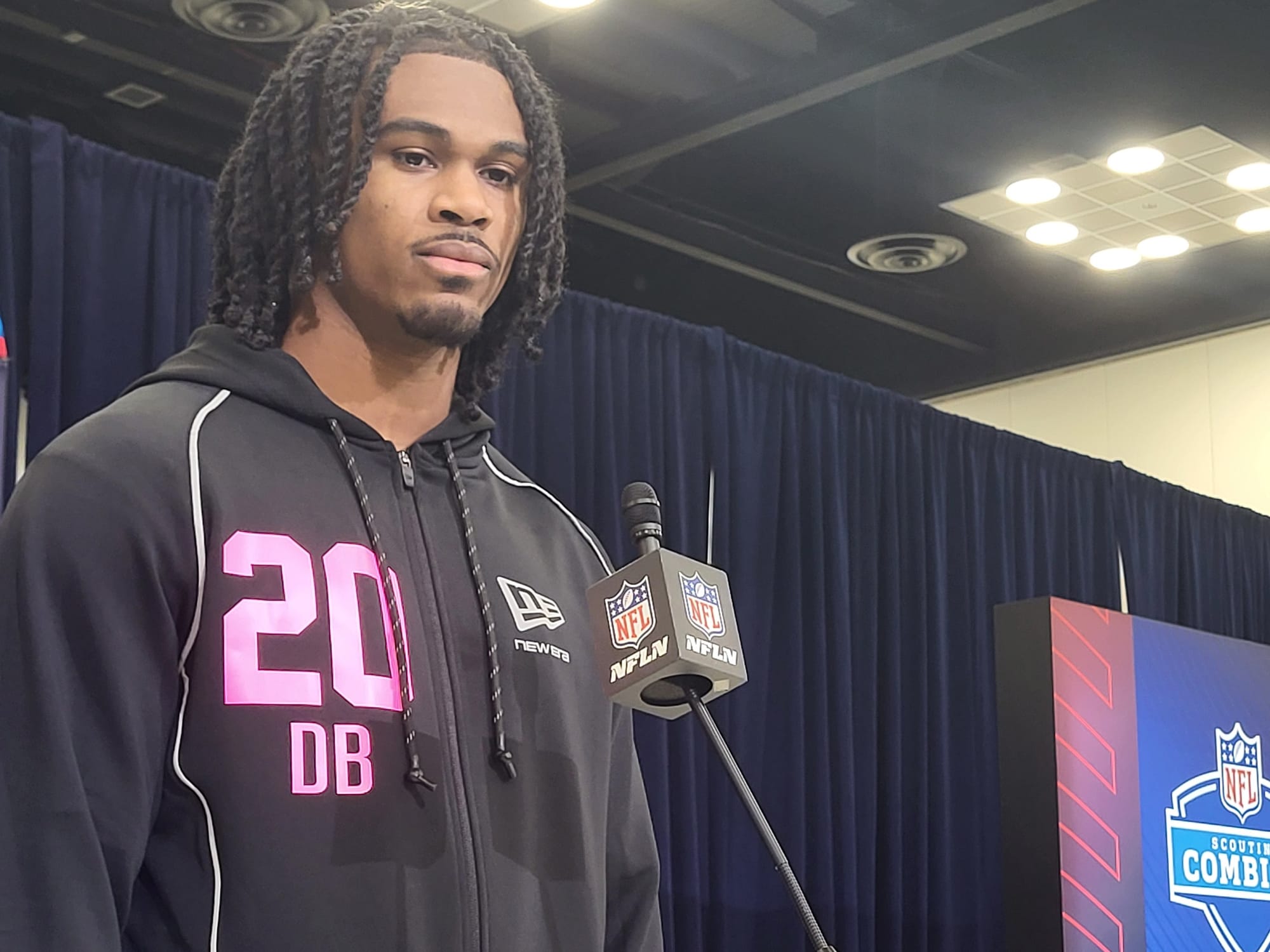
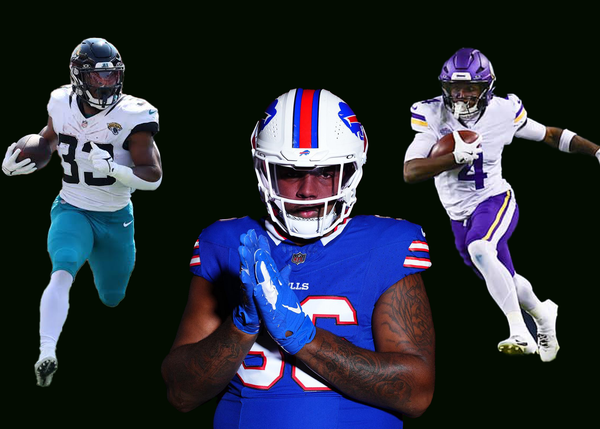
Is Jermod McCoy ranked ahead of Mansoor Delane on the Too Deep 96? Or did I just like this headline/photo better? The answers to this and ALL of your burning draft CB questions are just a click away.
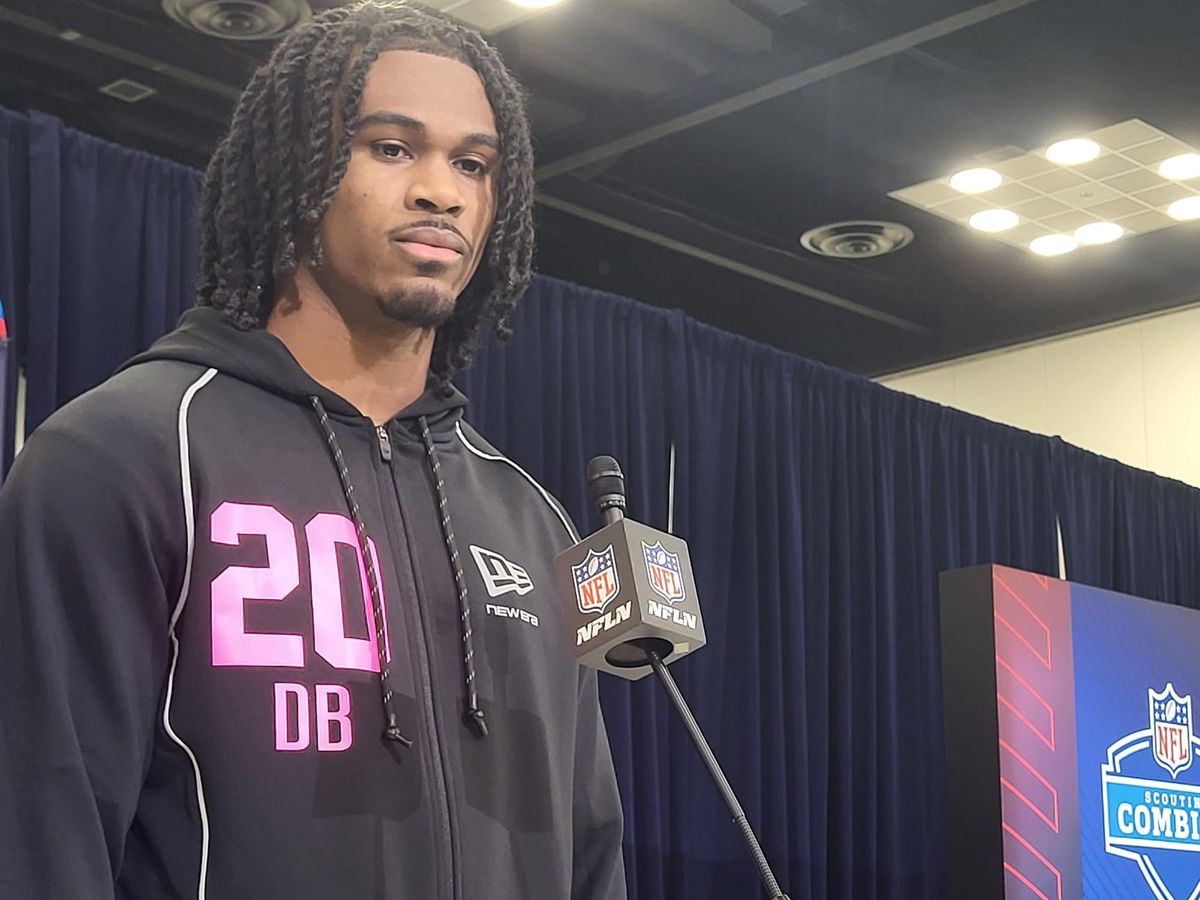
The 2026 cornerback draft class is relatively strong, at least compared to other position groups. It is headlined by three potential stars, followed by an intriguing mix of big hitters, toolsy athletes and student-of-the-game types.
Mansoor Delane, CB, LSU
Delane was so good in 2025 that he was invisible.
Clemson decided to challenge Delane in the 2025 season opener. Cade Klubnik targeted Delane’s receivers ten times. The results: one 19-yard catch, one interception, another pass broken up, lots of hopeless throws to utterly blanketed receivers.
That was that. Delane was targeted just 23 times the rest of the season. He allowed a total of eight catches for 95 yards, with two interceptions and 10 passes defensed. Alabama targeted Delane twice, Vanderbilt once. Florida targeted Delane four times; he allowed zero receptions. Opponents simply avoided Delane’s side of the field.
Delane ran a 4.38-second forty at his Pro Day. He has all the athletic tools a team could ask for in a shutdown cornerback. His weaknesses are mostly quibbles. Delane was good-not-outstanding for three years at Virginia Tech before portalling to LSU in 2025, which may be why Clemson chose to challenge him. But Delane turned 22 in December: he’s not some overaged prospect or system product. He appears to be a defender who blossomed while climbing up a level.
Delane is the #1 prospect in the 2026 Too Deep 96. He’d be a Top Ten prospect in most drafts. I will admit that I may be evaluating him on the negative space on his stat lines and tape: in other words, all the plays he did not have to make. But it means something when SEC coaches and quarterbacks go out of their way to avoid a defender.
Delane may be a notch below former LSU standout Derek Stingley as a prospect, but it’s a tiny notch.
Jermod McCoy, CB, Tennessee
McCoy tore his ACL while working out in January of 2025. He missed the entire 2025 season.
McCoy told reporters at the Combine that he might have been able to return had the Vols reached the playoffs. He also said that he was practicing without limitations, but that he would not be working out at the Combine. This led to a minor controversy/kerfuffle among that strange breed of media members whose beat is best described as Combine coverage for its own sake, i.e. coverage of the workouts themselves, as opposed to college football or the draft.
I have never understood these reporters, who ask prospects what workouts they plan to participate in, how fast they hope to run the forty, why they are not running the forty, and so forth.
Players work out the day after podium interviews. A reporter who rushes a “Speedy McTrackboi says he will run a 4.20 forty” story onto the Internet has less than 24-hour window before the breathless scoop becomes obsolete. The target audience is also tiny: NFL fans will care if McTrackboi does run a 4.20 forty, but who really speculates upon 40 times? “Gamblers,” you might respond, but who would wager on McTrackboi’s forty (itself a gambling micro-niche) based on his say-so? How does a reporter justify a flight and hotel to cater to such an audience?
Some of these Combine-for-Combine’s-sake reporters think they are Woodward or Bernstein when a prospect like McCoy sounds like he’s fibbing a bit. Excuse me, young man, but are you healthy enough to run the forty or not? Americans have a right to know! Granted, 2026 became the Year of 40-Time Disasters, but nobody knew that when we were interviewing McCoy. Some folks were just getting really weird about how a dude with a documented major injury responded to questions about his willingness to run a drill.
McCoy ended up running a 4.38 forty at his Pro Day, ending the tempest in the teapot and reassuring some evaluators who rank a healthy McCoy almost neck-and-neck with Mansoor Delane.
McCoy is 6-foot-1. He doesn’t turn 21 years old until August. He recorded eight passes defensed in 2024, per Sports Info Solutions (other sources list 10), intercepting four. He’s quick, aggressive and sometimes plays the ball better than the receiver he’s covering.
McCoy could have used a senior season next to Colton Hood in Knoxville to clean up some issues, including grabbiness (three DPI penalties in 2024). He’s a bit of a project due to his age and the lost 2025 season. But McCoy looked like a better prospect than Delane entering last season. He has Pro Bowl upside.
Chris Johnson, CB, San Diego State
Johnson allowed just 12 completions on 37 targets for 135 yards, one touchdown and four interceptions in 2025. The Aztecs didn’t face many elite passing offenses in the Mountain West, but those numbers remain outstanding.
The 2026 draft class is thin at most positions, but it’s loaded with physical cornerbacks who are effective at the line of scrimmage. Johnson is solid in run support and will fight off blocks to get to the ballcarrier. He was charged with just three broken/missed tackles in 2025. He reads pass patterns well and breaks quickly on plays in front of him.
It’s hard to find knocks on Johnson’s game. Receivers from Colorado State or Washington State sometimes appeared to beat him by a stride or two, but he made the play if/when the ball hung in the air too long. He demonstrated progress in each of his four seasons with the Aztecs. He’s only 21.
Johnson is a worthy mid-to-late first-round pick. Even if he has downfield coverage deficiencies that weren’t evident at the midmajor level, he could be an effective enforcer in the slot or in a scheme that runs a lot of Cover-2.
Avieon Terrell, CB, Clemson
Falcons cornerback A.J. Terrell offered some high praise of his kid brother back in 2024. “I feel like he was ahead of me at every phase of football at every age,” he told the Greenville News. “It’s nothing new to me. Nothing he does surprises me.
“He’s more of a ‘rah-rah’ cocky dude when he is on the field. He don’t really show it off the field, but when the lights are on the big stage, you’ll feel his presence early.”
The younger Terrell plays cornerback like a 186-pound linebacker. He loves to hit, and he’s a sound wrap tackler. He forced five fumbles in 2025. He makes run support his business, shuts down receiver screens and will chase ballcarriers downfield to prevent touchdowns.
In coverage, Terrell is a big cornerback in a small body. He’s physical and fights for contested catches, but he can get out-maneuvered on shorter routes, and pure speed could be an issue in the NFL.
Clemson used Terrell outside more often than in the slot, but he may fit best as a slot defender who can thrive by limiting YAC on underneath routes and in run support. On the outside, he’s a Cover-2 type who will always benefit from safety help.
Terrell can be a very capable starter. Forced fumbles and a tough-guy demeanor could also make him a fan favorite.
Colton Hood, CB, Tennessee
Hood began his college career at Auburn in 2023, then portalled to Colorado to play for Coach Prime and with Travis Hunter in 2024, then portalled to Tennessee in 2025.
“Every time you go up a level, the players get better,” Hood said at the Combine. “The guys turn out to be better route runners, better releasers. But you know, I’m going to get better too.”
Hood did get better. Playing mostly as a nickel defender for the Buffaloes, he surrendered nine missed/broken tackles on 308 defensive snaps. Last year in Knoxville, he surrendered 11 missed/broken tackles, but on 748 defensive snaps.
“I definitely had to get better at that,” Hood said on his tackling. “My sophomore year in Colorado, I had a good amount of missed tackles. I cut that down this year.” Hood also appears to have adopted a more physical mindset: he’ll rip away from blockers to get to the ballcarrier on outside runs and screens.
Hood’s size, speed, physicality and confidence level are all excellent. His change-of-direction quickness is good-not-great.
Hood may still be improving: he just turned 21 in February, and he wasn’t a full-time starter until last year. He may become quicker as his instincts and recognition skills improve.
Hood should be able to play a role right away. He has very high upside.
Brandon Cisse, CB, South Carolina.
Cisse is pronounced “see-SAY.” The name is of French origin; Cisse’s family background is West African. Cisse’s nickname is “Glitch,” which is not of French origin. I wanted to ask Cisse to elaborate on his nickname, but I could not come up with a question that didn’t make me sound like my own grandpa. (Duhhhhh, “glitch” is a funny name. Why would you name yourself after a mistake? Does it have something to do with those newfangled vidja games?)
Cisse told Combine reporters that his favorite defender was Champ Bailey, so I asked him about that instead.
“I used to go back and watch his tape,” Cisse said of Bailey. “He changed games. He could play offense. He could play defense. Anything you ask him to do. He carried himself [well], too.”
“I was watching YouTube. My mom’s always been a big Broncos fan. So I went and dug into her history and I saw this stuff.”
Ah, Bailey was Cisse’s mom’s favorite player. I feel much less like my own grandpa now. As for digging through his mom’s browser history … that probably just came out wrong.
Cisse’s browser history may well be similar to his mother’s (and mine). He gave a shoutout at the Combine to someone named Joe Lisle in the South Carolina athletic department who assembled cutups for him. “If I want to see Christian Gonzalez press reps, I say ‘hey, can I please get a cutup of that,’ and I’ll get it real fast.” Cisse said. “If I’m studying at night, I’ll send another player, then I’ll send another player, and then, ‘hey, patterns, reads, and things like that.’”
I was going to call Lisle and offer him a job at Too Deep Zone: it would be great to have someone at my beck-and-call who cuts up videos. But if I have identified the correct individual, Lisle is the Senior Associate Athletic Director and Chief Technology Officer. He’s roughly my age, but (let’s be real) far more successful than I am. Yet he doesn’t mind if a student emails him late at night asking for cutups. What a mensch! Cisse is fortunate to be surrounded by people who love watching film of cornerbacks.
This draft capsule has derailed into a ravine.
Cisse allowed just 13 completions on 33 targets in 2025. Alabama, LSU and Oklahoma targeted Cisse’s receivers just one time each. Virginia Tech’s Kyron Drones targeted Cisse’s receivers six times. The results: one 25-yard catch and two or three passes defensed, depending on your source.
Many draft experts have all manner of quibbles with Cisse’s play recognition and other finer points of cornerback play. But if there’s a tall, speedy cornerback who SEC quarterbacks don’t want to throw to in the draft, and the first dozen picks or so are off the board, a team should take him. Especially if that cornerback, like Cisse, has some high-character, student-of-the-game tendencies.
Daylen Everette, CB, Georgia
Everette spent four years in Athens, three as a regular in the secondary. He had some huge moments in huge games: two interceptions (and an end-zone pass defensed against Matthew Golden) in the 2024 SEC Championship Game against Texas; an interception in the 2023 Orange Bowl; an interception of Ty Simpson in last year’s SEC championship; a fumble recovery for a touchdown against Notre Dame in the Sugar Bowl.
Everette is a robust 6-foot-1 and ran a 4.38 second forty at the Combine.
So far, this sounds like the capsule for a top-15 pick, doesn’t it? But while Everette is a potential NFL starter, he will not be a top-15 pick.
In that 2024 SEC Championship, Everette allowed three catches for 47 yards on eight targets and committed pass interference in the end zone. (It was a classic “college CB just makes contact instead of turning for the ball” situation.) Those aren’t bad numbers at all, especially when two interceptions are factored in, but they illustrate the fact that opponents weren’t afraid to target Everette.
Ole Miss targeted Everette 11 times in last year’s Sugar Bowl. Both of the Rebels’ top receivers had over 100 yards in a shootout. Fellow Bulldogs cornerback Ellis Robinson also had a rough day, but he was targeted just four times.
Everette was targeted 48 times in 2023, 55 times in 2024 and 59 times in 2025. His coverage snaps actually decreased from 2024 (463) to 2025 (423). A starting cornerback’s target rates should not go UP in his third season as a major-program starter. Everette’s completion rate allowed fell from 60.0% in 2024 to 40.7% in 2025, but the stats suggest that Everette was more of a capable SEC starter than a Pro Bowler awaiting takeoff.
Having watched Everette in a few of Georgia’s big games, my analysis of his weaknesses boils down to: he allows his receivers to catch too many balls. Brilliant, right! But that tautology sums up a bunch of plays where Everette doesn’t quite break up a slant, has position on his receiver but doesn’t make that good a play on the ball, loses contact with his receiver during a scramble or proves just capable enough to almost make a play against a top receiver. There may be a dozen little footwork or technical skills that he hasn’t quite mastered which I can only pretend to both understand and detect.
Everette’s traits, highlights and pedigree suggest that he is a first-round pick. His stats and tape say he’s more of a third-rounder who fits best as a nickel or matchup defender. As a big, fast, experienced elite-program defender, Everette’s performance floor is at least pretty high.
Keith Abney, CB, Arizona State
It’s a tale as old as time: a college cornerback with good film whose first instinct when his receiver slows down for a deep ball is to turn into Grabby Gus. Abney committed five pass interference penalties last year, and I saw a few other examples of unnecessary contact at the end of the route that weren’t flagged.
Abney is a smallish 5-foot-10 and more quick than fast. His start-stop and change-of-direction quickness are assets in man coverage. He diagnoses plays quickly in zone coverage, though he’s just as likely to arrive in time to make the tackle as to break up the pass.
Abney has a leadership reputation. The amount of on-field communication he did for the Sun Devils defense was noticeable on the tape I watched. Abney can often be seen barking and moving teammates before the snap and/or pointing out crossers when he’s in off coverage. It’s a tiny thing, but draft capsules are all about tiny things.
Pencil Abney in as a Day Two draft pick and a CB2 or CB3 at the NFL level. He’s a safe, high-floor prospect.
D’Angelo Ponds, CB, Indiana
Ponds actually has a pond named after him. Or, at least, he did. The city of Bloomington named a retention pond near Indiana’s stadium “D’Angelo’s Pond” in January. In your face, Carnell Lake!
J.J. Post’s ESPN article about D’Angelo’s Pond is perfect. It’s a watershed achievement in dry humor by a sportswriter tasked with writing about a watershed. You can picture Leslie Knope writing the press release about D’Angelo’s Pond, then getting Jammed in her attempt to make the name change permanent.
Ponds became a water feature after a huge playoff performance against Miami: pass breakups against Keelan Marion and C.J. Daniels, a big hit to prevent a catch by tight end Alex Bauman, some key tackles in run support. Against Ohio State’s Jeremiah Smith earlier in the season, however, Ponds wouldn’t have gotten a rain barrel named after him: six receptions allowed on eight targets for 106 yards, usually in coverage against Smith. Covering the likes of Smith might sound like an unfair test, but it’s about to become Ponds’ weekly occupation.
Ponds’ coverage stats are ordinary: 26-of-53 for 357 yards, one touchdown and an interception in the playoffs against Oregon. (Ponds’ other 2025 interception came on a deflected pass, so it is not in his “coverage” stats.) He’s a tiny 5-foot-9, with Pop Warner-sized shoulder pads.
Ponds’ film is so splashy that it’s hard not to love him. He’s tough, alert, fluid and sometimes seems to be playing at 1.5 speed. But Ponds remains a smol defender who gave up many catches to top-tier receivers.
Based on quickness, toughness and a bunch of big-game performances, Ponds is a worthy Day Two draft pick. He may max out, however, as a CB2 or CB3 who specializes in matchups against smaller receivers.
Keionte Scott, CB, Miami
Look! It’s yet another physical, toolsy slot/Cover-2 cornerback! Thank heavens this draft class is deep in something. It’s a wonder college offenses didn’t abandon the slot screen with dudes like Scott, Chris Johnson, Avieon Terrell, etc. lurking on the other side of the ball.
Scott recorded 23 pressures on 92 pass rushes last year. NFL teams will draft defensive tackles in the first three rounds this year who did not record 23 pressures.
Scott played 291 pass snaps in the slot and 60 at linebacker, per Sports Info Solutions. He rarely, if ever, lined up at outside cornerback. It’s unusual to see a college defensive back in such a highly-specialized role.
Scott spent two years at Snow College, then three years at Auburn, then a few weeks at Houston due to a transfer portal malfunction before blossoming for Miami last season. He turns 25 years old in August. He’s aware of his status as an older prospect. “It’s a win now game,” he said at the Combine. “I feel like that takes a lot of the age things away. Some of these teams, these coaches, don’t have time to waste.”
Self-awareness is all well and good. Scott’s tales of being singled out by juco blockers trying to thump him to make a name for themselves were also enlightening. And Scott’s film is fun. But he was a 24-year old playing a specialized role at either his third or fourth college stop, depending on how you count. He’s likely to max out as a low-ceiling dime defender and hustling special teamer.
Chandler Rivers, CB, Duke
Rivers is a 5-foot-9 mighty mite who spent four seasons as a regular in the Blue Devils’ secondary. He made a bunch of flashy plays around the line of scrimmage as a run defender, pass rusher or when spotting slot screens and swatting them away. He’ll lower his shoulder and throw his whole body at ballcarriers, and he does a fine job on tackles after screens and flat passes.
Rivers allowed 31 completions for 419 yards on 57 targets last season. That’s 8.2 yards per attempt, and that’s a very high figure for a cornerback with buzz.
Some draft analysts love Rivers. Pro Football Focus apparently has him ranked very highly. Rivers’ target figures, however, make me worry that there’s too much Rule of Cool scouting at play. Hard-hitting little slot corners are fun. (Rivers played both inside and outside, but you get the idea.) It’s easy to start forgiving completions allowed, and some missed tackles, after you’ve watched a defender like Rivers scream off the edge to make a tackle in the backfield or reject a pass back into the quarterback’s face.
All of that said, Rivers is tough, experienced, has a high-character rep and can run. He can be a slot specialist at the NFL level.
Malik Muhammad, CB, Texas
Muhammad is the biggest star of the Red River Shootout since John Wayne and Montgomery Clift. He blocked a punt for the Longhorns against Oklahoma as a true freshman in 2023, then intercepted two passes to beat the Sooners in 2025.
(I know the Texas-Oklahoma game is now the “Red River Rivalry,” but that’s not as amusing to the 30% of Too Deep Zone readers and 3% of the regular population who grinned at the previous paragraph.)
Muhammad is a twiggy 6-foot-0 defender who ran a 4.42 Combine forty. He has 32 3/8th inch arms that he can use to reach past receivers to knock balls away. He has held his own against lots of SEC receivers, and against Jeremiah Smith and Carnell Tate against Ohio State in both 2024 and 2025. He is skinny and grabby, and he’s not much of a block shedder or tackler. But he’s toolsy and experienced.
Muhammad is a potential starter as an outside cornerback in the NFL.
Ephesians Prysock, CB, Washington
One must have faith in Prysock’s traits, not his works on the field.
Prysock is 6-foot-3 with 33+ inch arms, has three years of major-program starting experience (two at Washington, one at Arizona) and ran a 4.45-second Combine forty. He’s a grabby defender with four pass interference penalties each in 2024 and 2025. His man coverage technique consists of being taller and faster than his receiver, which works most of the time.
Like many extra-lanky cornerbacks, Pryock can stall out when changing directions or starting and stopping. He’s a reliable tackler but doesn’t look like a candidate for a slot hybrid role.
To quote St. Paul: “Traits on a stick. A likely end-of-day-two pick.”
Charles Demmings, CB, Stephen F. Austin
Demmings is a 6-foot-1 defender who held his own against Houston (the only FBS opponent on the Lumberjacks’ schedule in 2025) and smothered receivers from Incarnate Word and something called Sul Ross State, not to mention UTRGV, whatever that stands for. Demmings then handled himself well at the Senior Bowl and produced juicy Combine results, including a 4.41-second forty and fine jumping results. There was some buzz about his intangibles coming out of both Mobile and Indy.
I have no idea how to parse tape (scant as it is) of Demmings blanketing receivers from UTFLA (University of Tantalizing Five Letter Acronyms). The tools and buzz suggest a useful NFL defender.
TJ Hall, CB, Iowa
Hall tied three other defenders with 14 passes defensed, the highest total in the power five conferences. He was also targeted 60 times, so B1G quarterbacks didn’t seem too frightened of him.
Hall is a tall cornerback who matches up well against lanky receivers and does a fine job uncoiling on ballcarriers in the open field. His 4.59 Combine forty, unfortunately, matches up with the tape: receivers can get a step on him in the open field.
Hall’s sluggish forty might have knocked him off some draft boards. He’s big and hard-hitting enough for a hybrid safety role, however, and a high-effort/attitude reputation could make him stick on rosters as a sixth or seventh defensive back.