The Angry Forty Demigods
The 40-yard dash has been cursed by fickle deities. NFL draft prospects are now avoiding tracks and stopwatches as if they are whistling past a graveyard at midnight.
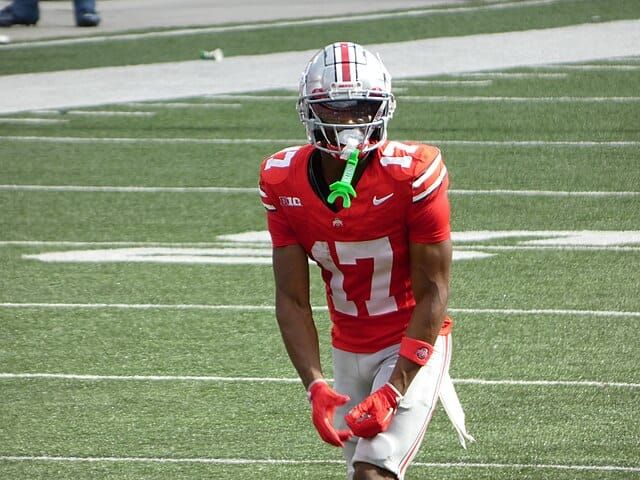
The ancient Demigods of Speed are angry. Hermes. Mercury. Savitar. Sonic the Hedgehog. These fickle deities have cursed the 2026 draft class for reasons unknowable to mere mortals.
It all began when Florida’s Caleb Banks, perhaps the top defensive tackle prospect in this class, broke his left foot while working out at the Combine. The injury occurred the night before his formal on-field testing, per Dane Brugler. Banks ended up needing surgery.
Banks ran a 5.04-second forty on his ailing foot: not a terrible figure for a 327-pounder. Watch Banks running his forty, however, and it’s clear that he could not comfortably give it his all. Banks also notched a 9-foot-6 inch broad jump, which could not have felt great on a broken foot. Banks then bowed out of further tests and drills.
Banks has been dealing with injuries to his left foot since the end of the 2024 season. He missed all but three games in 2025 due to the injury. He missed spring practice, then fall camp, then re-aggravated the injury against LSU last September, then finally returned for the last two games of the season.
Banks has first-round traits. He took over some games in 2024. He was a Senior Bowl standout. But he’s a 327-pounder with a foot injury that won’t go away, one that can get re-aggravated while going through warmups in a hotel hallway or convention center ballroom in mid-winter. Any team that drafts Banks in the first round had better cross-check a lot of X-rays with a whole battalion of orthopedists.
Did Banks fall victim to the curse of the demigods of speed? Was he an unworthy sacrifice? Or was his injury merely the first indication of their displeasure? What’s obvious is that no NFL prospect feels safe around a stopwatch in 2026. They don’t fear injury in most cases, but embarrassment and a sudden tumble down the draft board are frightening fates. As a result, many prospects are avoiding the sprinter’s track like it’s a graveyard at midnight.
Banks’ tribulations aside, the blasphemer who likely brought this pox upon the draft isn’t hard to to identify. His name is Adam Schefter, disgraced Oracle of the Combine and Desecrator of the Sacred Hundredths of a Second.
Carnell Tate and the Terrible, Horrible, No Good, Very Meh Forty
Carnell Tate ran a 4.52 forty at the Combine last month, and it threw a socket wrench into the entire Draft Media Industrial Complex.
Adam Schefter rushed to Tate’s rescue like a fireman racing to an orphanage. “Ohio State WR Carnell Tate, a potential top 10 pick, was timed by several NFL executives and GMs on Saturday with a 40 time in the range of 4.45-4.47 seconds,” Schefter posted to X not long after Tate ran his drill. “Although the combine registers official times, teams always conduct their own timing, and those measurements with some teams were lower than his clocked 4.52.”
Tate is represented by the mighty Drew Rosenhaus. Schefter is sometimes reduced to errand-boy status by his powerful scoop benefactors, and everyone in my line of work does a favor now and then. Revising a Combine result in real time, however, was a rather extreme, humiliating and ineffective attempt to gaslight the football world. The awkward attempt to protect Tate’s dignity and draft position had the opposite effect. It was like a debutante covering a tiny pimple with a massive Spongebob band-aid.
Tate later quietly opted out of running the forty at Ohio State’s Pro Day. He told reporters that the forty can be “overvalued.” I often tell my wife that a 36-inch waist and 120/70 blood pressure are overvalued in a husband. No one who meets such thresholds are likely to agree.

A 4.52-second forty is not terrible, mind you. It’s just very ordinary, especially for a 192-pound prospect. And Tate is not supposed to be ordinary.
The last wide receiver drafted in the top ten with a Combine forty slower than 4.5 seconds was Mike Evans in 2014, and Evans ran a 4.53-second forty at 6-foot-5 and 231 pounds. Many other top receiver prospects of the last decade skipped the forty at the Combine, but many of them clocked a reassuring figure in the 4.4s at their Pro Days.
Hence the flopsweat surrounding Tate: no one expected him to run like Xavier Worthy, but he may have failed to reach a benchmark NFL teams rely upon when sorting out the tops of their draft boards.
Tate was the top wide receiver prospect in the 2026 class before his unimpressive forty. He remains the top prospect after it; USC’s Makai Lemon ran a reported 4.48-second forty at his Pro Day, but that probably wasn’t enough to change minds. Also, you know this draft class is cursed when folks buzz about a wide receiver running a 4.48.
Tate’s forty, and the sweaty reaction to it, says a little bit about Tate but a lot about the 2026 draft in general. The tl;dr:
- About Tate: He ain’t exactly Ja’Marr Chase, or even Jaxson Smith-Njigba.
- About the 2026 Draft in General: It blows.
(Stay tuned to the end of this rant about Combine/Pro Day results for more on Carnell Tate! Also: Mailbag is coming this week. Get your questions ready!)
Mad Prophets of the Pro Days
In olden times — say, 20 years ago — prospects who didn’t run the forty at all at the Combine, or who produced a disappointing result, ran it at their school’s Pro Day. Trainers prepared them for the forty by laying out a precise 37-yard track, then assigning the stopwatch to an old coach with three-whiskey reaction time, then just making up a number that sounded plausible.
Granted, the days of short tracks and other obvious chicanery ended long ago. But Pro Day tracks reliably remained “faster” than the track at Indy until very recently, for mystical reasons. The Demigods of Speed accepted such concessions to human frailty. NFL scouts timed the sprints themselves and placed asterisks beside the results.
This year, prospects are avoiding even their friendly neighborhood Pro Day tracks for fear of the curse.
Penn State running back Kaytron Allen and Washington running back Jonah Coleman did not run the forty at their respective Pro Days. Coleman is overcoming an ankle injury that he played through at the end of the 2025 season. Allen is dealing with a chronic case of not being fast. Both were healthy enough to perform positional drills at their Pro Days. They were just dodging the stopwatch. (Allen’s teammate Nick Singleton has been sidelined by a broken foot since the Senior Bowl.)
Allen and Coleman are burly running backs in a shallow draft class. Pokey forty results would be forgiven. But even big backs with big reputations may fear disastrous results. Nebraska’s Emmitt Johnson ran a 4.56-second forty at just 202 pounds at the Combine; that’s a poor size-speed ratio for an early-round running back.
Johnson was productive for the Cornhuskers, has some fun film and A+ intangibles, but it’s hard to project him as anything but a committee back, especially when his lack of OMG speed can be seen on tape.
Notre Dame wide receiver Malachi Fields ran a 4.61-second Combine forty. The 4.6-second mark has long been a minimum threshold for receivers for many NFL evaluators. A receiver who falls below that mark, even if he’s 6-foot-4 and built like an Asgardian, will either be taken off the board or flagged as someone a coach must really-really-really pound the table for.
A prospect like Fields would normally re-run the forty at his Pro Day in search of a time in the safe harbor closer to 4.5. Fields did not. He did bench press 15 reps at 225 pounds, however, which may do wonders for his Tinder profile.
Like Fields, Washington’s Denzel Boston stands a hearty 6-foot-4. Like his college teammate Coleman, Boston avoided the sprinting track at his Pro Day as if it were lava.
Boston performed other timed drills, and the results were very good. At Boston’s size, no one expects a 4.38 forty. Based on tape, he should be able to clear 4.6. Perhaps Boston is just coquettishly leaving something to the imagination.
Boston’s NFL.com profile compares him to Puka Nacua, which is downright zany. Boston is a matchup headache and a fine route runner for his size, but he has trouble getting up to full speed, and better college cornerbacks were able to erase him. Boston has about as much in common with Treylon Burks as Nacua.
A Nacua comp from a major source has a life of its own in the echo chamber of the predraft bibble-babble economy, however. You won’t have to look too hard to find Boston mocked to the Rams in the middle of the first round. Why would a receiver getting buzz like that harshen it by running a 4.56 or something?
An anonymous scouting director is quoted at the end of Boston’s NFL.com profile saying: “You don’t have to be fast when you are as good as he is when guarded.”
First of all, bullshit. If you can’t get separation on deep/sideline routes in the NFL, you aren’t getting targeted, and NFL cornerbacks aren’t as easy to post up on 50-50 balls as Washington State and Rutgers cornerbacks. Second, Boston went just 12-of-33 on passes of 15-plus air yards in 2025, from a credible college quarterback in Demond Williams. How “good when guarded” was he, really?
Teams establish minimum benchmarks for prospects precisely because they must protect themselves from scouting directors who talk themselves into goofy philosophical positions. That’s what makes getting some quasi-official forty in the books so important.
The strangest forty-avoidance situation I’ve seen on the Pro Day circuit involves Clemson’s Peter Woods, a sleek, athletic, generally-impressive defensive tackle likely to be selected in the first round. Woods ran a three-cone drill and participated in the broad jump at Clemson’s Pro Day, performing well. He also ran a 10-yard sprint, which was clocked at an impressive 1.67 seconds. He chose not to run the forty, however, citing a lingering hamstring injury.
What sort of hamstring injury allows someone to run a three-cone drill and execute a broad jump but prevents them from running a forty?
Astute draftniks may note that a defensive tackle’s 10-yard “split” is more important than his forty time. The split measures the burst to the quarterback and the short-area quickness to chase down a ballcarrier near the line of scrimmage.
Even more astute draftniks, however, may note that there’s a difference between running a 10-yard dash and running the first ten yards of a longer sprint, especially when hundredths of a second are at stake. I wouldn’t care at all about Woods’ forty under normal circumstances; he’s not a receiver, running back or defensive back. The fact that he didn’t run a forty calls attention to itself in a way that a time of something like 5.02 seconds would not.
Trust me: this is all very strange. I have spent decades covering drafts. It’s unusual to see so many top prospects with slow forties or no forties. It’s odd to read a lengthy Pro Day feature praising several prospects without a single forty time tossed in, even when the author cites broad jump results and lots of PFF grades.
It’s reaching the point where a non-noteworthy sprint result feels noteworthy.
LSU cornerback Mansoor Delane ran a reported 4.38-second forty at his Pro Day. Delane may be the best overall prospect in the 2026 draft class, and his Pro Day result may have solidified a Top Five pick. Had he chosen not to run, most observers would have shrugged, and Delane would still have not escaped the top ten picks of the draft. (The Chiefs, for example, pick ninth and no longer have a secondary.) Had Delane run a 4.55 or something, however, the 2026 draft might have been cancelled due to a lack of interest.
The Death of Draft Szn
Snark about angry demigods aside, we should be able to guess what is really going on with the 40-yard dash. Draft prospects are now fully professionalized. Many have been getting compensated for their services, above the table, for several years. These young professionals are using their power to question the assumptions of the NFL’s Byzantine pre-draft process, one which burdens the prospects with many risks in exchange for few rewards.
Why should Caleb Woods risk exacerbating a foot injury to participate in what has become a glorified promotional event? Why should Carnell Tate risk his hard-earned reputation on five seconds in late February? Sure, some workouts and professional cooperation should be expected of these young job applicants. But why feed the Draft Media Industrial Complex a single number that could rattle around a prospect’s portfolio like a blown piston rod, scaring away some NFL teams who, despite protests to the contrary, hear 100% of the reverb coming from our echo chamber?
My best answer is BECAUSE IT MAKES MY JOB EASIER. That’s not a great answer.
I don’t know what the pre-draft process will look like in ten years. The NFL may have realized that the Combine will never be the television extravaganza they were hoping for, not when speedy receivers won’t run and quarterbacks won’t throw. That’s why the league has not moved the Combine from Indianapolis to Los Angeles yet: it realizes that the Combine may not be on life support, but it’s definitely on maintenance meds.
Everything from the Senior Bowl through Pro Days may soon become an extended job expo for fourth-to-seventh round picks in a few years. The famous prospects will rest on their game film, which now often extends into mid-January anyway.
It’s still 2026, however, and there’s still an expectation that most players will run 40-yard dashes, that first-round receivers who aren’t huge will crack the 4.5 barrier and that even thicc running backs will post numbers which can be added to a database and used for comparisons across players and years.
This year’s results, particularly among top prospects, have been often been worrisome and sometimes unavailable. That makes for a weak draft class, poorly covered. And it makes this whole draft season feel a little cursed.
Draft Capsule: Carnell Tate, Wide Receiver, Ohio State
This year’s Too Deep 96 draft capsules are coming along great. They are not behind schedule at all. Nosiree! While you are waiting, here are some free breadsticks in the form of Tate’s draft capsule.
Tate joined the Buckeyes as a five-start recruit in 2023. He rapidly worked his way through a crowded receiver pipeline. By 2024, he was an oft-used WR3 behind Jeremiah Smith and Emeka Egbuka. In 2025, he was WR2, going 51-875-9 to Smith’s 87-1,243-12.
Smith chose to stay in Columbus one more year; he’s probably getting paid in NIL sapphires and magical items instead of dollars, because the NFL is eagerly beckoning for him. Tate declared for the draft, which was wise: he’s as NFL ready as he needs to be, and he won’t have to compete with prospects on the caliber of, well, Smith.
There’s lots and lots to like about Tate’s film:
- Suction-cup hands, particularly on balls away from his body.
- Tracking capability on deep passes, even off-target ones.
- Sharp route-running on curls, outs and comebacks.
- Some slipperiness on double moves.
- A knack for getting open during scrambles.
- Solid-effort, gives-a-damn blocking.
Tate just turned 21 in January, so he may also still be developing athletically.
These are very useful traits and abilities. But they are WR2 traits and abilities, especially when coupled with ordinary size and meets-minimum-requirements speed. Tate was a WR2 in college and projects as a possession receiver in the NFL.
That’s a problem, because Tate is the WR1 of a draft class with no serious challengers to his status.
Tate is not a guy who will make the Browns offense credible or immediately change Cam Ward’s fortunes. He might look pretty spiffy next to Malik Nabers for the Giants, but it’s pretty clear which one would be Batman.
Now, Ohio State churns out wide receivers the way Gibson churns out Les Paul guitars, and it’s not unusual for a Buckeyes WR2 to develop into an NFL WR1. Egbuka, a WR2/3 for Ohio State in 2024, had a great rookie season for the Buccaneers in 2025, though it looked better if you stopped paying attention around Halloween. Terry McLaurin was a WR3 at Columbus. Chris Olave battled Jaxon Smith-Njigba and Garrett Wilson and others for targets, even in his final college season.
Tate’s NFL.com scouting report compares him to Olave. But Olave ran a 4.39-second forty at the 2022 Combine. That comparison is a real stretch.
Since we are “program scouting,” Smith-Njigba might be a better comp for Tate: unimposing size and speed, high-end route work and ball skills. Comparisons to JSN are rather loaded, however, after his Offensive Player of the Year season and the Seahawks’ championship. It sounds like special pleading to compare any receiver who isn’t a size-speed marvel to him.
Also, JSN went 95-1,609-9 for a 2021 Buckeyes team with Olave, Wilson, a young Egbuka AND young Marvin Harrison Jr clamoring for targets. The truly great ones tend to separate themselves from the crowd.
Playing second fiddle to Jeremiah Smith may have juiced Tate’s scouting report a bit, even though it nerfed his target share. One thing I noticed about Tate’s deep catches is how often they occurred when he was isolated on the “field” side of the formation when the ball was spotted on the opposite hashmark. Let’s look at one quick example:
The ball is spotted on the left hashmark. Tate is split wide to the right. Smith starts in the right slot but motions left before the snap. Smith runs a fake end-around, and 90.9% of the Gophers defense follows him. Watch the deep safety, who starts out in center field. He follows Smith to the offensive left. Tate gets a one-on-one matchup with the cornerback in a vast meadow.
That’s an extreme example because of the end-around motion, but Tate caught a lot of passes, both deep and on comebacks, where he was isolated on the field side of the formation against a cornerback with lots of acreage to defend and no safety help. It was the opponent’s second-best cornerback in many cases. Tate put up credible numbers as a deep receiver: 13-of-20 targets for 488 yards and six touchdowns on passes of 15+ air yards. (Smith was 19-of-29-671-4.) But a lot of those targets looked like schemed-up mismatches made possible by the threat of Jeremiah Smith.
Michael Pittman feels like a better comp for Tate than Smith-Njigba or Olave. Pittman is bigger than Tate, but they have broadly similar games that aren’t built on pure speed.
Jakobi Meyers is another possible comp: Meyers was very productive at NC State but ran a pokey 4.63-second Combine forty. He has grown into an extremely capable possession receiver.
Here’s one more comp, albeit a very loaded one: Brandon Aiyuk. Tate and Aiyuk have somewhat similar measureables, and Aiyuk left Arizona State with a rather polished overall game. I can picture Tate becoming the WR1 in a system with an excellent pass-catching running back and tight end, and maybe a designated speed merchant on the other side of the field.
Pittman, Meyers and the seldom-seen, emotionally-regulated version of Aiyuk are very good receivers. So is Olave. But when those are the upside comps, it’s easy for a team at the top of the draft board to select an edge rusher or cornerback instead. That’s what made Drew Rosenhaus nervous enough to launch a disinformation campaign about Tate’s 40-yard dash results. And it’s one of many reasons why it so hard to get jazzed about the 2026 draft.
COMING THIS WEEK: A springtime Mailbasket. Look for an email thread soliciting questions on Monday. Please don’t leave any in this comment thread, because I might not find them!