Life Gives Ya' Lemons: 2026 NFL Draft Wide Receivers
What the 2026 WR draft class lacks in top-tier quality, it at least makes up for in quantity.
We have a lot of wide receivers to get to, so let’s jump straight into the fray.
Carnell Tate, WR, Ohio State
Tate’s profile appeared as part of an earlier feature. You can find it here.
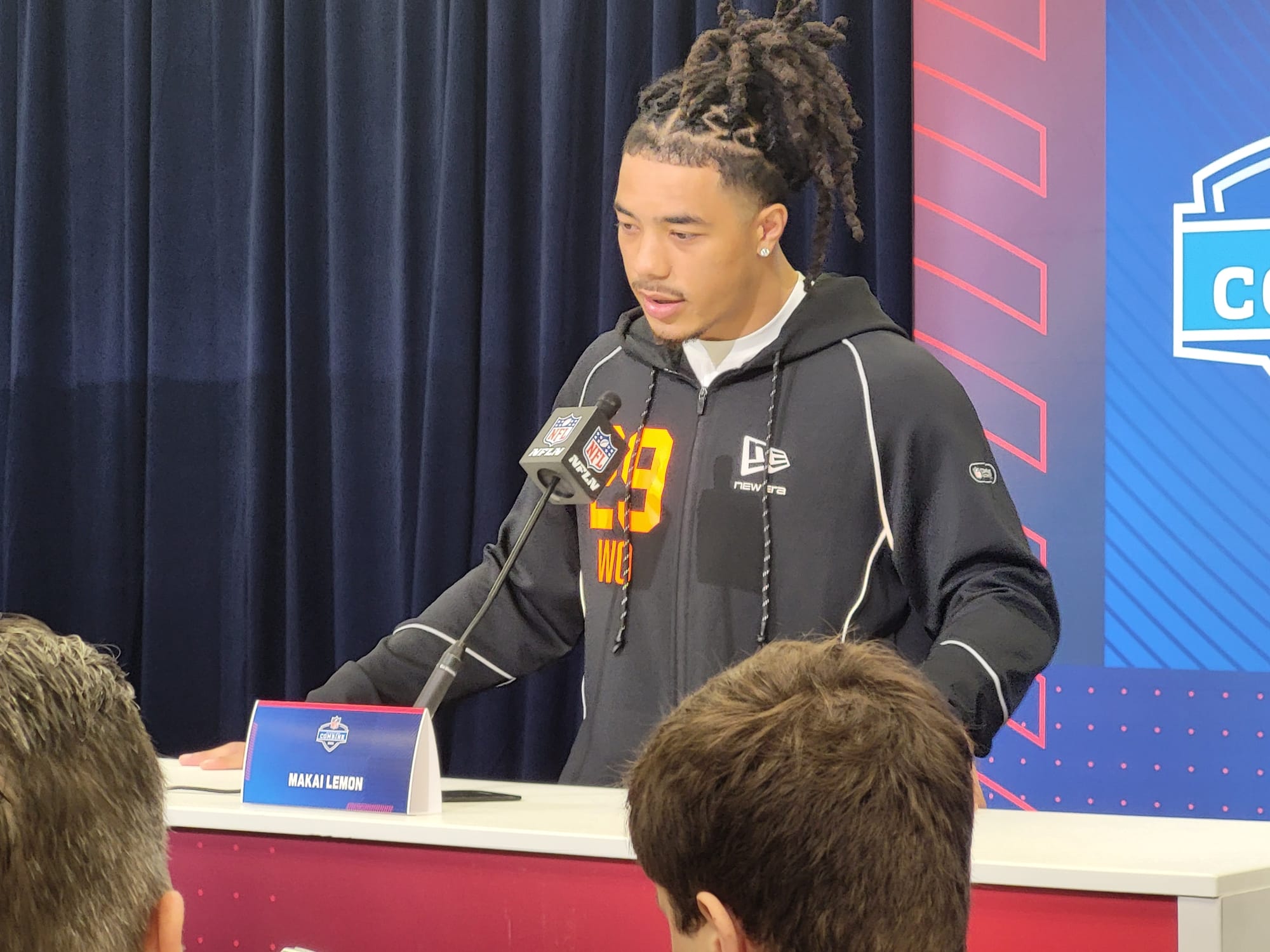
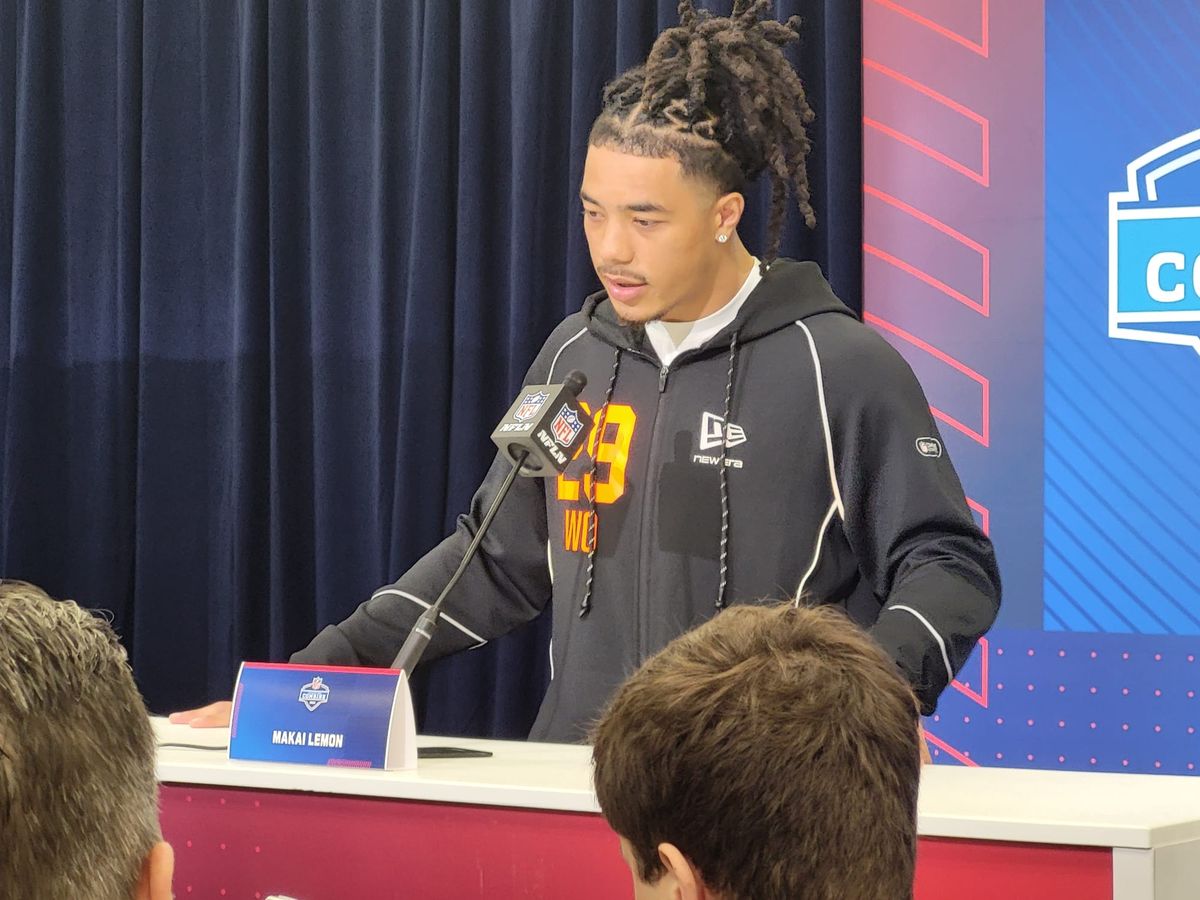
Makai Lemon, WR, USC
Announcers loved to compare Lemon to Jaxson Smith-Njigba. NFL.com’s Lance Zierlein, who is on a “program scouting” kick lately, compared Lemon to Amon-Ra St. Brown. It’s as if all prospects are now run through the Draft Comp-o-Matic:
- Does he have ordinary size and speed? Yes.
- Do you still really like him? Yes.
- Is he a very crafty route runner? If yes, your comp in Jaxson Smith-Njigba.
- Is he a tough, determined slot guy? If yes, your comp is Amon-Ra St. Brown.
Neither comparison is totally erroneous for Lemon, but both are very optimistic.
Lemon is a sturdy, compact slot guy. He works underneath well: sharp cuts on shorter routes, a feel for zone coverage, an ability to make tough catches, some YAC capability (19 eluded tackles on 79 catches in 2024 and 2025). Lemon can shift smoothly into third gear to outrun defenders up the sideline after short completions. Sports Info Solutions charged him with just one drop each in 2024 and 2025. He can adjust to off-target passes. He blocks very well for a WR1-type.
Lemon is just 5-foot-11, though he has a sturdy frame. He lacks pure speed on tape. He’s not really a jitterbug. Lemon has the body type of Mister Nifty-Shifty or a downfield threat, but he plays like a 6-foot-3 chain mover in the middle of the field.
The trouble with searching for JSN/Amon-Ra-type prospects is that you can end up with dozens of not-big/not-blazing guys who need all the grit and craftsmanship they have to be WR4s at the NFL level. Lemon is too good at hoovering in footballs to be a bust, but he looks like a late first-round receiver who will end up getting selected in the top 15.
Chris Brazzell, WR, Tennessee
Brazzell went ham with a 6-177-3 game against Georgia in 2025. He Mossed Ellis Robinson in the middle of the field for one touchdown, burned Daniel Harris on a skinny post for the second, then Mossed Harris up the right sideline for the third. Sorry to use Mossed twice in the last sentence, but it paints the most accurate picture of the receptions.
Brazzell is bony and leggy at 6-foot-4. He ran a 4.37 Combine forty. He can do Mossy things on jump balls, going 19-of-33, 613 yards, 6 TDs on targets of 15+ air yards. He’s also surprisingly fluid and quick on slants, posts and digs. He dropped just two passes in 2025.
Brazzell’s a better prospect than Denzel Boston, a similar receiver who is slower, less developed as a route runner and less likely to make a leaping catch on an off-target football.
So why isn’t Brazzell ranked higher by other draft analysts? “Program scouting,” that dreaded scourge, may be part of the reason. Recent receiver prospects like Jalin Hyatt, Velus Jones and Cedric Tillman, not to mention quarterbacks Hendon Hooker and Joe Milton, have struggled to adjust to the NFL after playing in Josh Heupel’s pass-happy “veer-and-shoot” system.
Brazzell addressed the system question at the Combine. “This last year was a completely different offense than what y’all think Tennessee offense is,” he said. “I was really playing more regular, traditional offense last year.”
Brazzell later hedged those comments a bit. “I think it’s harder playing at Tennessee versus regular offenses. You cut on the sidelines, so it’s a little room for error. Once I’m playing in a traditional offense, not playing that far to the sidelines, I’ll get a two-way go. It makes it easier for me as a receiver.”
Maybe Brazzell was overstating the “completely” different offense, or comparing 2024 to 2025. Whatever. If you overlook a tall, fast, productive receiver with some polish in this draft class because of what happened to Jalin Hyatt, you are overthinking things.
NFL.com compares Brazzell to Christian Watson. I dig it.
Zachariah Branch, WR, Georgia
“My mentality is to never let the first person tackle me. If I do that, I’m really upset at myself.” – Branch, at the Combine.
Dear friends and draftniks: this is the slot-motion speedster you are looking for, the fun-on-a-bun Diet Tyreek (hold the misbehavior) who can turn any screen pass into an NFL Gamebreak.
Here are Branch’s numbers on screen passes in 2025: 46 targets, 44 receptions, 313 yards, 21 eluded tackles and three touchdowns. Roughly one eluded tackle for every two screen passes is a damn fine ratio.
Sports Info Solutions has a metric called Boom Rate that measures how often a player produces an explosive play. Branch’s Boom Rate on screens in 2025 was 28.3%. Again: a yummy ratio on short, safe passes against SEC defenses.
Branch, the grand-nephew of Raiders Hall of Famer Cliff Branch, gave an impressive Combine interview. He revealed that he’s been “doing cryotherapy, laser therapy” and drinking protein shakes since middle school. He discussed some student-of-the-game details and talked a good game about his grindset:
I spend countless hours watching film at my house by myself, or going up to the facility late night. At 10 o’clock, 11 o’clock I’m sometimes going to the facility, watching film. I take notes on everything that I hear from coaches. No matter if I heard it five times, ten times: still gonna write it down every time because you can’t overstudy.
(You may think every Combine prospect says things like that, and many of them do. But a lot of them are vague about it, unable to cite specifics about their study habits. Call it leftover teacher sense, but I think I can tell who is bulls**ting me about how long they spend on their homework.)
The knock on Branch is simple: he’s a 177-pound pure slot YAC guy and return man (two career return touchdowns) who rarely did anything downfield in college. He’ll be a role player in the NFL.
Prospects like Branch usually do little for me – there are a half dozen of them in a typical draft class – but Branch’s YAC skills appear to be special, and the 2026 draft class is rewriting my neurons. Wan’Dale Robinson just got $38 million guaranteed from the Titans. I think Branch will be a better player.
Jordyn Tyson, WR, Arizona State
Tyson’s brother Jaylon plays for the NBA’s Cavaliers. That brought out what friend-of-the-Zone Mac Robinson calls the “Cleveland amoeba,” an amorphous, quivering blob of reporters and sports personalities that slithers through each Combine looking for something to talk about besides the state of their team, sometimes excreting a noxious substance from its excretory gland: the tonificus grossi. (That last wisecrack is mine, not Mac’s. Let’s not get him in any trouble.)
The amoeba asked which Tyson brother would buy the house if the Browns drafted Jordyn. “He’ll be buying the house, and he’s gonna get the big room cuz he’s the big bro,” Tyson said, passing the buck to Jaylon. Let the record show that he may be the only player in this draft class for whom getting drafted by the Browns is incentivized. The Browns should offer rent control for other prospects.
Tyson’s brother Berron played for Southern Alabama and now runs their performance department. Both brothers are older.
“Yeah, compete, that’s all we’d do,” Tyson said of his brothers. “I was the baby, too, but they would never take it easy on me. They actually made it a little harder, and I had to work two times as hard. We’d go bowling. We used to go play golf, par 3 courses and stuff like that. We used to play ping pong. Basketball, football, anything you can imagine, we did it.”
Sounds idyllic! I would make a snide remark about football coming last, but years of Combine coverage has taught me that if you want to raise two sons to end up in the NBA and NFL, let them enjoy lots of bowling and ping pong in their down time.
I’m stalling on Tyson, because he seems like a cool cat but I don’t like his game very much. He’s at his best when getting open on short, square routes. Arizona State used him on lots of screens, hitches and shallow routes to get him the ball.
Tyson was also a go-to guy on third-and-short: 22 targets on third/fourth down and 5 yards or less, 14 catches, 11 first downs. He can snap off short routes to get open.
As for deep shots, Sun Devils quarterbacks Sam Leavitt and Jeff Sims tended to spray anything more than 10 yards downfield. Tyson caught just 14 of 33 targets on 15-plus yard routes in 2025. He went 15-of-36 in 2024. Those aren’t great numbers, and I am not sure where the quarterbacks’ limits ended and Tyson’s limits began.
Tyson battled hamstring injuries in 2025. He also missed time with a collarbone injury in 2024. He told the amoeba that he was “finding my perfect regimen” and seeking “many modalities,” sounding like someone with an athletic trainer for a big brother.
The hammy injuries for a guy who thrives on quick, violent cuts are a yellow flag. So is the lack of downfield consistency. So is the “feed him a touch” production, which doesn’t always translate to the next level. I love Tyson’s quickness and moxie but fear he could be a frustrating NFL player.
Denzel Boston, WR, Washington
Like most of the top receivers in the 2026 draft class, Boston may be a step slower than NFL coaches would like. Like every receiver in the wake of the Carnell Tate Forty Fiasco, Boston would rather eat a box of thumbtacks than come within 500 feet of anyone holding a stopwatch.
Boston at least has the advantage of being 6-foot-4. But the tape shows a receiver who lumber-lumber-lumbers off the line of scrimmage before finally slipping into third gear.
As you might have guessed, Boston is a jump-ball guy. He high-points the ball and can twist his body for off-target catches. He works hard in the red zone to make a target of himself. He is not nifty by any means, but had some screen-and-YAC production in an offense loaded with receiver screens.
Boston also returned a punt for a touchdown (against UC-Davis) and completed two trick-play passes. He’s a better route runner than the typical collegiate 6-foot-4 oak-tree-on-wheels. He does a decent job snapping off hitches and using his frame to get open on slants.
Boston’s NFL.com profile noted that his “production dipped when the competition level rose.” It’s true. Boston caught just three passes for 27 yards against Ohio State; he was invisible for most of the game. He caught an early deep shot over the middle against Michigan and finished a respectable 4-71-0, but a fourth-quarter pass went through his hands for an interception, and he was a non-factor for much of the afternoon. He went 4-25-2 against Oregon, with a Demond Williams interception where Boston had trouble getting separation on a corner route against a linebacker.
You get the idea: better collegiate cornerbacks could generally limit Boston, who padded his numbers a bit by playing through the fourth quarter of blowouts against UC-Davis, Washington State and Rutgers.
Let’s wrap this capsule with the deep-receiving (15+ air yards) figures for a few notable prospects, plus Sir Not Appearing in This Draft:
- Denzel Boston: 12-of-33, 396 yards
- Malachi Fields: 9-of-25, 311 yards
- Makai Lemon: 20-of-31, 637 yards
- Jordyn Tyson: 14-of-33, 354 yards
- Carnell Tate: 13-of-20, 488 yards
- Jeremiah Smith: 19-of-29, 671 yards
Boston’s numbers are lackluster for a purported deep threat (something Jordyn Tyson is not), despite the fact that Demond Williams is a solid collegiate quarterback. There are a lot of plays on tape where Boston can’t quite get a foot inbounds, or makes a catch outside the back of the end zone, perhaps because his timing with Johnson isn’t right.
I’m not suggesting that Boston will fail in the NFL, or that he’s not worthy of a Day Two pick based on 50-50 ball capability and return skills. I just wish I had a forty time to reassure me one way or the other.
Omar Cooper, WR, Indiana
Cooper ran a 4.43 forty at the Combine.
A 4.43-second forty isn’t earth-shattering, but it stands out in a draft class full of receivers trying to avoid getting times like truckers pulling off the interstate to drive the back roads so they don’t get weighed. At least Cooper was willing.
Cooper is a well-built, rumbling slot receiver who rose to stardom when Fernando Mendoza arrived in Indiana and began force-feeding him RPOs. Cooper caught 34-of-40 targets for 393 yards and four touchdowns on RPOs, breaking/eluding 19 tackles on these plays. The broken tackles are where the action is in that previous sentence.
Cooper went 51-of-71 for 716 yards and nine touchdowns on all targets from the slot. His game is screens, curls, outs and slants. He can reach, leap or scoop for off-target passes. I’ve seen criticism of his blocking, but he blocks often on running plays, as opposed to slot receivers in other systems who shimmy toward the sideline on running plays.
Cooper caught 28 passes in 2024, though he averaged 21.2 yards per catch. He came on late as a top prospect. It’s hard to tell what he would be without Mendoza, or without Elijah Sarratt handling traditional WR1-type responsibilities, or if we didn’t get to see him on a national championship run. I’m comfortable projecting him as a Luther Burden-type who is less gifted but also less bugnuts. Cooper may end up a role player, but I can see him thriving in the role.
KC Concepcion, WR, Texas A&M
While researching Concepcion’s age (he turns 22 in August), I discovered the existence of the “other” KC Concepcion, the Filipina actress, singer, entrepreneur and influencer …
Why, yes, I think I WILL make breakfast with you, um, [checks Concepcion’s marital status][Checks again][Brushes up on rudimentary Spanish][Checks a creepy third time][Crosses fingers] Senorita? [Scrubs search history in shame].
Concepcion has the potential to be an outstanding punt returner. He returned punts for touchdowns against LSU and UTSA, had a second long return against LSU, and ripped off long returns against Texas and South Carolina last year. Concepcion has exceptional burst from a standing start, works the middle of the field well and gains lots of YAC by accelerating so quickly after the catch that he dusts his defender.
Concepcion dropped seven passes in 2025. He takes a lot of hits in traffic and doesn’t always secure the ball. He’s rather lean but can extend for off-target passes, making him the type of receiver who hauls in the difficult catch but then drops the easy one.
Concepcion isn’t huge nor blazingly fast, and he’s not the human-joystick type in the slot. He’s a WR3 (at best) and return man. But at least he doesn’t come with first-round expectations.
Concepcion is a Chimere Dike-type who could be an instant-impact returner. In this draft, some team should take that and run with it.
Chris Bell, WR, Louisville
Bell tore his ACL in November. He underwent surgery in December. He understandably did not work out at the Combine. He did, however, state his case.
“Don’t let this injury fool you,” he told reporters. “I’m still that dawg. I’m still that beast that you see on the field. Just give me time, and I’ll be back right.”
Bell had some bestial games at Louisville: 10-135-1 against Pitt, 12-170-2 against Virginia and 9-136-2 against Miami. He really looked dialed in with quarterback Miller Moss, who was comfortable either tossing alley-oops toward Bell’s back shoulder or throwing the ball on comebacks or curls before Bell made his break.
Bell does an excellent job getting open in underneath zones. He shuffles, slows down or adjusts his path to find little creases between defenders when working the middle. He killed Miami by catching routine-looking drags in heavy traffic and turning them upfield for big plays.
I believe Bell would have ranked no lower than third in this draft class if not for the injury. He’ll max out as a WR2 in the NFL, but so will Carnell Tate. The injury adds some uncertainty, but a team that doesn’t need immediate help, or isn’t seeking some boundary big-play producer who might not exist in the 2026 draft class, would be better off drafting Bell than some of the big names ranked ahead of him.
De’Zhaun Stribling, WR, Ole Miss
Stribling’s great uncle was Don Muraco, who wrestled in the then-WWF in the 1980s. He fought world champion Bob Backlund several times, and beat Jimmy “Superfly” Snuka in a steel cage match, back when I was rasslin’ years old.
In other words, Stribling is a first-round pick and future Hall of Famer.
No, no. Stribling grew up in Hawaii, started his college career in Washington State, then portalled to Oklahoma State for one year before arriving in Oxford.
“You adjust to the new geographical locations,” he said of his peripatetic career at his Combine interview. “I don’t really carry a lot of stuff with me. It’s just moving states, getting adjusted to each different state, the food there, the people there, and just the overall weather.”
Stribling turns 24 in December. Like many older prospects, he touts his maturity, an attribute that can serve you well if, say, a college coach like Lane Kiffin strings a program along for a month while deciding if and where he wants to get even richer and more powerful.
“I feel like for some of the younger guys, it was a little harder because they’re new to the whole process,” Stibling said of Kiffin’s protracted 2025 departure from Ole Miss. “They just got into college or they just transferred there, so it must have been hard on them.
“But me, being an older guy, more experienced and more of a vet, I understood what it was. And I just tried to help keep the whole team together.”
Good heavens. Stribling is my eldest son’s age and already sounds world-weary.
Stribling caught 55 passes for the Rebels in 2025, 24 of which were labeled as curl routes by Sports Info Solutions. He thrived in an RPO-heavy offense with lots of short curls and hitches. He went 3-96-1 with a catch-and-run touchdown against Georgia in the regular season, then 7-122 against the Bulldogs in the Sugar Bowl, where he lined up at H-back, fullback and in the Wildcat in an effort to maximize his touches.
Stribling ran a 4.36 forty at 207 pounds at the Combine. His breakaway speed is evident when, well, he breaks away after a catch. But Stribling doesn’t do a great job separating against better cornerbacks. He needs RPOs or motion to get open consistently. He gives a high effort when blocking but he probably should not line up at H-back or fullback all that often.
I like Stribling’s story, personality, measurables and uncle. I liked his Sugar Bowl and Fiesta Bowl film. He’s an older prospect who may never develop into a high-level starter. But Stribling is the kind of player who spends a decade in the NFL as a WR3/WR4.
Skyler Bell, WR, UConn
Watching Bell’s tape was like watching Justin Jefferson when Max Brosmer was quarterbacking the Vikings.
UConn quarterback Joe Fagnano is probably a wonderful young man, and he threw 28 touchdowns for a team that played in a bowl game in 2025. But golly, does he spray the ball. I went from watching Ty Simpson and Trinidad Chambliss to watching Fagnano while prepping these capsules, and let’s just say it provided a greater appreciation of Simpson.
Bell went 101-1,278-13 for the Huskies. He went 65-535-4 on passes of five air yards or less. The Huskies passing game consisted of force-feeding Bell the ball by any means necessary: 144 targets, 93 more than any of his teammates! Bell guzzled up anything that came close to him against lower-level competition and got open consistently against better opponents like Duke. But he sometimes beat his defender by two steps, only to find he had no chance of retrieving a football 10 steps away.
Bell spent three years at Wisconsin before portalling to UConn. He turns 24 on July 5th. As you might imagine, I’m skeptical of an older prospect who suddenly became a literal man-among-boys against MAC and American Conference competition.
Most sources rank Bell well above De’Zhaun Stribling. Both are older prospects who bounced around a lot. Both have good measurables but are not crisp, crafty route runners. Sterling is younger, moved up the NCAA ladder instead of down and ended his career as a productive receiver on a playoff team. I like him better than Bell, who might be benefitting from some contrarian logic. Bell won’t perform better in a better situation. He was already in an ideal one.
Josh Cameron, WR, Baylor
Cameron looks like a running back. He wore #34 for Baylor. He measured in at 6-foot-1 and 223 pounds at the Senior Bowl. Those are running back’s numbers, and Cameron has a lower body reminiscent of Bijan Robinson, not Justin Jefferson.
Cameron had a quietly solid Senior Bowl. He kept catching short passes in tight windows, placing his body between the (often wobbly) throw and the defender. I kept looking down at my notes to try to figure out who this pass-catching running back from Baylor was.
Cameron did not create much separation at the Senior Bowl, nor did he run away from quality cornerbacks in college. Contested catches were Cameron’s bread and butter. Cameron has strong hands, physicality and outstanding body control. Put the ball on his body and he’ll probably catch it. It’s not clear, however, how often he will get open enough to be targeted at the NFL level.
Cameron is a former walk-on with a hard-nosed personality. He returned punts for Baylor and looks like the kind of receiver who can be useful on special teams.
Pencil in Cameron as a WR4 type who keeps finding his way onto the field at the start of his career. If he makes a few clutch tight-window catches, he could emerge as a quarterback’s favorite security blanket, and perhaps a goal-line binkie as well.
Ja’Kobi Lane, WR, USC
Lane played second fiddle to Makai Lemon in 2024 and 2025. He’s an ultra-lanky 6-foot-4 long-strider who gets separation on vertical routes by changing speeds to cross up his defender.
The Trojans used Lane as a goal-line specialist of sorts in 2024: 17 targets in the red zone, 11 catches, 8 touchdowns. Last year, those numbers dropped to 11 targets, seven receptions and three touchdowns. Lemon went 11-of-13 for seven touchdowns in the red zone, while tight end Lake McRee posted the exact same figures as Lane.
Lane dropped seven passes in 2025, four in 2024. He is not nifty or rugged after the catch. He may have benefitted from drawing the opponent’s second-best cornerback for his entire college career and winning with pure verticality.
Brenen Thompson, WR, Mississippi State
In the Land of the Pokey, the prospect with a 4.26-second forty may not be king, but he’s definitely worth drafting.
Thompson plays like a receiver with 4.26 speed. His film is full of Whoosh moments. He can turn a seven-yard cushion into a cornerback’s crisis in just a few heartbeats. Flat-footed defenders can find themselves beaten by three strides. Thompson can catch a slant or comeback and suddenly accelerate into fourth gear for YAC.
Since we are so far down this list of less-than-spectacular receiver prospects, you have already surmised that the rest of Thompson’s scouting report is bean dip. He weighs 164 pounds. He could barely see the field at Texas or Oklahoma before portalling to a weaker program in his fourth season. He rounds off routes, something he can get away with when his defender is backpedaling for dear life. But the most troubling aspect of Thompson’s game is his almost complete lack of experience as a return man. The fact that the Longhorns and Sooners barely tried to marshal his speed on returns indicates some unseen deficiency.
I have seen Thompson compared to Zay Flowers, but Flowers was a sharper route runner and much niftier. Calvin Austin is a better comp. Austin was a disappointment for the Steelers, but he still has value as a lid-lifter. Thompson is so blurry when running vertical routes that he could have more of an impact. But he may have to prove that he can handle punts to get his chance.
Ted Hurst, WR, Georgia State
Hurst became the star of a Sun Belt bottom feeder that won only one game in 2025 after transferring from Valdosta State. He’s a hair under 6-foot-4. He looked like he was built out of breadsticks on tape but bulked up to 206 pounds at the Combine, where he ran a 4.42-second forty. Hurst tracks deep balls well, has some niftiness in his release and can snap off sharp routes. He handled Senior Bowl competition well.
Hurst has lots of NFL traits and some good tape. But I feel like I have spent half my adult life writing about tall, fast receivers from small programs who generate Senior Bowl buzz. Most of those receivers turn out to be Travis Fulgham at the NFL level. Hurst, for all his assets, reminds me a lot of Fulgham.
Antonio Williams, WR, Clemson
Williams is a lean get-him-the-ball-in-space receiver with just enough juice to be interesting. He works the middle well and makes catches away from his body. He’s not an ultra-shifty YAC fiend but has some wiggle.
Williams gets a lot of jet sweeps: he rushed 20 times for 179 yards in 2024 and 2025. He also completed four passes in his career. Williams went 10-142-1 versus Duke with a rushing touchdown, but it looked like Duke just didn’t bother covering him several times. He returned punts in 2024.
Pencil Williams in as a slot gadget receiver and potential return specialist. He’s not flashy, but his willingness to make catches in heavy traffic could help him stick at the NFL level.
Germie Bernard, WR, Alabama
Bernard, who started his college career at Michigan State and also spent one year at Washington, was Alabama’s best playmaker in 2025. That doesn’t mean what it used to mean.
Bernard played quarterback in high school. He ran a lot of trick play concepts for the Tide. He took Wildcat snaps, lined up at running back now and then, and ran some receiver options. He sometimes bailed his coaches out on these gadget plays: against Tennessee, he was about to get walloped by defenders 10 yards in the backfield on an option pass, but knifed between them for a positive gain.
Bernard is sturdy. He runs sharp, crisp routes, and won deep a few times on in-cutting “dagger” concepts. Alabama’s coaching staff worked hard to get him open: motioning into quick outs, hiding him in stack formations, and so forth. Bernard scooped up some tricky throws, and only dropped two passes for a program plagued by drops in 2025. (One of the drops, however, was a doozy against the Sooners in the playoffs.) He eluded 17 tackles, though he really doesn’t look like a “human joystick” type on film.
I have no idea what to make of Bernard. He’s not that big, fast or nifty. He’s no WR1 at the NFL level, despite his role for the Tide, because he will always need to get schemed open against better defenders. But he’s a capital-F Football Player who could end up gobbling up underneath targets and becoming a quarterback’s security blanket. I would love to see what a Shanahan-family offensive coordinator could do with Bernard as the motion receiver in a share-the-ball passing game.
Elijah Sarratt, WR, Indiana
Sarratt was Fernando Mendoza’s binkie during the 2025 championship run. Omar Cooper ended last season with more catches and yards, but Cooper went 10-207-4 against Indiana State and 8-115-1 in a blowout of Michigan State. Sarratt served as Mendoza’s go-to guy in Indiana’s more competitive games. He went ham in two games against Oregon.
The Indiana offense was loaded with RPO concepts. Cooper led the nation with 34 catches on RPOs, per Sports Info Solutions. Sarratt finished sixth with 23 catches. When Mendoza wasn’t running an obvious RPO, he was often setting quickly and delivering a short pass near the boundary. Sarratt caught 31 passes on 46 targets for 355 yards, with four touchdowns and four drops, on passes labeled as an Out, Curl or comeback. Many of those passes were RPOs.
Sarratt is a possession receiver who runs crisp underneath routes and has excellent timing with Mendoza. He was able to work upfield to get open late in a play or during scrambles. He’s a willing blocker downfield when someone else has the ball.
Sarratt has an ordinary size/speed profile. He missed a few layups on shorter catches. He appears to be a methodical route runner who thrived in a defined role. His strengths appear to be competitiveness and consistency. Those traits can help Sarratt stick in the NFL as a hard-working WR4. I wouldn’t be surprised, however, if Sarratt transformed himself into a gritty WR2.
Deion Burks, WR, Oklahoma
Burks spent three years at Purdue before portalling to Norman for 2024-25. He became the Sooners WR2 behind Arkansas transfer Isaiah Sategna last year; Sategna elected to remain in college.
Burks is a quick, compact slot-type receiver, though he frequently lined up outside for the Sooners. He was most productive on curls and other short, underneath routes against soft coverage. His two best NFL traits are a knack for catching poorly-placed throws, particularly low throws, and the ability to knife upfield immediately after the catch. He will also work to get open to help a scrambling quarterback.
Burks is smallish and lacks ideal shiftiness. He doesn’t look like a great route runner, since so much of his production came on “run five steps and turn around” routes. He’s a 23-year old coming off a breakout season in which he still finished second on his team in receptions/yards/touchdowns. But Burks performed very well against Alabama in the playoffs, then at the Combine. He’s worth a third/fourth round selection to see if he can become a useful WR3 in the NFL.
Malachi Fields, WR, Notre Dame
Fields ran a 4.61-second Combine forty at 6-foot-4, 218 pounds. That might be an intriguing size-speed profile for a big box safety or small outside linebacker. It’s a big enough red flag to halt the Daytona 500 in its tracks.
Fields is an absolute unit. He’s a former Feldman Freak: “He has elite strength and power for a wideout,” BruceFeldman wrote. “He has close-grip bench pressed 365 pounds and did 21 reps of 225 with a close grip this offseason. He front squatted 355 pounds to go with a 38-inch vertical and a 10-7 1/2 broad jump. His shuttle times are impressive, too, going 4.18 in the pro agility and 6.81 in the 3-cone, and he passed 22 mph on the GPS.”
GPS results from the college media department are what they are, but beware of any wide receiver (or Tinder date! Or Grindr date I guess!) whose profile starts with his benchpress numbers.
Fields went 9-of-25 on deep passes (15+ air yards) in 2025, so his performance doesn’t match his highlight reel, and his contested-catch skills may not match his measurables. He’s a bit of a one-trick jump-baller, and he turns 24 in July.
Fields set off the Chase Claypool alarms in my brain before he ran his forty. Devin Funchess also leaps to mind. Receivers like Fields end up “making the switch to tight end” in their third NFL seasons.
Kevin Coleman, WR, Missouri
Coleman is a slot specialist who spent one year each at Jackson State, Louisville, Mississippi State and finally Mizzou. He’s a tough 179-pounder who does traditional slot stuff: screens, quick outs, jet sweeps, the occasional seam-stretcher. He has some jump-cut capability and will make catches in traffic. He sometimes disappeared from the Tigers’ gameplan but still found ways to contribute. Against Arkansas, for example, he was shut out as a receiver but put the game away with a 67-yard punt return touchdown.
Coleman is not as toolsy at the best slot jitterbugs. The excessive portalling is a minor concern. So are his occasional disappearances from the gameplan. But Coleman is quick, tough and can return punts. And we are coming to the end of a very long list of wide receivers.
Tyren Montgomery, WR, John Carroll University
Montgomery is that fellow who didn’t run a single pass route, not even with his pals on the playground, until he was 19 years old. He played some flag football after failing to make the LSU basketball team, then spent two years at the DIII level, then absolutely tore up the Senior Bowl. I interviewed and profiled him in some depth here. It’s a remarkable story.
Montgomery was not invited to the Combine. He did attend Toledo’s Pro Day. He officially ran a 4.53 forty, though reporter Camryn Justice notes some skepticism about that result. His jumping figures were very good. I can confirm that Montgomery can jump.
Montgomery is a better story than a prospect. He’s 24 years old and has never played a down of special teams. He may fit better on the Olympic flag football team than an NFL roster. He will probably be a UDFA. But Montgomery represents everything I love about covering the NFL draft. If I can’t write up a little capsule and root for him to succeed, I might as well go back to teaching trigonometry.