Such Small Portions: Ty Simpson and the Perils of Scouting Overconfidence
If a QB prospect has not played enough to determine whether he is good or bad, it's dangerous to assume that he's good.
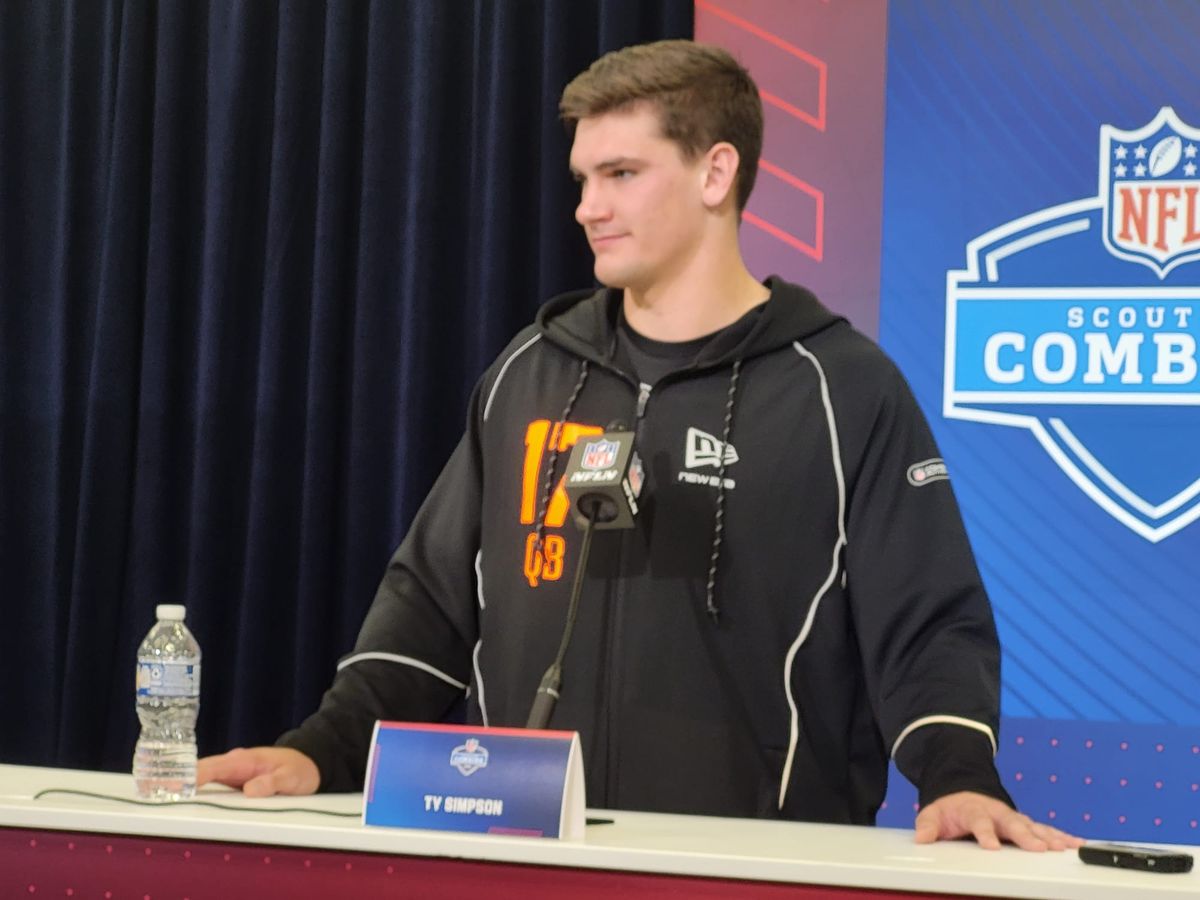
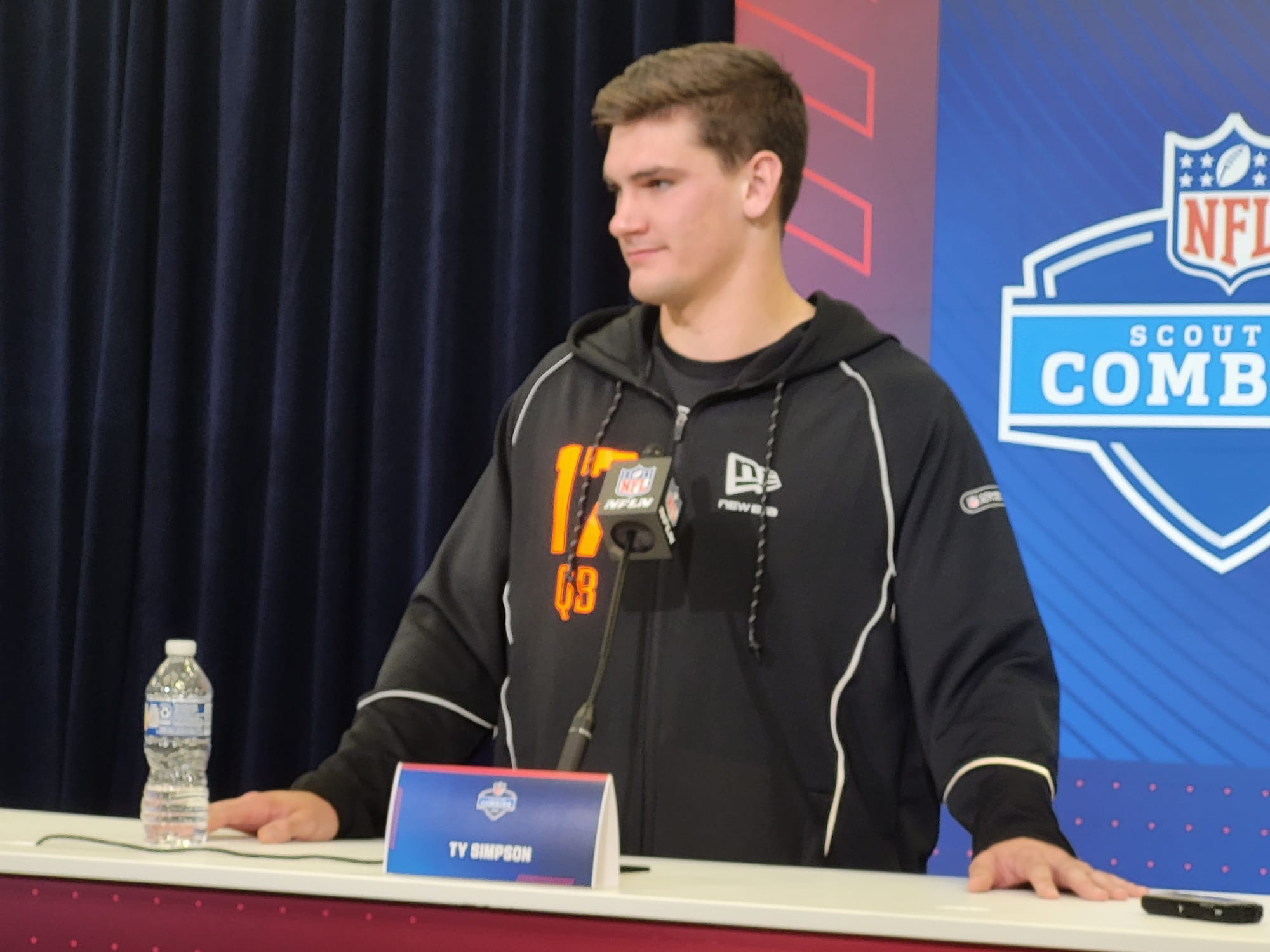
Ty Simpson started 15 games in his entire collegiate career and played badly in the most important ones.
All Simpson analysis starts and ends here: 15 games of steadily decreasing quality.
Let’s examine a few of those games.
The Rose Bowl loss to Indiana was a miserable game. Simpson couldn’t move the Tide offense. He threw an interceptable pass on one of his 16 attempts before he suffered a cracked rib on a fumbled third-down scramble.
It’s tempting to excuse Simpson’s performance against Indiana because of the injury, but that would be line-item vetoing away not just the biggest game of his career, but 6.7% of his entire starting career.
The playoff victory over Oklahoma, while not a dreadful game, was much better in the box score (232 yards, two touchdowns) than on the field. Simpson again couldn’t move the offense at all in the first half; the Tide defense (a pick-6) and special teams (a fumble recovery on a punt) got Alabama back in the game after they fell behind 17-0.
Simpson did put together some crisp drives and threw some lively deep balls in the second half against the Sooners. Receiver Germie Bernard committed a brain fart of an E8 when he dropped a wide-open bomb on a Simpson scramble-and-throw, but he made up for it by reaching over a defender’s back to catch an underthrown pass near the goal line. Simpson took too many third-down sacks for my liking, both near his own goal line and in the red zone, but he did enough to win a playoff game. If I were Simpson, however, I wouldn’t mail this game film to the Jets or Cardinals with a note that read “DRAFT ME.” Unless I did not want them to. But let’s not get bogged down.
The SEC Championship loss to Georgia was an undeniably bad game. Simpson threw an interception into a crowd and at least two more interceptable passes. His touchdown pass came on a screen-and-scamper, at the end of a penalty-aided drive, to cut Georgia’s lead to 21-7 early in the fourth quarter.
Simpson was indecisive and jittery against the Bulldogs defense. He threw behind receivers and scrambled when he shouldn’t have. Yes, the Alabama line buckled more than once, and there were some times where it was clear that no one was getting open. But the Georgia game was still evidence against Simpson as a NFL franchise-quarterback prospect.
Simpson threw three touchdown passes in Alabama’s late-November win against Auburn. It’s tempting to call this a “good” game because of those touchdowns, despite the 19-of-35, 122-yard passing line. But Simpson went 2-of-11 on passes of 10+ air yards in that game. Remember, the threshold for a “deep” pass is universally accepted to be 15+ air yards; Simpson was 0-for-5 on such throws. Lowering the threshold to ten yards scoops up just about everything except screens, flats, RPOs and other quick-and-easy concepts. Simpson could do nothing except dink-and-dunk against a conference also-ran.
We have now covered the final 27% of Simpson’s entire career, and nothing about it suggests that he’s anything but a midround NFL pick and career backup.
Rest assured that if we backtrack far enough, we can find a streak of very impressive Simpson games, starting in mid-September against Wisconsin (let’s not bother with the 73-0 drubbing of Louisiana-Monroe) and ending in mid-October against either Mizzou, Tennessee or South Carolina, depending on how easy you are to impress.
Simpson was a smooth, rhythmic passer with fine mechanics and a strong arm in those games. There were flaws – four sacks in 11 pressures against Vanderbilt isn’t a great ratio – but fine performances in midseason wins over major-program opponents make a credible base layer for a top prospects dossier. Unfortunately, those games are Simpson’s only layer.
I must point out that Simpson was reportedly dealing with “severe gastritis” in the second half of last season. He also suffered a lower back injury against South Carolina on October 25. There was some elbow bursitis in there somewhere. Why, it’s a wonder the lad was able to crawl out of bed each morning!
Simpson’s litany of ailments was reported well after the fact by insiders cutting and pasting texts straight from Simpson’s agent Drew Rosenhaus. Perhaps the injuries were serious, though I don’t recall typing “severe gastritis” into a draft capsule anytime in the last 20 years. If we stop Simpson’s evaluative clock in late October for medical reasons, then we must base any opinions of him on eight games, total, including the South Carolina game. The other seven didn’t count. He had not one, but three doctor’s notes!
Forgive me for not playing along with such special pleading.
Ten-Yard Fight
Since the Sports Info Solutions database was already sorted for Simpson’s throws of 10+ air yards for that Auburn tidbit earlier, let’s look at his game-by-game numbers on such throws.
Week 1. Florida State: 7-of-18, 151 yards.
Week 2. Louisiana-Monroe: 5-of-5, 121 yards, 2 TDs.
Week 3. Wisconsin: 9-of-11, 208 yards, 3 TDs.
Week 5. Georgia: 7-of-17, 121 yards.
Week 6. Vanderbilt: 10-of-13, 234 yards, 2 TD, 1 INT.
Week 7. Mizzou: 6-of-9, 105 yards, 1 TD.
Week 8. Tennessee: 6-of-9, 127 yards.
Week 9. South Carolina: 4-of-15, 98 yards.
Week 11. LSU: 9-of-15, 233 yards.
Week 12. Oklahoma: 8-of-18, 161 yards, 1 INT.
Week 13. Eastern Illinois: 4-of-7, 73 yards, 2 INT.
Week 14. Auburn: 2-of-11, 24 yards.
SEC Championship. Georgia: 1-of-10, 10 yards, 1 INT.
Playoff Round 1. Oklahoma: 6-of-10, 1 TD.
Playoff Round 2. Indiana: 1-of-2, 13 yards.
Sports Info Solutions lists 13 dropped passes among these throws, seven by Ryan Williams. It also lists two dropped interceptions among these throws.
There’s a rather clear demarcation line at the South Carolina game, which is also when Simpson suffered a back injury which required some treatment on the sideline. Simpson’s ability to complete passes downfield decreased sharply from that game on. Was he hurt? Was he “figured out?” Playing tougher opponents? Wilting under pressure? “Some combination of the four” might be the safest conjecture.
Simpson’s overall completion rate for passes of 10+ air yards was exactly 50% in 2025. That’s very low for a prospect worth our time and attention. Here are some figures from noteworthy prospects of the past few years:
Completion Rate: 10+ Air Yards, Final College Season
- Jayden Daniels: 63.1%
- J.J. McCarthy: 61.5%
- Bo Nix: 59.7%
- Cam Ward: 58.7%
- Fernando Mendoza: 58.5%
- Shedeur Sanders: 56.5%
- Jaxson Dart: 55.1%
- Caleb Williams: 54.7%
- Ty Simpson: 50.0%
- Drake Maye: 48.5%
You probably don’t have to be told that Simpson lacks the pure athleticism of Williams or Maye.
I don’t want to misrepresent this particular split as anything but an interesting nugget. We have so little to work with when it comes to Simpson, however, that I am trying to isolate something which suggests a first-round pick.
If we play along with the injury narrative and stop counting before the South Carolina game, Simpson’s completion rate on 10+ air yard throws leaps to 61.0%. But we are coming perilously close to just saying, “Gosh, he played really well against Louisiana-Monroe, Wisconsin and Vandy.”
And Wisconsin really stunk last year.
Small Samples and Scouting Overconfidence
Back in the early days of Football Analytics, Aaron Schatz and his Football Outsiders collaborators (not me; I wasn’t there yet) built a rookie quarterback projection system out of just two data points: total college starts and completion percentage. It was the primitive ancestor of the modern QBASE method, which can be found at FTN.
The early projection system had limited value for identifying sleepers or future All Pros but was a crackerjack bust detector. Total starts, in particular, worked as a powerful counterbalance against scouting overconfidence. It doesn’t matter how good 15 starts may look: the sample size is small, and therefore more volatile. NFL evaluators tend to be overconfident in their abilities given two or three years of tape to work with; given a smaller sample, they are even more likely to lean upon preconceptions, groupthink and (let’s call it what it is) arrogance.
Dan Orlovsky illustrated an example of how groupthink/overconfidence seeps into the NFL decision process with his extra-thirsty claim that Simpson would be a worthy second-overall pick “if he was 6-foot-4” and if he had “23 college starts.” I might be one as well, if I met those qualifications! But I do not, nor does the 6-foot-1 Simpson.
We can chuckle at Orlovsky and speculate about his ulterior motives, but NFL evaluators are capable of equally faulty, loopy reasoning. The evaluation process distills prospects down to gloopy mounds of traits. Scouts and GMs don’t do a good job keeping track of what the gloops were distilled from. Once a quarterback prospect becomes footwork, release quickness and “processing” floating in an amorphous void, his scouting report can become untethered from reality. A quarterback who checked down to his secondary receiver twice against Northern Illinois “possesses the ability to check down,” like it’s a skill listed on a character sheet. If the prospect was never seen doing something, who can claim that he is bad at it?
NFL evaluators don’t handle uncertainty well. There’s no box in their brain for we may not have all the data we need to make a well-informed decision. If you don’t believe me, remember that the 49ers traded UP to draft an FCS quarterback whose final college season was cancelled five years ago. And they are one of the league’s smarter organizations.
Back in the early-2000s, quarterback prospects with low career start totals were likely to be juniors leaving college a year too early. Now, the typical top prospect spends his early career portalling around in search of starting opportunities and dough. Simpson is something of a rare breed: the prospect who spent two years waiting behind an established starter in Jalen Milroe.
Simpson should not be punished for staying at Alabama, but his situation remains somewhat unusual for a 2020s prospect. We can look to 2024 or earlier to get a greater sense of Drew Allar or Garrett Nussmeier. In Nussmeier’s case, tape from 2024 corroborates the claim that he was never really healthy in 2025.
Such reassurance would be helpful in Simpson’s case, but it’s unavailable.
For Comparison’s Sake
I can’t come up with a comp for Simpson which doesn’t sound like an insult. He’s your typical major-program game-manager. Alabama used to produce bushels of them: Greg McElroy, AJ McCarron, John Parker Wilson, Brodie Croyle. Tua Tagovailoa was one, really; Mac Jones and Bryce Young may simply have been slightly elevated versions of the type. Simpson might be a Tua or Mac who got stuck with a weaker supporting cast, but Tua and Mac didn’t stumble and fumble through the back stretches of their college careers.
Expanding out to other SEC powerhouse programs known for producing so-so quarterbacks, Simpson is better than Jake Fromm or Danny Etling, but not by that much. He’s a much better pure passer than Matt Corral, but not nearly as mobile.
My search for a comp led me back to Jarrett Stidham, whom you might remember from the AFC Championship Game, in which he was defeated by snow, his own mediocrity and the Patriots defense (let’s not quibble about the order). Stidham was physically unimposing at Auburn in 2017-18. The more he played, the less impressive he looked.
What buzz Stidham generated in the 2018 draft boiled down to “he had some SEC success, and some folks in the NFL dig him.” Ten years later, that’s still his scouting report, but since the “folks” include Josh McDaniels and Sean Payton, Stidham has enjoyed a decade on NFL benches.
Simpson also reminds me a bit of Tom Savage, who came from nowhere to have a breakout year for Pitt in 2013. Savage was a bigger dude with a stronger arm, but he had a similar final college season, including an early-season hot streak and a late-season meh streak. The Texans drafted Savage in the fourth round. Bill O’Brien noodled with him for a few years before getting bored.
Jaxson Dart makes a reasonable upside comp for Simpson, though it’s a loaded one. The NFL world is currently pretending that Dart had a marvelous rookie season, when in fact he mostly dinked-and-dunked through lopsided losses and scrambled head first into danger. Dart, like Simpson, had rough outings against LSU/Georgia-caliber opponents late in his college career. But Dart’s outings were not as rough as Simpson’s outings. He’s also bigger, more mobile, and showed progress across three seasons as an SEC starter.
I am not certain that Simpson lacks what it takes to be a quality NFL starter. That’s the flip side of not having a large data set to work with: I lack information, too! The burden of proof, however, is upon the prospect claiming to be worthy of a first-round pick and franchise-quarterback status. Such a prospect must provide on-field evidence. Simpson stopped just short of providing evidence to the contrary. All the injury revelations, agent favors and spit-polishing in the world cannot change that fact.
I would not be surprised at all if Simpson ends up getting drafted in the third or fourth round. I have a feeling that the media and fans are higher on Simpson than the NFL is. But all it takes is one NFL evaluator to decide that he can interpret Simpson’s 15 starts on a deeper level than the rest of us. And the Jets pick twice in the first round.