Movin' to Guard: 2026 NFL Draft Offensive Linemen
If you love huge collegiate offensive tackles who might be forced to switch positions in the NFL, have we got a draft class for you!
The 2026 offensive line class is full of toolsy blockers, ornery blockers and technically-proficient blockers. It’s a little short, however, on toolsy, ornery, technically-proficient blockers. Still, if a team is not too picky about a prospect’s age and is willing to speculate about moving a tackle inside to guard or center, there’s some talent to be found.
Doesn’t that intro just grab you and make you want to keep reading? Hey, I am making the tastiest chicken salad I can this year!
Francis Mauigoa, OT, Miami
“Sisi” Mauigoa played 995 snaps at right tackle for the Hurricanes in 2025, 862 in 2024 and 833 in 2023. He has blocked for Cam Ward and Carson Beck and played in a Pop Tart Bowl, a Pinstripe Bowl, playoff games and a championship game. Experience and durability are not concerns.
Durability briefly looked like it could be a concern. Mauigoa underwent a medical reevaluation after a disc issue was flagged during his Combine physicals. The recheck came back A-OK, per reports.
Mauigoa plays low for a 6-foot-5 lineman. He packs a wallop when he engages defenders. He can sustain blocks during scrambles, though he’ll hold (four penalties each in 2024 and 2025) when his defenders try to twist away. He reads stunts and blitzes well. He’s a bit of a lunger and can get beaten by elite quickness. But the biggest knock on Mauigoa is that he’s a pure right tackle entering an NFL that still places a premium on left tackles.
Some experts and outlets think Mauigoa will move to guard in the NFL. Some experts and outlets think any offensive lineman who doesn’t have Joe Thomas’ traits and college film will have to move to guard. It’s a ball-knower tic that has crossed generations. Oooh, he wasn’t perfect on that rep. He’ll never be Orlando Pace. He’s dead to me forever as a left tackle. If every less-than-ideal tackle prospect moved to guard, NFL teams would either field three-man offensive lines or have two guards piggy-backed on top of one another on the edges of their lines. I do the “move-to-guard” thing too, but I try not to do it as a reflexive throat-clearing every time I see an imperfection in a college lineman’s game.
(And if you think I am exaggerating on this point, remember that Will Campbell played left tackle in the Super Bowl as a rookie and folks are still doing this to him!)
While I don’t think Mauigoa must move to guard, he lacks ideal length and athleticism for left tackle, and he has never played there. He’s not a Lane Johnson-level prospect at right tackle, either. He’s a safe pick who should be an NFL starter for years. In most drafts, he’d be selected in the middle of the first round. This year, he might not get past the Browns, unless the NFL’s evaluative herd got spooked by the medical recheck.
Vega Ioane, OG, Penn State
Ioane started at left guard for three years at Penn State. He arrives at the draft with the typical “three-year B1G starter at left guard” dossier. Ioane is a powerfully-built 320-pounder with a low center of gravity and an ornery demeanor. He can forklift defenders directly in front of him out of a gap. He sumo-wrestled Ohio State’s Kayden McDonald to a draw in 2025. His lateral quickness is adequate for his position. The further Ioane is forced to move to his left or right, the worse the results.
Ioane appears to be moving up draft boards. A team seeking a guard would be better off drafting an impressive, experienced guard than some tackle with “traits” but no experience and disappointing film. Some NFL evaluators, however, are likely to disagree.
Caleb Lomu, OT, Utah
Lomu took over as the Utes’ starting left tackle in 2024, moving Spencer Fano from left to right. Lomu recorded 25 blown blocks in 2024 but just 11 in 2025. He looks great when pulling or when blocking in space. He’s not a technician in pass protection, but edge rushers who try to beat him to the outside often end up getting kicked out the back door of the nightclub.
Because Lomu appears to be a “developmental” left tackle prospect, I tried to find out his precise date of birth. Longtime draft analysts will warn you that this can be a real journey.
The dumbass Google AI claimed Lomu was born “around December 23rd,” citing an Instagram post from a grandparent. That may sound creepy, but I have triangulated a few grandparent birthday greetings to figure out a prospect’s birthdate. Anyway, “born on Festivus” is of little use if we don’t know the year.
An extremely dubious source confidently listed Lomu’s date of birth as January 15, 2002. That would make him 24 years old, which would change my appraisal of him considerably. It’s important to note that Utah players often go on Mormon missions, so it wouldn’t be unusual for a prospect to suddenly appear on a roster as a “freshman” at age 21 or so. But seriously: look at this slop. It looks like it was written by an AI summarizing an AI.
The Utah football website lists Lomu as having played high school football in 2021 and 2022. That would indicate a traditional academic career: no missionary work, juco, or whatever. I could contact the university or hunt down Lomu’s agent, but I’m lazy. Assuming he’s around 22, Lomu should still be developing a little as an athlete and a lot as a technician at his position.
I think I rank Lomu higher than most other experts because he’s a true left tackle with upside.
(Note: During editing, I searched for Lomu’s date of birth again, and the dumbass Google AI now claims that he was born in 2002 but cannot cite any real source. Again: it would be odd for someone to still be eligible to play high school football at age 20.)
Sam Hecht, Center, Kansas State
I definitely have Hecht ranked higher than most experts.
Hecht was a Senior Bowl standout. He looked good in individual and team drills, and he generated some buzz about his ability to handle line calls and take on a leadership role.
On tape, Hecht looks great when pulling or leaking out for screen passes, duties he often handled for the Wildcats. He’s a quick, fluid lateral mover, and he arrives at his defender with some pop. I also liked what I saw on “reach” blocks and when moving laterally on outside zone-type rush concepts.
Hecht is a short-armed 303-pounder who may always have trouble when a top-tier defensive tackle is head-up on him. Many NFL centers need help from a double-team when facing a top-tier 1-tech.
I get the impression that Hecht has just been shuffled onto some media draft boards behind all the major-program left tackles who might switch to guard, plus Trey Zuhn, who is more interesting to write about. Hecht has the potential to grow into a starter in a system that values a quick-footed center.
Trey Zuhn, OT/C, Texas A&M
Zuhn started at left tackle (mostly) for the Aggies for four years. He set a Pro Football Focus record with a pass protection grade of 96.8. So naturally, he’s expected to move to center in the NFL.
To unpack a bit, Zuhn played 124 snaps at center last year, as Texas A&M coaches tinkered with some funky rotations on the offensive line. Zuhn told reporters at the Combine that he asked for some center reps because he felt his short arms (32.5 inches) might hurt his draft stock at left tackle.
I rip PFF for many things, but their game charters can identify very good or very bad games, so a grade of 96.8 is noteworthy. Zuhn blew just 16 blocks in 741 snaps, per Sports Info Solutions: a fine figure for a blocker flipping between positions in the middle of games.
Zuhn is a rectangular athlete who indeed has shortish arms and good-not-great lateral quickness. Speed rushers can force him immediately into find-a-way mode. Zuhn did a fine job reaching and swatting to keep outside rushers away from Aggies quarterback Marcel Reed, but it’s not hard to imagine how some of Zuhn’s successful blocks would turn into sacks if he remains at tackle in the NFL.
Zuhn performed well during Senior Bowl practices, taking some reps at both center and tackle. Projecting him as a starting center based on 124 snaps and traits is a bit of a reach. But he will play somewhere in the NFL.
Kadyn Proctor, OT, Alabama
You wanna get nuts? Let’s get nuts.
Heck, let’s get really nuts.
Riddle me this, Batman: when is a Big Man Touchdown not a Big Man Touchdown? When the big man doesn’t reach the end zone, of course! Still, those gadget plays illustrated just how athletic the 6-foot-7, 352 pound Proctor is.
Proctor is gargantuan, has quick feet, and usually pass-protects with a wide base and fine balance. Defenders who enter his gravitational field are never seen again. But Proctor can be beaten by quickness to either side of him, has trouble finding and striking defenders consistently on the second level, and suffers from the usual leverage issues a 6-foot-7 lineman faces when his technique slips.
Proctor may be the most boom-or-bust prospect in this class. He could develop into Jordan Mailata. But he’s simply the wrong type of athlete to (here it comes) slide inside to guard, where he could end up obstructing the view of any quarterback shorter than Josh Allen.
Many mock drafters link Proctor with the Browns. That’s not a stretch by any means, but I would not want to rely on him immediately at left tackle. Proctor makes more sense later in the first round, where teams have time to develop a lineman and the leeway to gamble a bit.
Monroe Freeling, OT, Georgia
Freeling is 6-foot-7 and has lots of first-round traits, but he’s a waist-bender and leaner.
If you don’t know why waist-bending is bad, try to pick up something heavy by bending at the waist. On second thought, please don’t do that, because I cannot afford to get sued. You negate much of your body’s strength when waist-bending, putting all the strain on your arms and lower back to do the work of your core muscles. Taller offensive linemen have a habit of waist-bending instead of bending their knees for the same reason that middle-aged guys bend at the waist instead of the knees when shoveling snow: bending properly feels like harder work, especially when fatigued.
If you don’t know why leaning is bad, imagine the bully in a karate movie trying to beat the sensei by shoving him with all his body weight. The sensei barely has to sidestep the bully to defeat him. The defender is the sensei in this scenario. When Freeling leans too far forward, experienced defenders can send him toppling away with a quick rip move.
Despite the technical deficiencies, Freeling blew just 14 blocks in 838 snaps at left tackle in 2025. Pure size, strength and quickness, plus what looks like a hard-nosed demeanor, can take prospect with Freeling’s tools a long way.
Freeling only took over as a starter midway though the 2024 season and turns 22 in July. He is probably still developing, and his technique is fixable.
Freeling looks like a Day Two developmental tackle. In this draft class, however, I could see him getting selected late in the first round by a team that can afford to stash him on the bench.
Spencer Fano, OT, Utah
Fano was a consensus All-American and won the Outland Trophy as the nation’s top lineman. He’s a three year starter: left tackle in 2023, right tackle in 2024-25. He’s rugged, he avoids mistakes, and he can shove defenders from the second level into the parking lot. He lacks top-end athleticism, however, and Texas Tech’s edge rushers gave him all sorts of trouble.
Fano’s CBS Sports draft capsule states, you guessed it, that he could “potentially slide inside to guard.” Again, this is cool-kid jargon for “not a very good prospect at tackle.” But yes, a bad-body lineman with a tough-guy demeanor and gobs of college experience could indeed move to guard in the NFL. He could just as likely stick as a sturdy right tackle.
Max Iheanachor, Offensive Tackle, Arizona State
Iheanachor grew up playing soccer in Nigeria. His family moved to Los Angeles before high school, where he switched to basketball because of his size. An AAU coach suggested that Iheanachor try football, which may or may not be an indication of how basketball was going.
Iheanachor enrolled at East Los Angeles College, where he first learned how to strap on his helmet and pads. He needed a year on the bench at the juco level just to learn the basics. After two seasons at East Los Angeles, Ihanachor transferred to Arizona State, where he quickly found himself in the lineup due to a rash of injuries. He ended up sticking at right tackle for two-and-a-half seasons.
Iheanachor is thickly-built, gets out of his stance and sets quickly, plays with fine balance and has pitter-patter feet. His most notable weaknesses are holding penalties – five in 2025 – and issues with blitz pickup. Texas Christian kept running stunts to Iheanachor’s side last season, and he kept taking the cheese, chasing the defender looping away from him instead of the blitzer coming straight at him. That may have been a coaching/schematic issue, but Iheanachor’s football instincts may still be a work in progress.
Iheanachor was a standout during Senior Bowl week. He was also outstanding in the all-star game itself, driving defenders backwards as a run blocker on an icy day in Alabama. His Senior Bowl performance suggests that Iheanachor may still be growing into his tools. He looks like an adequate starting right tackle or multi-position sub on tape, but there may be more to him than meets the eye.
Blake Miller, OT, Clemson
Miller took over as the starting right tackle for the Tigers in 2023 and stayed there for three years. He’s a rugged finisher who loves to smush his defender through the whistle. He’s also active and always looking for work, finding someone to block when he’s uncovered or going on seek-and-destroy missions during scrambles or screens. Unfortunately, Miller struggles to sustain blocks, can get beaten by pure speed and ends up on the ground a little too much.
NFL coaches love a good snap-to-whistle guy, and Miller has the right size/athleticism/durability/mindset package to be a capable NFL right tackle.
Connor Lew, Center, Auburn
Lew took over as Auburn’s starting center midway through the 2023 season, played well in 2024 and was off to a fine start before tearing an ACL in October of 2025. He’s expected to be ready for training camp. He turns just 21 years old in August; the combination of youth and SEC experience is ideal.
As you might expect from a center, Lew has a high-character, team-leader rep. He can make line calls and adjustments, and he recognizes blitzes and stunts well. The tape shows your basic athletically so-so center who needs help with bigger and/or quicker defenders. But Lew may still be over one year away from filling out athletically.
Lew may be a great Day Two fit for some team that has penciled in a stopgap like Juice Scruggs, Elgton Jenkins or Garrett Bradbury at center. (Lions offensive line coach Hank Fraley might recognize Lew as a kindred spirit.) He may not be ready to start in 2026, but Lew has a future as a quarterback-of-the-line type of starter.
Keylan Rutledge, OG, Georgia Tech
Rutledge executed some form of pull block (looping out of his gap to block elsewhere along the line) 339 times in 2025. That was the highest total in the ACC. It had to be one of the highest totals in the nation; that’s a tricky split to sort for.
The Yellowjackets use all sorts of counters and other run concepts that require pulling linemen, tactics that aren’t popular at higher levels of competition anymore. Rutledge was a blast to watch on these plays: he’s a 330-pounder who can glide along the line of scrimmage and squash cornerbacks and other in-space defenders along the sidelines.
Rutledge is quite a character. An anime villain, perhaps:
The offensive lineman has always been susceptible to nosebleeds, but the problem seems to have worsened since coming to Georgia Tech. Sometime during warmups – usually whenever his helmet gets jostled – Rutledge will start to feel the blood leak out from his nostrils. A rivulet will run down his lip. A splotch or two may make its way onto his No. 77 jersey. Tech’s athletic trainers have come to expect it too, always prepared to plug his nose with gauze.
The man known as “Red” (or alternatively, “Big Red”) for his ginger mop of hair seems to have added another meaning to his nickname.
“When it bleeds, it bleeds pretty good,” the 6-foot-4, 310-pounder said. “A little blood never hurt nobody.” – Andy Demetra, Georgia Tech website.
Back in 2023, Rutledge flipped his 2007 Nissan Frontier twice while driving on a slick stretch of I-85 from one transfer visit to another. The vehicle landed upside down. Rutledge broke the passenger-side window with his elbow and climbed out. He suffered a broken toe which, after some complications, was nearly amputated. No one asked him if the car crash also caused a nosebleed.
I like Rutledge as a “storyline guy” and as someone who looks like he would have been a star in the heyday of the counter trey. He has also grown on me as a prospect. His pass protection isn’t stellar, and his Senior Bowl pit drills were a real mixed bag. But I have seen scouting reports criticizing his ability to block defenders in open space. Well, when no one else in the nation is asked to do so 339 times, it’s inevitable that he’ll end up with a higher-than-usual number of whiffs.
Rutledge screams “Ben Johnson lineman” to me. Look for him to go to the Bears/Jets/Lions sometime in the third or fourth rounds.
Gennings Dunker, OT/OG, Iowa
Here’s a lengthy excerpt from what I wrote about Dunker from the Senior Bowl:
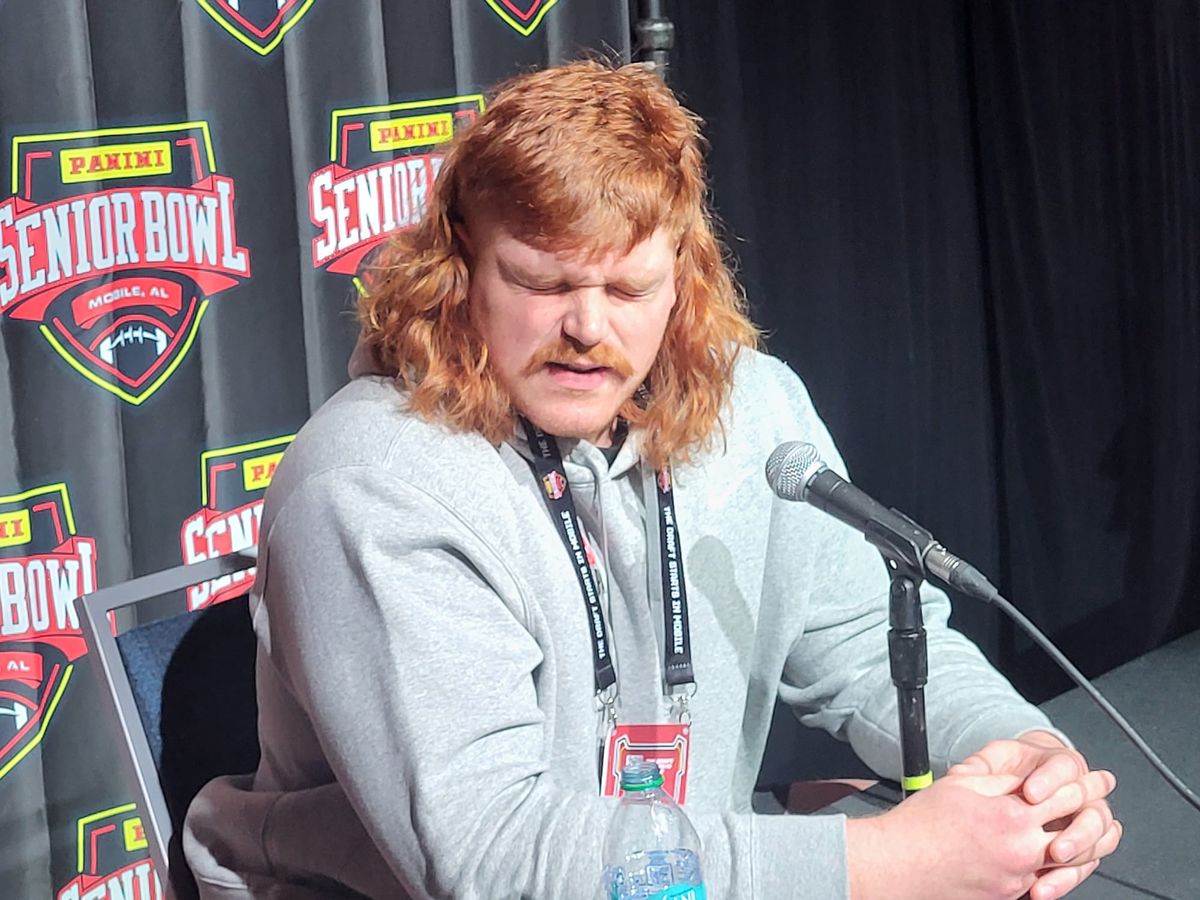
Iowa offensive tackle Gennings Dunker has unruly ginger hair, a moustache that could mop up a fifth of Scotch, and a problem.
“Sometimes I get too excited,” he told reporters on Wednesday. “Like sometimes I need to hit a single and I’m, you know, I’m going for a triple or sometimes even a home run.”
In other words, Dunker is just an excitable boy who likes to hit a little too hard, even by offensive lineman standards.
“Let’s say you’re playing right tackle, and you’re the front side of inside zone,” Dunker explained, when asked to elaborate on the singles and homers. “The ball is probably not going to go to your front side. It’s an important block, but it’s not the key block for the play. So you really just don’t want to get beat inside.”
A blocker who goes for the piledriver on such a play runs the risk of whiffing in a situation where just getting in the defender’s way for a moment would be preferable. “It’s not a home run block,” Dunker said. “It’s not a knockout block. Not a pancake. Just do your assignment.”
So yes, I love Dunker’s mustache, mullet and mentality. I also loved a lot of his reps in Mobile.
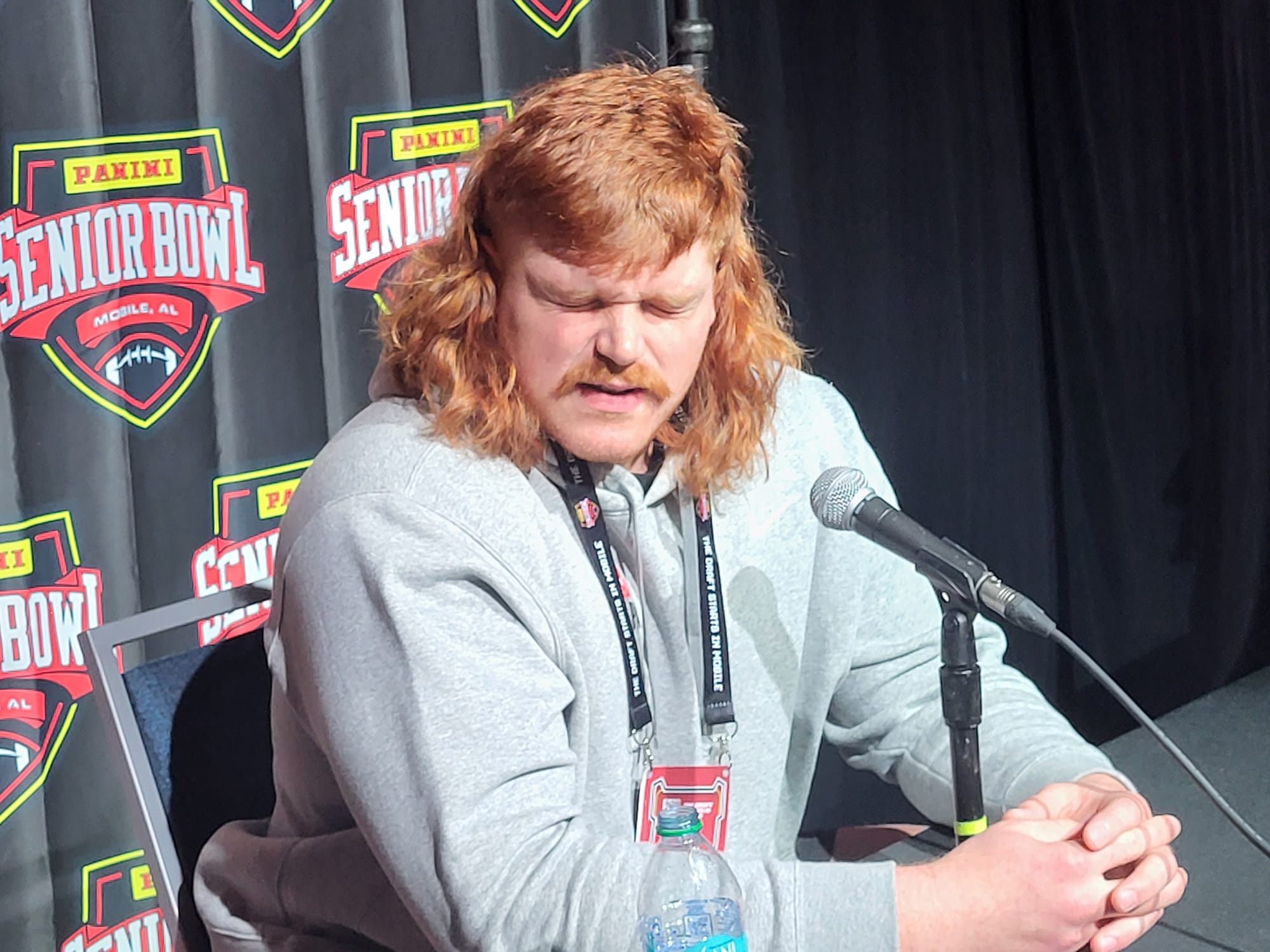
I hate Dunker’s backpedal at right tackle, however. It’s sluggish and clumpy. Dunker also ends up on the ground a lot. Like he said, he tries to hit too many triples. But that doesn’t excuse windmill swings that leave him on the turf.
As you might have already surmised, Dunker is considered by most experts to be a candidate to move inside to guard. It makes sense in this case: Dunker can use his brawler’s mentality at guard without having to backpedal against outside rushers. He should turn into a capable starter at guard. And his Vercingetorix, King of Gauls aura will make him a fan favorite.
Emmanuel Pregnon, Guard, Oregon
Pregnon is built like a forklift. He’s so wide that the 7 and 5 on his jersey don’t even have to like each other. He can drive defenders who lose the leverage battle through the back of the endzone. His lateral quickness is good enough, considering that it takes two bus transfers to get around him.
I have no idea how old Pregnon is. He lost his freshman year at Wyoming to COVID in 2020, then redshirted in 2021. He earned freshman All America honors in 2022, even though we used to call third-year collegians “juniors.” Pregnon portalled to USC for two years before landing in Eugene in 2025. The wealth of college experience is great. The fact that Pregnon is probably around 24 years old, however, complicates his scouting report a bit.
Pregnon appears to be a safe, low-upside, high-floor prospect.
Chase Bisontis, Guard, Texas A&M
One thing I noticed while cross-checking the CBS Sports draft capsules is that they often lead an offensive lineman’s scouting report with a snap count.
“Chase Bisontis is a strong, versatile and dependable three-year starter with more than 1,950 snaps at both guard and center,” CBS Sports says of Bisontis. That’s a fine opening sentence. It’s also an impressive figure. But snap totals can be a little misleading.
It’s not unusual for a college starting offensive lineman to play 850 snaps or more in a season. Eleven SEC linemen did so last year. So did five Big 10 linemen and ten ACC linemen (including four Miami linemen, thanks to their long playoff run.) Four Ole Miss linemen topped 1,000 snaps in 2025. The CBS capsule on Monroe Freeling cites 1,650 snaps, but that boils down to a year-and-a-half as a starter, plus all the fourth quarters Georgia backups end up playing as underclassmen. Freeling is actually a relatively inexperienced lineman, a point which the snap count confuses.
Anyway, citing the snap count is a great way to state: He played lots of football, but otherwise he’s just your typical big, sturdy interior lineman. He played on a solid line that also featured Trey Zuhn and Ar’maj Reed-Adams. He’s strong. His arms are short for a man his size. His lateral quickness is ordinary. What more is there to say?
Position versatility will keep Bisontis in the NFL for years. He has the portfolio of a potential starter at guard.
Caleb Tiernan, OT, Northwestern
Tiernan stands just under 6-foot-8. He weighs 323 pounds, carrying much of it in his thighs, giving him a wider base and better leverage than most power-forward-sized tackles. His pass protection set looks smooth. He has gobs of starting experience. His athleticism is good enough. He doesn’t appear to be the barroom brawler type.
Tiernan’s blown block rate of 1.9% ranked third in the B1G among left tackles in 2025. He has the traits and experience to get by as an NFL swing tackle who won’t get your quarterback killed if he starts on the left side. He’s gotten the move-to-guard treatment from some evaluators. Any team that thinks a player of Tiernan’s length and background cannot play tackle should just draft a guard.
Kage Casey, OT/OG. Boise State
Casey played left tackle at Boise State but – stop me if you have heard this before – may need move to guard at the NFL level. He’s a well-built lineman who packs a mean initial punch, but he’s not super quick, and there are all sorts of little flaws to his game: leaning, lunging, hooking his outside shoulder in a way that will result in NFL holding penalties, and so on.
Casey is worth drafting in the middle rounds as a developmental tackle. But a team that wants a guard has better options in this draft class.