Kenyon and Beyond: 2026 NFL Draft Tight Ends
Yeah, this position group stinks like moldy cheese. Don't worry: a long feature on the edge rushers is coming soon!
If you really like Kenyon Sadiq as an NFL prospect, you may discover some other tight ends who interest you in this rather shallow, quirky talent pool.
If you don’t like Kenyon Sadiq as an NFL prospect, thank you for dropping by! You may want to check out some of the other installments of this year’s Too Deep 96 draft coverage. But feel free to stick around, wallow in the skepticism and perhaps hunt down some sleepers.
Kenyon Sadiq, TE, Oregon
Great news, everyone: Sadiq can block!
Sadiq often lined up next to the offensive tackle, turned his defender inside on sweeps or pinned him toward the sideline on inside runs. He lined up at H-back and led Noah Whittington or Jordan Davis through interior gaps on power runs and counters. Dante Moore could keep the ball on option runs to Sadiq’s side of the field knowing that Sadiq had a better-than-even chance of sustaining his block on a slot cornerback or overhang defender. Oregon ran some designed swing passes to Sadiq’s side, knowing that he was unlikely to whiff on the cornerback.
As a blocker, Sadiq isn’t Rob Gronkowski. He will lunge and miss now and then. But he’s more of a Tyler Warren than a Kyle Pitts. He will be able to do tight end stuff effectively in the NFL.
Sadiq’s blocking is important because you probably know about his receiving chops: he’s a mismatch nightmare in the Pitts mold, with a 4.39 forty time at 241 pounds. Sadiq is one of the five best prospects in the 2026 draft if we ignore positional value, and he’s a possible Top Ten selection in a shallow pool.
Picking a tight end that early in the draft, however, often means electing to suffer through the player’s formative years as he learns that there’s more to playing his position in the NFL than running a 4.39 forty at 241 pounds against some 19-year old nickel safety.
I’m reluctant to get too far into the weeds on positional value at tight end, particularly in the 2026 draft. After the eighth pick or so in the first round, this draft class runs fresh out of “undeniable first rounder” types. Selecting Sadiq makes more sense than selecting a weaker prospect, or trying to trade down with some team that’s looking at the exact same landscape, or rubbing a lamp and hoping a genie poofs Jeremiah Smith onto the board.
What’s undeniable is that no team should draft a tight end under the assumption that he’s really a big wide receiver. That’s the Kyle Pitts Fallacy, and it leads to years of frustration. A fast tight end who cannot block is not a big slot receiver. He’s a fast tight end who cannot block.
Fortunately, Sadiq can block.
If Sadiq were a slot receiver, he might merit a Day Two pick in a typical draft or a late first-round pick in this draft. He’s a skilled route-runner who can do nifty stuff at the top of his stem to get open. He can high-point the ball. He eludes tacklers after the catch and produced some splashy hurdling highlights.
Sadiq also dropped six passes on 70 targets in 2025. He sometimes appears to be thinking about stringing together combo moves before he has secured the football. He’s not an exceptional bad-ball receiver; he doesn’t do a great job scooping up low throws or extending for outside fastballs.
Sadiq would fall somewhere between Luther Burden and Treylon Burks on the matchups-and-YAC spectrum if he couldn’t line up in a three-point stance, battle edge rushers to a draw in the running game and force mismatches against linebackers in the passing game. But again: Sadiq can do those things, so his NFL team can deploy him the way the Colts deployed Warren.
Sadiq ranks above Carnell Tate and the other 2026 wide receivers on the imaginary draft board in my mind. Sadiq is faster than the top receiver prospects, for starters. But I’m comfortable that he can have an earlier positive impact on an NFL offense than Tate and the others.
The Titans or Saints could benefit from the services of a multifaceted tight end. So could the Commanders: it’s not like Chig Okonkwo is Shannon Sharpe. The team that drafts Sadiq doesn’t have to reimagine its offense around him because of his unique athleticism. They can just insert that athleticism into the spot next to the right tackle. Good things are bound to happen as a result.
Michael Trigg, TE, Baylor
Not to go on a tangent, but I don’t see signs of any top-tier tight end prospects beyond Kenyon Sadiq. Other draftniks would surely cosign that opinion, and it wouldn’t be hyperbolic.
Trigg’s ability to run traditional wide receiver routes popped during tape study. For example, Trigg led the nation’s tight ends in targets (15), receptions (10) and yards (114) on slants. Sadiq went just 4-of-6 for 34 yards on slants, for comparison. It’s not unusual for collegiate tight ends to line up in the slot, but they often end up running lots of screens, seamers and rudimentary “take a few steps and stop” patterns from the position. Trigg looked more like a polished possession receiver.
Trigg broke or eluded 19 tackles on 50 receptions for Baylor last year. He’s a determined runner with the ball in his hands, and he’ll accelerate through arm tackles immediately after the catch. Six dropped passes betray Trigg’s inconsistent pass-catching skills. But Trigg is well-built, athletically smooth and an acceptable blocker.
Trigg could be a Harold Fannin-type who proves to be a handful every time he catches a short pass. Fannin would not have caught 72 passes in a normal offense, of course, so don’t expect that sort of production. But a 35-catch rookie tight end who turns some flat passes into highlights and is willing to block could be worth pursuing on Day Two.
Max Klare, TE, Ohio State
Klare has inconsistent hands, doesn’t break many tackles and is not a great blocker.
Welcome once again to the Draft Class of 2026!
Klare’s hands may be improving. He dropped five passes on 79 targets for Purdue in 2024 but just two passes for Ohio State last year. The tackle-breaking is what it is – just five missed/broken tackles in 2025 – but Klare does have the speed to generate some YAC by running away from defenders.
As for the blocking, Klare did line up as an in-line tight end frequently in 2025, but Ohio State used Will Kacmarek as their primary blocking tight end. Klare caught a lot of quick-release passes into the flat and was used as an occasional seam stretcher against whichever defenders were left after Jeremiah Smith and Carnell Tate were accounted for.
Klare reminds me a little of Daniel Bellinger. He could contribute as a TE2 who produces occasional splash plays.
Eli Stowers, Vanderbilt
Stowers is an athlete playing quarterback playing slot receiver playing tight end.
Stowers spent two years as a deep-bench quarterback at Texas A&M. He transferred to New Mexico State in 2023 and transitioned to tight end. Stowers then portalled to Vanderbilt, where he went 40-492-4 when lined up in the slot or split wide in 2025 and just 21-270-0 when lined up as a tight end or H-back.
It often looks like Stowers is still evolving, and that his final Pokemon form will be as a small forward or a Taysom Hill. His role in the Vanderbilt offense was to be the best athlete in the huddle, line up all over the field in search of mismatches and exploit those mismatches. He looks like a superhero chasing a villain on a motorcycle when running, often turns and plucks the football with remarkable grace and generally moves like someone ancient Greeks would write poetry about. But Stowers dropped four passes in 2025 and doesn’t handle contested catches or errant throws very well. He doesn’t really separate when running routes against a quality defender. His blocking technique is poor, his tenacity adequate-at-best.
Stowers is also old for a raw, toolsy prospect: he turns 23 just before the draft. Knock a year or two off his early collegiate career, and he might be an interesting developmental project.
Stowers may still be worth a midround pick based on his mix of athleticism and production. But I could see him ending up as the most gifted member of the practice squad or inactive list because he can’t do the things that a backup tight end is expected to do.
Joe Royer, TE, Cincinnati
Royer, who spent three years at Ohio State before spending the 2024-25 seasons at Cincinnati, is well-built and becomes a bullet train when he turns upfield with the ball in his hands. The Bearcats used him effectively on wheel routes and chip-and-release passes underneath, often lining him up as an H-back or fullback. He was the fifth option in an explosive passing game, and he slowly disappeared from the game plan as Cincy’s schedule stiffened late in the year. He caught just 29 passes, and many of them were simple underneath receptions against a stretched defense.
Royer’s size and straight-line speed are projectable NFL traits. He can be an H-back and seam stretcher at the NFL level.
Jack Endries, TE, Texas
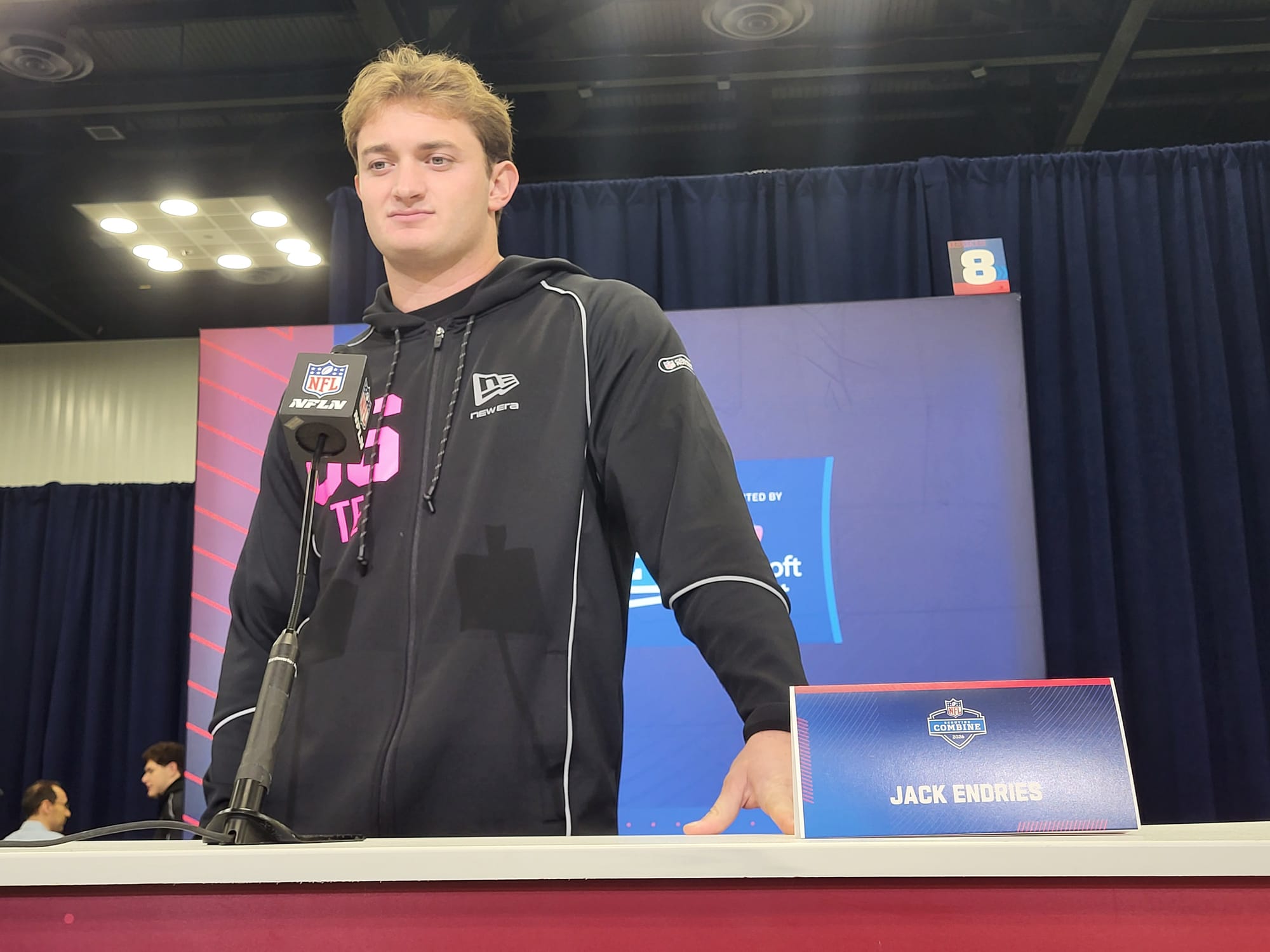
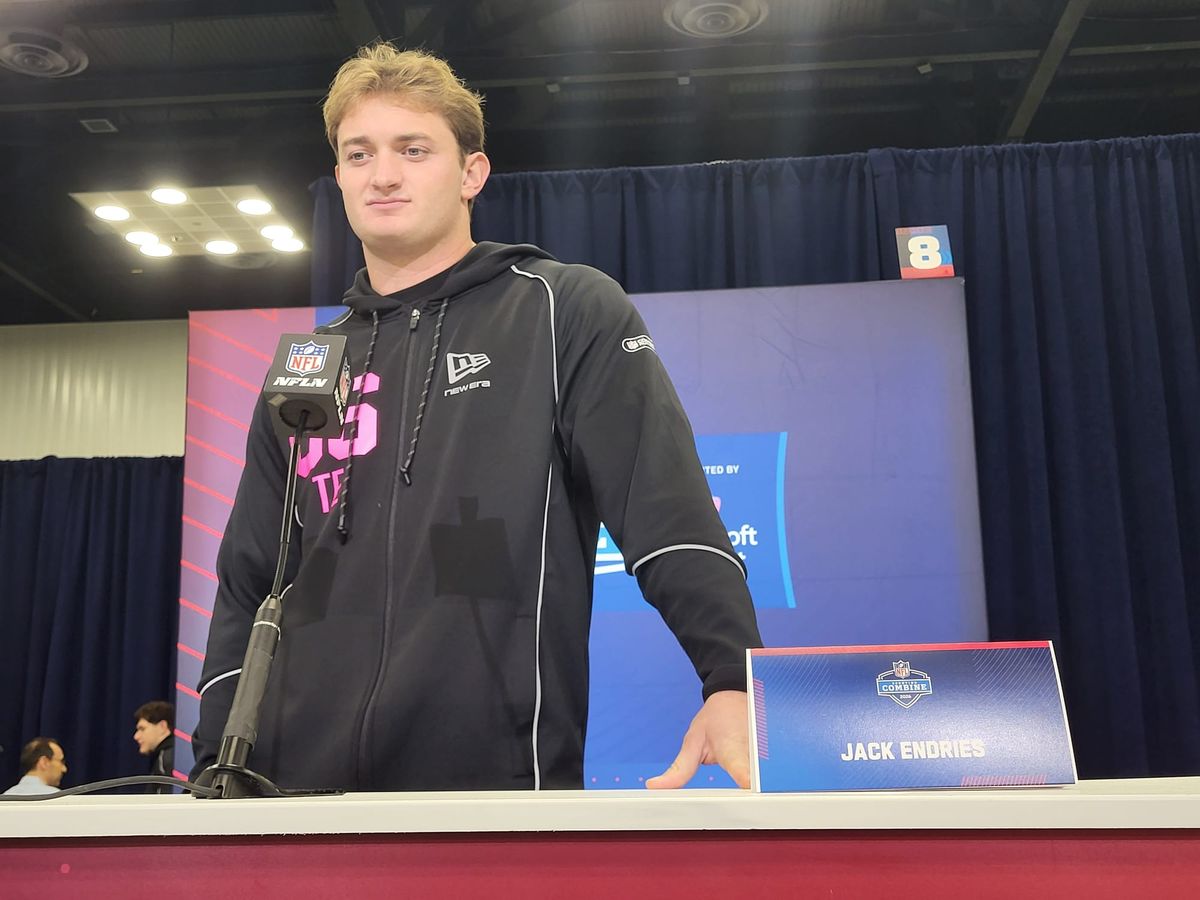
Endries played two years at Cal with Fernando Mendoza and one year at Texas with Arch Manning. That made the poor lad catnip for Combine reporters eager to get quotes on the famous quarterbacks. The press pool around Endries’ podium became particularly jackal-like, which is saying something, because I have been in my share of packs of braying scavengers over the past 15 years. One reporter asked Endries which quarterback had a stronger arm. Endries wisely sidestepped the obnoxious question. “Both places, I wasn’t running the deep post.”
Endries’ film is fascinating because Cal used him as a slot receiver, while Texas used him as an H-back and motion tight end. Endries served as a run blocker from the tight end position on 222 snaps in 2025, often pulling or folding into inside gaps. Sports Info Solutions also listed Endries as a pass blocker on 88 snaps. He’s no mauler, but he’s quick-footed, alert and ornery.
Endries is a lumbering receiver when working downfield, but his hands are reliable: zero drops in 2025, one drop on 53 targets in 2024.
Endries is a Brock Wright type. There are much splashier prospects in this tight end class, but Endries looks like the sort of player who clings to rosters for years by doing unsexy stuff.
Sam Roush, TE, Stanford
Roush is a 6-foot-6, 267-pound blocking tight end who runs like an animated suit of plate mail. He catches the ball well on underneath routes, but he’s a high-cut athlete with limited quickness who gets toppled soon after the catch.
Roush already has a degree in computer science. In this video, titled Sam Roush: Come to Class With Me, he explains that he has learned to code in multiple languages and was taking classes last summer in data science.
I love a prospect who knows more math than I do, but the title of the video is misleading. We never actually “go to class” with Roush, except in some brief shots, possibly because no one in Roush’s class signed a waiver. I was hoping to get three quick Stanford credits in, or learn a little bit about programming in R, which is all the rage with the cool nerds these days.
Anyway, there’s a place on most NFL rosters for an extra-large backup tight end who can block edge rushers in some specialized packages. Roush could be that tight end.
Josh Cuevas, TE, Alabama
Cuevas spent one year at Cal Poly and one at Washington before portalling to Alabama for the 2024-25 season. He turns 23 in September, but that makes him a spring chicken among the tight ends in this draft.
Cuevas caught 37 passes in 2025, 27 of which were of five air yards or less. He lines up in-line or at H-back frequently and hauls in lots of dumpoffs, flat passes and tight end screens. He dropped four passes in 2025, an alarming total for someone who is usually targeted on short, easy throws. He has some rumbly YAC ability.
Cuevas could be a solid NFL TE2. He’s a better athlete and receiver than some of this class’ designated blocking specialists.
Oscar Delp, TE, Georgia
Delp caught just 20 passes in 2025. He caught 21 passes in 2024 and 24 passes in 2023, when he was the Bulldogs’ TE2 behind Brock Bowers. So yes, we’re reached the “blocking tight end” segment of our program. Delp is a solid blocker: good base and technique, some pop, great ability to sustain contact.
“I think I’m looked at as a blocking tight end,” Delp told reporters at the Combine. “But when I look at myself, I’m a receiving tight end that learned how to block. I’m a guy that can play everywhere on offense. I can get open. I can find zones. I can beat people in man.”
Delp is indeed just athletic enough to beat some people in man. Inattentive middle linebackers, for example. But his NFL future is as a backup tight end and H-back type who can be relied upon in pass protection and doesn’t expect the ball much. He should do well in that unsexy role.
Nate Boerkircher, TE, Texas A&M
Boerkircher turns 25 years old in early September and caught 38 career passes in six collegiate seasons. I now feel obligated to write a Norse saga about his blocking, but a tight end prospect must catch at least two passes for every year of his life on earth for me to give that much of a damn about his blocking prowess. The fact that Boerkircher is ranked among the top ten tight ends and top 100 prospects at many high-profile sites says a lot about his blocking but much more about the 2026 draft class.
Tanner Koziol, TE Houston
Koziol is the type of prospect I despise: the king-sized slot receiver who wins a bunch of matchups against 5-11 nickel defenders through sheer heightitude.
Koziol looks like the power forward who comes off the bench to commit fouls. He has an odd, lumbering gait. There’s nothing remotely quick or twitchy about him. As a route runner, he practically signals before turning. He’ll be a below-average blocker on his best day; he’s just not physically designed for it. His running style and high center of gravity make him easy to chop down with an arm tackle.
And yet, Koziol also uses his wingspan well, both for leaping sideline catches and for plucking the ball in traffic over the middle. He’s sure-handed on routine passes and has a third gear in the open field. Some Arthur Smith-type coach will give him a long look as a matchup nightmare in 13-packages, and he could stick on teams as a kick blocker.
I don’t believe Koziol is one of the 96 best prospects in the draft class. It’s possible, however, that some team drafts him by the end of the third round based on height, 74 receptions in 2025 and sheer despair. And if he does merit playing time as a rookie, Koziol may end up with more catches than someone like Oscar Delp, if only because his height is an asset at the goal line.
Ultimately, Koziol is listed here because he illustrates how shallow this draft class is, at tight end and elsewhere, and also because I took lots of notes on him in January.