Five Signature Moments from New Orleans Saints History
From Hurricane Katrina to the Ain'ts to the Super Bowl, and back again.
Hurricane Katrina made landfall on the Gulf Coast on August 29th, 2005: twenty years ago today.
By 9 AM, flood waters breached a levee in New Orleans’ Ninth Ward. By noon, winds reaching 125 miles per hour ripped a hole in the Superdome, which was being used as a shelter of last resort for as many as 30,000 New Orleans residents who were unable to evacuate the city.
In the days that followed, the Superdome became a scene of terror and tragedy. The Saints, like so many of their fans, were suddenly homeless. The Saints spent the 2005 season playing home games in Baton Rouge and San Antonio as the floodwaters receded and the scope of Katrina’s devastation became apparent. It was uncertain whether the Saints would ever come back to New Orleans. It was uncertain whether New Orleans itself could come back.
These Saints Signature Moments, many of them shaped by Katrina and its aftermath, are dedicated to those who lost lives, homes and livelihoods as the result of the hurricane, its aftermath and our government’s diffident response to the crisis; and to the fans who swarmed back to the Superdome and helped revitalize one of the world’s unique cities.
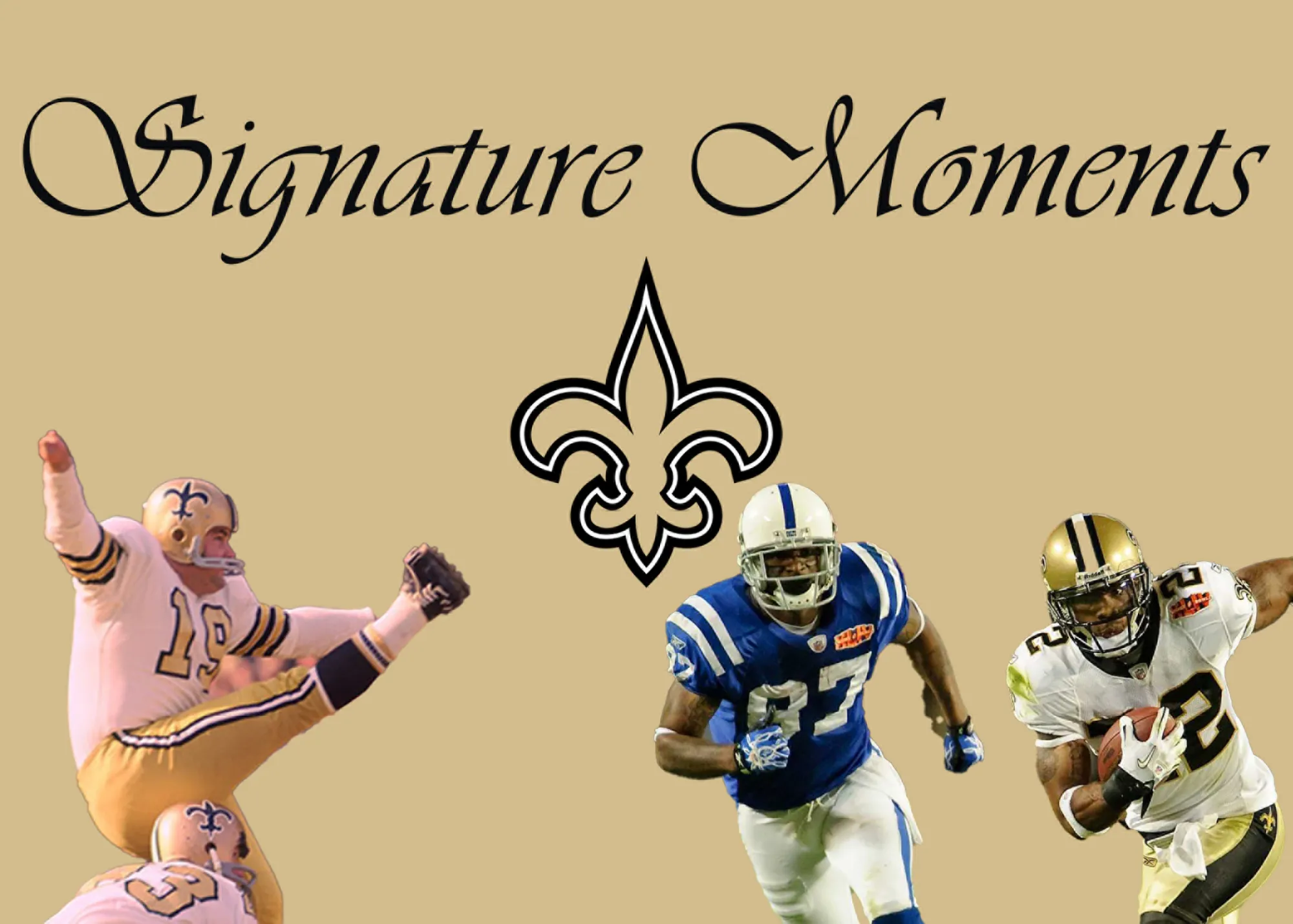
Honorable Mention I: Tom Dempsey’s 63-Yard Field Goal
Date: November 8th, 1970.
On the sideline Dempsey heard the voice of special teams coach Don Heinrich. “Tell Stumpy to get ready to kick a long one.” That was Dempsey's nickname—he had been born without any full toes on his right foot and with a withered, fingerless sapling of a right arm. The Saints ran one play, quarterback Billy Kilmer completing a 17-yard pass to Dodd, who caught the ball falling out of bounds in front of New Orleans's bench. There were two seconds left.
Holder Joe Scarpati, a seventh-year defensive back who was playing in his final NFL season, knelt on his left knee at the Saints' 37-yard line, 63 yards from the goalposts, which back then were on the goal line, not at the back of the end zone. The daunting distance was seven yards farther than the record 56-yarder that the Colts' Bert Rechichar kicked in 1953. The turf was pale brown and dusty, worn from overuse and neglect, a poor kicking surface.
Dempsey took a stutter-step, then two long strides forward—he was an old school, straight-on kicker—and he swung his deformed right foot, which on game days was encased in a custom kicking shoe with a thick, horseshoe-shaped hunk of leather on the front. On CBS's regional broadcast of the game, play-by-play announcer Don Criqui was silent for the snap. Then, as the ball sailed through the autumn air: "I don't believe this...." – Tim Layden, Sports Illustrated, October 2012.
There’s not much else to say about Dempsey’s field goal except that it was arguably the greatest accomplishment in Saints history for roughly the first 40 years of the franchise’s existence.
Honorable Mention II: Horatio Horn-phoner
Date: December 14th, 2003.
I’m actually with the hyperventilating ESPN broadcast booth on this one: stashing a prop in the padding of the goalpost for use in a touchdown celebration was some rotten sportsmanship on Joe Horn’s part. That sort of thing would not have happened, however, if the NFL weren’t so puritanical about celebrations in the first place. Now that everyone is allowed a little goofy self-expression in the end zone, no one feels the need to bring foreign objects into the ring like wrasslin’ heels.
But gosh, LOOK AT THAT FLIP PHONE WITH ITS TINY ANTENNA. It just had to be shared with the world one more time.
5. Nothing But an Ain’ts Thing.
Date: December 7th, 1980.
They had to work pretty hard to do it, but winless New Orleans managed to lose its 14th football game in a row – after leading 35-7 at the half.
San Francisco Sunday used the arm of Joe Montana and the legs of Lenvil Elliott to tie the count at 35-35 after regulation play and then the foot of Ray Wersching, who hit the 36-yard field goal 7:40 into overtime to pull out the 38-35 comeback victory and continue the Saints’ nightmare. – Mike Hudson, United Press International, Monday, December 8th, 1980.
The 1980 season was the year of the Ain’ts. Fans wore brown paper bags decorated with fleur-de-lis over their heads. Archie Manning and the offense weren’t bad. But the Saints run defense allowed 194 rushing yards per game, and the pass defense may have been worse. Also: cocaine appeared to hit the Saints earlier and harder than some other NFL teams. The shoestring organization, run on the whims of whimsical owner John Mecom Jr., collapsed just as it began showing flickers of late-70s life.
Henry Childs and Jimmy Rogers both fumbled deep in 49ers territory in the third quarter of this epic collapse. At one fateful point, the Saints reached the Niners 28-yard line on fourth down in the waning seconds of the third quarter of a windy day at Candlestick Park (the windiest place on earth). Coach Dick Stanfel claimed that he tried to call a timeout to attempt a field goal, but “they couldn’t hear me and time ran out.” Facing the wind at the start of the fourth quarter, Stanfel punted to Montana and company instead.
The Saints appeared to stop the 49ers in overtime, but defender Steve Parker was flagged for roughness while trying to tackle Elliott. “That’s the kind of stuff that’s been happening to us all year,” Parker said after the game.
The Saints would beat the Jets the following week to finish the 1980 season 1-15. They also went 2-11-1 twice, 2-12 once and 3-11 once in the late 1960s and 1970s. Manning was their quarterback in all of those years but one of the 2-11-1 seasons (Billy Kilmer, 1970). The Saints came by their Ain’ts reputation very honestly. This is who they were, for almost two decades. Stuff like this happened to them about a dozen times per year, every year.
(This game could also be considered Montana’s “arrival” moment, and would therefore qualify for the 49ers segment. We’ll link back to it when we get there. The 49ers have a lot of moments.)
4. Woulda Coulda Shoulda
Date: October 26th, 1986.
The outburst came on Oct. 26, following a 24-22 defeat by the San Francisco 49ers at the Superdome. There had been talk in New Orleans throughout the week of the Saints being a potential playoff team, of the 21 straight losing seasons finally coming to an end But the team’s record was 3-3, which included two victories during the strike. Mora was not a very happy man.
“I’m p*****off,” he said after the game. “I’m sick of hearing couldas, wouldas, shouldas, coming, close, if only … People say we’re close, but close don’t mean s***. We’re gonna work our butts off until we ain’t close anymore.”
The tirade woke up the team, and the town, and also made weekend highlight shows all over the country. It was so out of character for Mora that those close to him worried about whether the job was starting to change him.
“It was probably the best thing that could have happened to us,” said linebacker Sam Mills, one of four former Stars now playing for Mora. “Basically, the message was, “You’re too good to accept almost.’”
Now nearly two months later, More is a bit embarrassed when the subject is broached. The small creases on his face become a bit more pronounced. His jaws tighten.
“I kind of let everything out,” he said last week, a couple of days after the Saints’ 24-10 victory over Houston. “I certainly didn’t do it for the players’ benefit.” – Don Markus, syndicated from The Baltimore Sun, December 20th, 1987.
Tom Benson purchased the Saints from original owner John Mecom Jr. before the 1985 season. Benson hired Jim Finks, formerly of the Vikings, Bears and Chicago Cubs (long story), to run football operations. Finks brought in Mora, who had led the USFL’s Philadelphia/Baltimore Stars to two championships, as his head coach. Mora brought his top inside linebacker, Sam “The Field Mouse” Mills, with him to New Orleans. Mills joined Rickey Jackson, Pat Swilling and fellow USFL expatriate Vaughn Johnson to give the Saints one of history’s greatest linebacker corps. The Ain’ts were finally dead. The Dome Patrol was born.
But it did not happen overnight. Mora’s Saints went 7-9 in 1986: a good year by the franchise’s standards, a bad one by Mora’s. As the excerpt above notes, they started the strike-marred 1987 season 3-3. Morten Andersen’s 52-yard field goal try (a very long attempt for the era) failed in the final seconds of that two-point loss to the haughty, hated 49ers.
Mora cut loose, and the Saints won nine straight games. Jackson and Swilling combined for 20 sacks the following year. Mills went to the Pro Bowl. After two decades, the Saints finally reached the terra incognita of the playoffs: a feel-good story in a year of awful vibes across the NFL.
The Dome Patrol would remain a postseason fixture into the early 90s. They would never win a playoff game. But they permanently replaced the bags over the heads of their fans with Mardi Gras regalia. The Saints were finally a grown-up NFL franchise. Jackson and Mills would reach the Pro Football Hall of Fame.
And Mora, despite the soft-spoken reputation he once had, may become the only coach to give Signature Moment tirades for two different organizations.
3. Yeah, Right Coach. State Unfair.
Date: January 20th, 2019.
It's not often that you can get 73,000 people to all agree on something, but everybody inside the Mercedes-Benz Superdome definitely agreed on one thing after the Rams stunning 26-23 win over New Orleans on Sunday: The Saints got hosed by one of the worst no-calls in NFL history.
With 1:49 left to play in a 20-20 game and the Saints facing a third-and-10 from the Rams' 13-yard line, Drew Brees dropped back and threw a pass to TommyLee Lewis, and that's when this happened.
The no-call was so bad that the league office literally called Payton after the game to apologize about it.
"Just getting off the phone with the league office. They blew the call," Payton said following the loss. "Man, there were a lot of opportunities though, but that call puts it first-and-10 and we'd only need three plays. It's a game-changing call. That's where it's at, so it's disappointing. For a call like that not to be made, it's just hard to swallow."
To make things worse, the NFL's vice president of officiating, Al Riveron, actually admitted to Payton that there were a total of two missed penalties on the play.
"[The league] said not only was it interference, but it was helmet-to-helmet," Payton said. "There were two calls [the refs missed], they couldn't believe it. We spoke initially, then I called to follow up and the first thing Al said when I got on the phone, 'We messed it up.'" – John Breech, CBS Sports, January 21st, 2019.
Breech’s column was headlined “Rams-Saints ends with ugly pass interference no-call, here's the simple fix for the NFL going forward.”
That headline is false, of course. The game did not end on that missed call. The Saints settled for a field goal. Their defense then allowed a 45-yard field goal drive to re-tie the game 23-23. The Saints won the toss in overtime. Drew Brees threw an interception. The Rams drove just far enough for Greg Zuerlein to kick a 57-yard field goal.
In other words, the Saints lost because they failed to execute late in the fourth quarter and in overtime. Yes, they “wouldn’t have had to” if pass interference was called. But maybe they fumble a snap. Maybe they miss the game-winner and the game goes to overtime anyway. Why should we assume that they would do what they needed to do to win had they gotten the call when they could not do what they needed to do to win when they did not? All that’s certain is that the Saints could have won this game with a stop on defense or a drive on offense, and they failed. Everything else is sour-grapes sore-loser talk. Jim Mora would not have stood for it.
As for Breech’s simple fix: “Let every potential call be reviewable. Every. Single. One.” We’re now getting there, thanks to all sorts of eye-in-the-sky technology and initiatives which allow the league to efficiently overturn some officiating blunders without stopping the game for 10 minutes every time. But anyone who wants sporting events litigated down to quantum levels has never watched a college basketball game turn into a congressional subcommittee meeting in the last hour-long four minutes.
Payton’s whine marked the beginning of the end for the latter-day Saints. The Vikings marched down the field in overtime to beat them in the 2019 playoffs, and soon that too was decreed unfair: the NFL has been tweaking the overtime rules ever since. Tom Brady, who is Unfairness Incarnate, led a comeback to beat the Saints in the 2020 playoffs. Drew Brees retired. Payton fake-retired a year later to escape the messy rebuilding business. Perhaps he should have held his breath until the salary cap was declared unconstitutional instead.
As for Saints fans: some sued the NFL, others petitioned their politicians, and a few tried to organize a faux Super Bowl parade. Fans will be fans: rancor is just passion soured by heartbreak. But I cannot help but think that they angered the football gods, who then hardened Mickey Loomis’ heart and brain, but not his checkbook.
Let’s retreat back to more glorious times for Payton and the Saints.
2. Tracy Porter to the House
Date: February 7th, 2010.
For many Eagles fans, the most memorable play of Super Bowl LIX wasn’t Cooper DeJean’s pick-6 or any of the team’s early-game highlights, but “The Dagger:” Jalen Hurts’ 46-yard touchdown pass to DeVonta Smith to give the Eagles a 34-0 lead late in the third quarter.
Such is the nature of fan anxiety: 27-0 doesn’t feel nearly safe enough (the Falcons damaged all of us in a way), especially against an all-time quarterback at his peak. We need to see the vampire crumble to dust with a stake through its heart in the midday sun while Blade, Buffy, Van Helsing and an archbishop take turns dousing the dust with garlic-infused holy water. Only then do we get the rush of adrenaline and endorphins that lingers in our memories forever.
Based on my cursory inquiries, Saints fans felt the same way about Super Bowl XLIV.
Most of us remember Sean Payton’s audacious onside kick to start the second half, which allowed Brees to peck at the Colts defense until he tossed a short touchdown to Pierre Thomas to give the Saints the lead. But the Colts quickly regained the lead on the next drive. The Saints went up 24-17 with 5:42 to play, but talk about giving Peyton Manning too much time! No Saints fan was breathing easy or celebrating the brilliance of the onside kick, not as Peyton began one of his methodical marches down the field.
And then …
Super Bowl settings can often be sterile, no doubt due to the many corporate ticket holders, but the Saints changed that … For the Saints, this was a slice of the Superdome. As Manning lined up in the shotgun with 3:24 left, down 24–17, the energy in the stadium reflected the mood in the rest of the country, anything but neutral.
New Orleans cornerback Tracy Porter, positioned across from receiver Reggie Wayne, saw Austin Collie go in motion. Porter recognized from his film study what that meant: Manning was going to Wayne, and because the Saints were bringing six and possibly seven pass-rushers, he'd have to get rid of the ball quickly. Porter remembered [defensive coordinator Gregg] Williams's words—"I don't want robots; I want players who aren't afraid"—and decided to jump the route. "Everything slowed down," Porter said. "The spiral on the ball slowed down. The guys around me slowed down. The crowd noise stopped. It was just me and the football." Wayne ran a turn-in, but Porter got the better break on the ball. Manning's pass hit his hands so hard that even Saints defensive linemen heard the smack.
Porter had flown his barber to Miami, and two hours before heading to the stadium he asked for a custom trim: an image of the Lombardi Trophy, the Superdome and SB 44 carved out in tonsorial topiary. As he ran 74 yards for the clinching touchdown, the Saints' sideline erupted. Said cornerback Mike McKenzie, "It was crunk. It was crazy. It was off the chain. It was off the meter. It was off the meat rack." To the Colts the effect was the opposite: "A dagger in the heart," said linebacker Clint Session. – Lee Jenkins, Sports Illustrated, February, 2010.
There’s that “dagger” again.
The Saints were a laughingstock for 20 years. They were homeless five years earlier. Katrina’s impact could still be felt. But the Saints were now champions. No franchise had ever overcome more. No fanbase had ever had a greater reason to celebrate. And no city throws a crunk party like New Orleans. Even if they are throwing it in Miami.
Yet without our top signature moment, the Super Bowl victory might never have even been conceivable.
1. The Saints are Coming
Date: September 26th, 2006.
New Orleans will always be New Orleans. But what would New Orleans be without professional sports? What would it be without its metropolitan identity? Williamsburg? Santa Fe? Saint Augustine? Cahokia? An important historic center. A tourist destination. A glorified living history museum preserving a mummified culture.
It almost happened. The Saints were in San Antonio, the Pelicans in Oklahoma City, the Superdome in ruins. Relocating would be far easier for many residents – and businesses – than rebuilding.
Professional sports seem like a triviality for a city on the verge of extinction. Who cares about the damn football team when the whole community has been destroyed?
The answer: lots of people for whom sports ARE the community.
When Jimmy and Marilyn Felder walked into the Superdome at 5 p.m. on Monday, they were like anyone else trying to find their seats.
But the Felders were not simply looking for the seats where they would watch the football game. They were also looking for the seats where they lived last August.
On the morning of Aug. 29, 2005, as Hurricane Katrina peeled back the Superdome’s 9.7-acre roof, the Felders were curled up in the field level, trying to sleep with little success. They could not block out the stench or the noise in the stadium. They could not stay dry with the rainwater dripping through the roof.
They returned Monday, as new Saints season-ticket holders. The Felders, who fled the Superdome one day after the hurricane, wading through knee-high water to escape, were among the first fans rushing into the stadium when it reopened.
“A lot of people who were here are going to be afraid to come back,” Jimmy Felder said. “But we wanted to be here.”
Ninety seconds into Monday’s game, the Saints rediscovered the meaning of home-field advantage. A reserve cornerback named Curtis Deloatch picked up a blocked punt in the end zone, and a year’s worth of pent-up noise came pouring out.
The Saints’ victory over the Atlanta Falcons, 23-3, set off a Mardi Gras in September. – Lee Jenkins, New York Times, September 26, 2006.
Tom Benson appeared eager to move the Saints permanently. Fans with much more to worry about were outraged at the thought. NFL commissioner Paul Tagliabue prevented the move. He told Benson he would never get the necessary votes from his fellow owners. He facilitated Superdome repairs. He got New Orleans business owners to buy into the project, which gave them a reason to reinvest in the city.
“The NFL stands for two things, competition and community,” Tagliabue said of his efforts to keep the Saints in New Orleans. “I think this was the most significant thing that occurred during my years as commissioner, in terms of keeping faith with the community.”
Self-congratulatory? Absolutely. A trivial squandering of resources on sportsball? Hardly. The federal government and insurance companies were doing all they could to abandon New Orleans, turning the relief effort into a boondoggle. The NFL became one of the only high-profile institutions in the country that wasn’t ready to turn the city into Pompeii.
One of my favorite tales from history is the story of the rebuilding of the walls of Constantinople after earthquakes in the mid-5th Century. Attila the Hun was on his way, and Emperor Theodosus II needed those walls rebuilt in a rush. His prefect reached out to the fans of the city’s two biggest chariot racing teams for help, with the fanbase that rebuilt its stretch of wall the fastest winning a victory for their team. It was exactly like having Eagles and Cowboys fans compete on a public works project, with the best builders winning a Super Bowl, and incidentally saving themselves from annihilation. Over 16,000 fans went to work, not only rebuilding the walls well before Attila could arrive but also clearing debris from the moat.
That’s how important sports were 1,500 years ago. And that’s how important they were in 2006. New Orleans was still a deeply wounded city when football returned. But it was also still an NFL city, not a backwater or jazz-and-gumbo theme park.
Everyone who spoke of Katrina and its aftermath remembers the details of that game: Steve Gleason's blocked punt, the U2-Green Day concert, the noise echoing through the newly renovated (though not 100 percent finished) Superdome.
Former QB Bobby Hebert: It was so crowded we couldn't even get from the pregame show to the opening kickoff in the press box. There was U2, Green Day, a giant jazz fest. There were just masses of people everywhere who weren't even going to the game.
Security Guard Mike Foster: I wish you could see the joy on people's faces. Think about it: All that pain and what everybody went through during Katrina, that's what they needed in their life then. That joy. The happiness. To be overwhelmed with that joy. That was something to see.
Donald “Gametime Saint” Silcio: We hadn't seen each other since the Ravens game of course. Just seeing one another, everybody was tearing up. It was just a very emotional moment, talking to one another, asking each other, "How you doing?" "Where are you living?" "Where have you been staying?" So many had lost houses. Some had moved in with extended families. Some had their parents move in together. Everybody was talking about their story.
“Soul Saint:” There were so many people, it was like the city had never evacuated. I never saw it that crowded. We shed tears for that Atlanta game. – Mike Tanier, Bleacher Report, August 19th, 2015.
I visited New Orleans several times in the 1990s, getting to know the city beyond the French Quarter a bit. I returned for Super Bowl XLVIII in 2013, then again last February for Super Bowl LIX, on the heels of a very different, all-too common tragedy. New Orleans remains vibrant, multicultural, sexy and authentic. It’s a real place, not a Bayou time capsule or hoodoo tourist trap. The Saints and the NFL played a nontrivial part in making that possible.
(The Signature Moments series will take a break now that the season is about to start.)