Draft Coverage 2026 Minus One: A Sort-of Senior Bowl Preview
Oh dear ... I don't know who any of these prospects are.
(Takes break from covering NFL playoffs)
(Loads Senior Bowl roster)
I have no idea who any of these guys are.
(Wedges head between knees. Hyperventilates. Eventually calms down.)
Oh, that’s not true. Everybody knows LSU quarterback Garrett Nussmeier, who hasn’t played since he tore an abdominal muscle in early November. Nussmeier is a potential first-round pick in the quarterback-poor 2026 draft.
I initially thought Nussmeier would not play in the Senior Bowl or participate in practices; some prospects (particularly big-name quarterbacks) show up for weigh-ins and team interviews but use any available injury to beg out of throwing until their Pro Days. But Nussmeier is now listed as one of the three quarterbacks on the American Team roster, and three quarterbacks is generally the minimum number for conducting a full practice.
Nussmeier’s presence is a big deal; the press availability alone will make the trip worthwhile. I’ll miss the first day of practice thanks to Winter Storm Fern, but at least I’ll get to see a real big-name prospect do something when I finally reach Mobile.
I also know Vanderbilt quarterback Diego Pavia. He ranks somewhere between Dillon Gabriel and Bryce Young on the gutsy-heady-plucky smol-quarterback spectrum.
Pavia has some infectious-leader traits: he makes risky throws with the game on the line and turns into a daredevil in a collapsing pocket. He could be the type of prospect who wins a huddle full of college all-stars, then wins over some admirers in team interviews, all of it resulting in a Day Two draft selection.
Pavia, who started his collegiate career with two seasons at the New Mexico Military Institute, is at the forefront of a group of players suing the NCAA to stop counting junior college seasons against a college athlete’s eligibility clock. That lawsuit is currently moving through the bowels of our legal system. “A hearing on the motion for a preliminary injunction sought by Pavia’s attorneys has been set for February 10 in Nashville,” per Patrick Brown at 247 Sports. I have no idea what that means. But Pavia will be participating in the Senior Bowl and has hired an NFL agent, so the suit (in his case, anyway) is academic.
I’m a firm believer that college athletes should be able to profit from their fame. I also think the NCAA should be allowed to retain some small shred of jurisdiction to protect college sports from taking their final steps toward becoming minor professional leagues. I want my tax and tuition dollars to go toward allowing 18-year nursing and philosophy majors to play volleyball and run track, not allowing Greg Schiano to recruit 26-year old mercenaries who have been “in college” for eight years so he can lose a Pinstripe Bowl. (Yes, “booster clubs” and other creepy super-PACs pay the NIL money, but athletes using college as an AAA affiliate take up a roster spot, have meal plans, etc.)
I am also a believer in adult education. So I propose that any college athletes granted a 6th-through-nth year of eligibility must prove that they are still COLLEGE athletes by:
- Making their transcripts public (minimum 9 credits).
- Posting one photo per week on social media of them attending Sociology 304 at 8:30 AM in sweatpants.
- Sharing the Google Doc of one term paper to a public forum so we can watch them write it and comment on it. (Big cut-’n’-paste there. Probably ChatGPT. Not first-round material.)
- Provide video evidence of one college prank, like filling the dean’s station wagon with bubble bath.
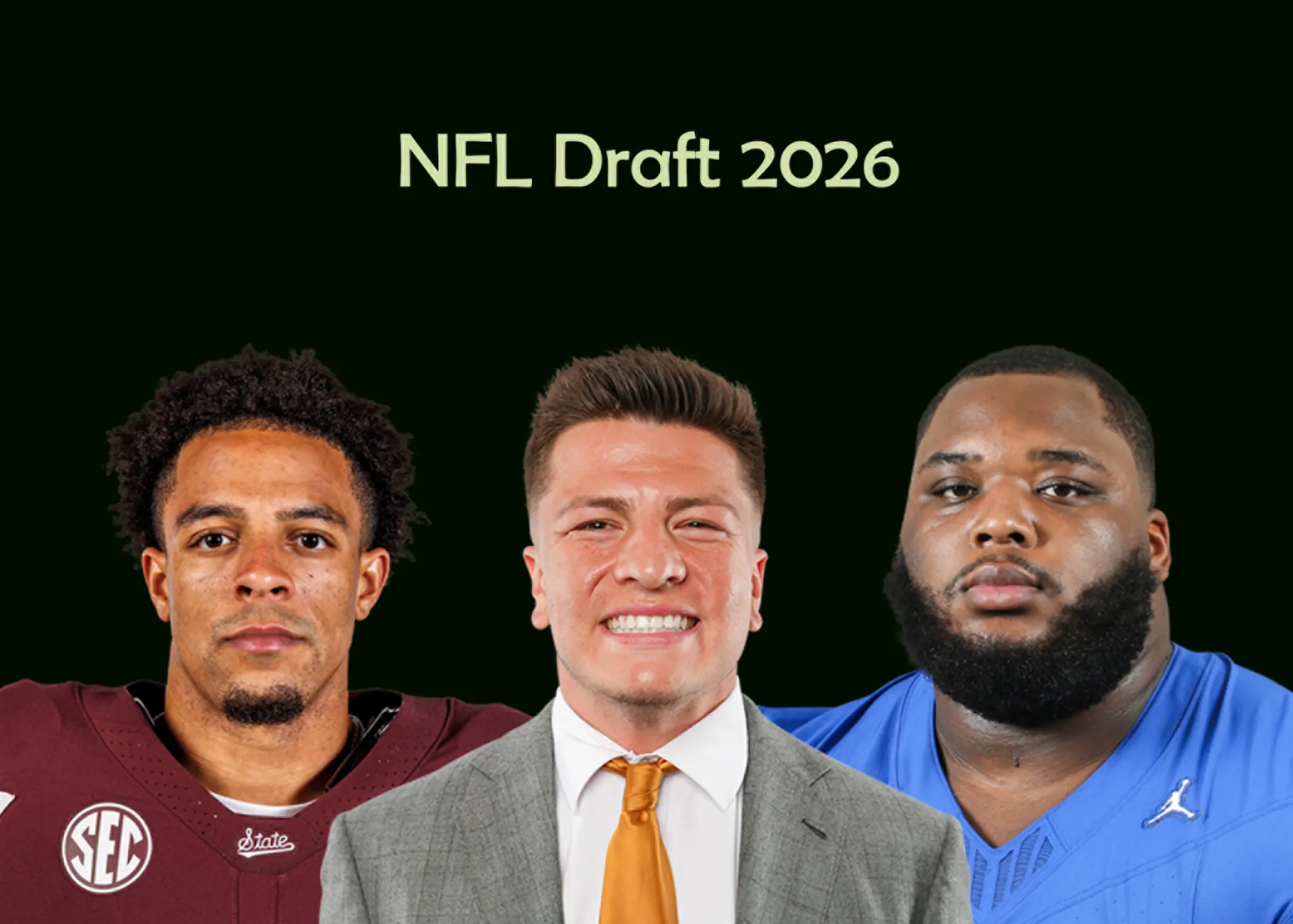
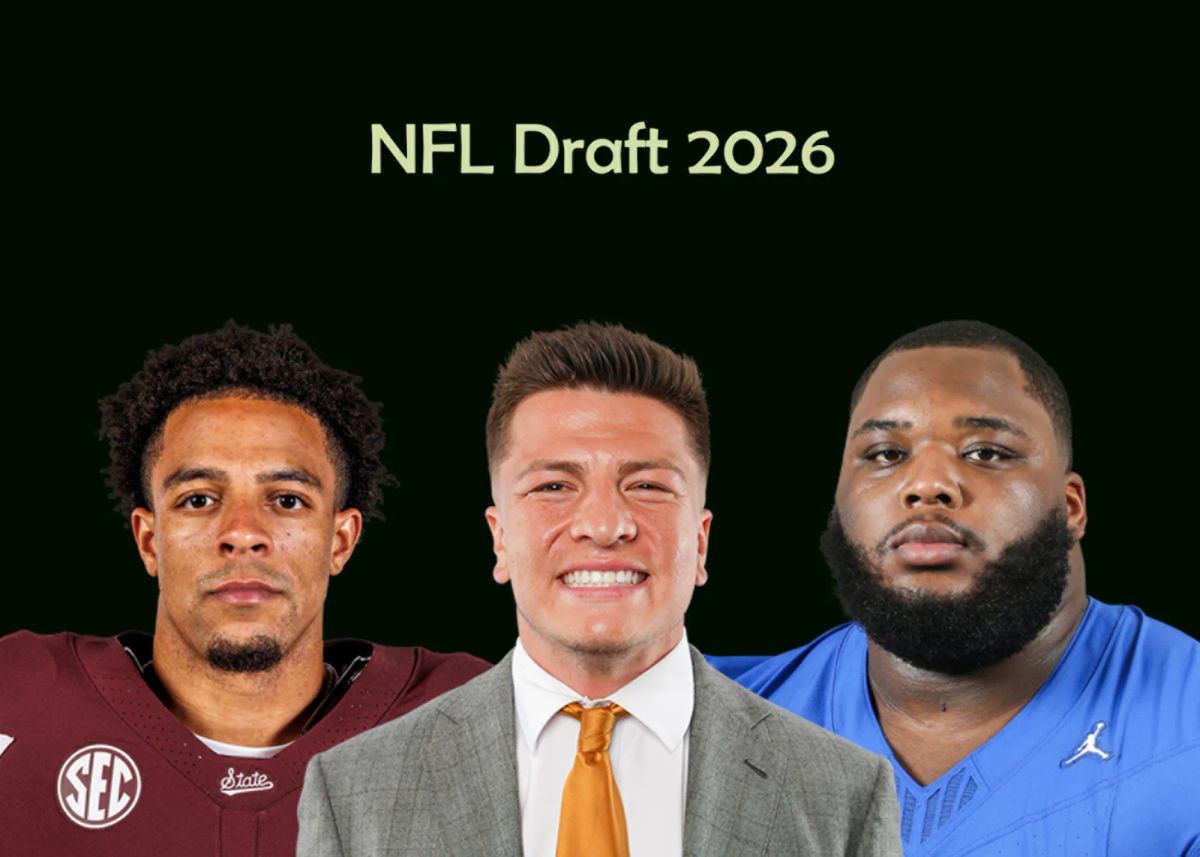
Pavia turns 24 in February. Apropos of nothing, he looks like he’s about 40 years old. That’s him in the middle on the title card for this feature, looking like the Sales Manager of the Month at your local Nissan dealership. If I told you he was the Titans’ new passing game coordinator, you would probably have believed it.
I’m used to Senior Bowl prospects either looking like grizzled hill giants or younger than my own kids. (Many of them are now younger than my eldest.) I have never seen one who looks like he could be standing behind me holding his Cologuard box at the UPS store.
Perhaps Pavia’s wizened countenance gives him extra gravitas; his teammates mistake him for a player-coach.
Or maybe battling the NCAA just adds years to your life.
Florida defensive tackle Caleb Banks moves like a fir tree that got ripped up by a tornado. He’s 6-foot-6, wears 330-ish pounds like Armani, and has branch-like arms that never stop swimming and swiping.
Banks looked like a first-round pick in 2024, with standout games against LSU (most of whose offensive line is now in the NFL) and Ole Miss. But he missed most of 2025 with a foot injury, suiting up briefly at the end of the season for a bad Gators team that had already fired its coach.
This is traditionally where I pause and ask you if the preceding summary was sufficient to your needs as a reader, fan and draft semi-enthusiast. Huge, long-armed, nimble, foot injury: you have the picture, right? When I eventually write a longer draft profile for Banks, I may add some stats or a quote, but I promise to not write 800 words about hip torsion or rip-dip-blip moves. One reason I travel to the Senior Bowl, in fact, is to hear from the prospects and come away with a quote or two.
Banks probably would not have attended the Senior Bowl if he stayed healthy in 2025. The event represents a boots-on-the-ground reality check for NFL evaluators. He’s here. He’s healthy enough to draft. Banks is the kind of player who performs a handful of “pit drills” against offensive linemen, then suddenly disappears for “personal reasons” if he performs well.
Whatever. Just make him available to the press. And one viral video from the pit might be worth more than 1,000 words.
Indiana wide receiver Elijah Sarratt was officially on the “National” Senior Bowl squad until late last week, when he not-so-mysteriously vanished.
Senior Bowl rosters used to be separated into North and South, until someone realized that was a horrible geographic way to separate college football programs. (Oklahoma and North Carolina players had to be on the North squad to make it work.) East and West is the Shrine Bowl’s IP; no reason to make that turf war any nastier. The new, arbitrary classifications, like most of what the Senior Bowl has done for the last six or seven years, are designed to make everything as confusing as possible for those of us trying to cover the event.
Anyway, Sarratt caught three passes in the Hoosiers’ National Championship win over Miami last Monday night and went 14-143-3 in the playoffs. He may be a first-round pick. He may show up for weigh-ins and interviews. NFL teams won’t hold a declined invitation against him; “gassed after winning championship” is an excuse they can all accept.
Back when Phil Savage ran the Senior Bowl, from 2012-18, he often publicly shamed prospects who didn’t respond to their Senior Bowl invitations. To be clear: Savage did not shame anyone who notified the event organizers that they were bowing out for any reason, just the no-show, no-call types. Savage made sure we all knew who blew him off, announcing their names one-by-one before weigh-ins (which used to be a media event). Savage sounded exactly like the spinster aunt who did not get a thank-you phone call for the five bucks she sent for your birthday, and henceforth made donations to the ASPCA in your name instead.
Savage stopped the Roll Call of Shame by about 2014. It got the “OK Boomer” treatment from lots of folks who covered the Senior Bowl; the 20-somethings who drink until dawn at Veets don’t want to hear about some all-conference behemoth’s failure to RSVP on the proper stationary. As the college football playoffs expanded into mid-January, more and more players had to decline at the last minute, making it even sillier to hold old-fashioned points of etiquette against anyone.
I am thinking about Savage because of what Captain Ake (Holly Hunter) told her new cadets at the start of the second episode of Star Trek: Starfleet Academy: “If you want to save the galaxy, start by making your bed.” Apparently, Boomer logic survives into the 32nd century! Some old-timey wisdom really does apply to life’s endeavors. If you want to succeed in the NFL, sweat all of the details, or at least hire someone to sweat some of them for you.
None of this has anything to do with Sarratt. This is the time of the NFL season to free-associate: past, present and distant future crashing together as the college all stars gather in Alabama just as the conference champions assemble in California.
Penn State running backs Nicholas Singleton and Kaytron Allen will both practice with and play for the National squad this week.
It makes sense for college teammates to play for the same squad in an all-star game, which may be why the Senior Bowl abandoned that simple concept for the last five years or so. College teammates wearing the same helmet at the same position can cause confusion for those of us watching practices with crippling hangovers deteriorating eyesight, but anyone who watched the Nittany Lions for the last four years has gotten practice telling Singleton and Allen apart.
Singleton is tall, sculpted and sleek. Allen is all hips and glutes. Singleton soars when he reaches the open field. Allen runs like a warthog in the brush. Singleton and Allen shared carries almost down the middle for three-and-a-half years before Drew Allar got hurt and James Franklin got dismissed midway through 2025. Allen became the workhorse when the Nittany Lions pulled themselves together late in the year.
Allen is Penn State’s all-time rushing leader. Singleton ranks fourth. Allen rushed for more yards than Saquon Barkley. Both Allen and Singleton outgained Curt Warner, Blair Thomas, Ki-Jana Carter, Curtis Enis, Franco Harris, Lydell Mitchell and many other legends. Yes, college seasons are longer now, and many of those great rushers of yesteryear either turned pro early or were forced to wait their turn. (Freshman were also ineligible in the Franco/Mitchell days.) But Singleton and Allen battled for carries for four solid years. And Allen, the less toolsy of the pair, is the one who came away with the rushing title.
Singleton will be a second- or third-round pick based on traits, production and versatility. Allen intrigues me because I predict that his 40 times are going to be slow. Singleton was the more active receiver at Penn State, so Allen needs to show off his pass-catching chops. There’s no tackling at Senior Bowl practices, so both backs must demonstrate their physicality in other ways, like blocking drills. Allen, the bruiser of the pair, can assuage worries about his speed by thumping a few linebackers.
You will hear a lot about Singleton and Allen this week. Heaven knows I will, too: I’m sharing a hotel room with the Nittany Lion mascot himself. I’m eager to watch both of them, but I’m rooting for Allen. He’s the “little guy” of this duo, and it’s fun to watch him root out yards that don’t appear to be there.
Mississippi State wide receiver Brenen Thompson is so fast that he sometimes has to slow down to wait for the ball to arrive. Thompson was a high school track star; he won a Texas state championship with a 21.27-second 200-meter dash.
I couldn’t really gauge Thompson’s speed during preliminary film study until Blake Shapen overthrew Thompson slightly on a deep shot up the left sideline against Florida. Thompson shifted from fifth to sixth gear to fetch the football. Receivers, remember, don’t often run routes at 100% speed, because that would make it hard for them to cut or adjust to coverage or the throw. Thompson has a gear that even most speedy wide receivers lack.
Thompson also tracks the ball well and will work the middle of the field. He’s not the kind of one-dimensional sprinter that sets off my Jalen Reagor alarms.
Thompson started his NCAA career at Texas in 2020. He then spent two seasons at Oklahoma, catching just 26 passes. His 2025 season at Mississippi State was his breakout: 57-1,054-6. He wasn’t even a kick returner for the Longhorns or Sooners. That peripatetic collegiate sojourn invites questions.
Sure, Thompson was stuck behind Xavier Worthy and others at Texas. There were injuries at Oklahoma. He followed offensive coordinator Jeff Lebby from Norman to Hattiesburg, so he was portalling into a better situation rather than away from a bad one. It’s just odd to see a receiver with such undeniable speed AND relative refinement need three years and two transfers to finally blossom.
Pure speed is a pleasure to watch in person. I remember when Marquise Goodwin attended the Senior Bowl. There was an audible whoosh when he ran. Up close, in an informal practice environment, you can tell who has everyday, every-play speed, as opposed to the guys who can only run that 4.35 forty in compression shorts on a track after a month at the performance academy.
Thompson also has a reputation as a high-football-character guy, which is the sort of thing that can be hard to track for a prospect who bounces around the nation. “He’s become one of our best leaders,” Oklahoma coach Brent Venables said in 2024. “Incredibly vocal. Really bright young guy that really cares about his teammates.”
Sadly, Thompson disappeared from the Senior Bowl roster sometime during the weekend. I can’t help but wonder if Fern made some of the better prospects decide to hunker down at home.
Cole Payton. Now there’s a quarterback name that you can set your watch to. Three syllables. Chunky consonants. Sounds like a Peyton Manning SNL character who thinks he can write showtunes.
Payton threw for 2,719 yards and 16 touchdowns for North Dakota State in 2025, adding 777 yards and 13 touchdowns. He’s a lefty with an elongated, whiplike delivery and a loping rushing style. Everything he does looks a little wrong until his deep shot up the sideline bends around two defenders to reach his target, or he beats the entire defense – the St. Thomas-Minnesota defense, perhaps, but still the entirety of it – to the end zone by three strides.
At about the 1:45 mark in the following highlight reel, Payton leaps over a North Dakota defender like a gazelle, lands on his feet and keeps going. It reminded me of the time when a deer tried to jump over my uncle’s fence but failed. Gruesome stuff, my uncle told me. That sort of thing is not supposed to happen in suburban New Jersey. What I’m trying to say: Missouri Valley Conference defenders are not the same as NFL defenders. If Payton tries to hurdle NFL defenders without breaking stride, he could end up an impaled impala.
Payton looks like lefty Caleb Williams at times on film. I suspect that he’s more like lefty Easton Stick. But Senior Bowl Szn is also NDSU Prospect Szn. It wouldn’t be late January in Mobile without some guy in a mustard-and-lettuce colored helmet doing what such guys must do before the draft: prove that they belong among the big boys.
At about the 1:13 mark of this T.J. Parker highlight reel, you will find a highlight which does not feature T.J. Parker. At all.
That’s Clemson teammate Will Heldt strip-sacking Furman’s quarterback. Unless Parker and Heldt suddenly changed uniform numbers before the game. And, er, ethnicities.
Parker does not appear to be on the field at all for that play. The announcers credited Parker by mistake, later smoothly shifting to Heldt without admitting the error. The misattributed highlight takes up 30 seconds of a three-minute, 42-second video, which doesn’t leave a lot of room for highlights which actually highlight Parker.
I don’t mean to rip the producers of these videos, who may use some sort of AI audio tools to grab clips. I rely on quick-and-easy highlight reels for preliminary “Who is this fellow?” analysis. The Parker-Heldt confusion is a reminder that draft coverage is a soap bubble. It forms fleetingly, exists delicately, and pops around May 1st, vanishing from our consciousness forever. At the staggering start of this sprint, I’m not the only one who cannot yet tell Parker from Heldt without a program.
Parker is an action figure of a dude who recorded 11 sacks and six forced fumbles in 2024. Veldt outshined him in 2025, recording 7.5 sacks to Parker’s 5.0.
Clemson had a down year, but Dabo Sweeney still had 100 defensive gremlins swarming his roster, so swings in sack production can often boil down to who had opportunities schemed up for them, how often and when. Still, Parker is the kind of defender who benefits from Senior Bowl pit drills: show up, school some offensive linemen, remind everyone that you looked like a first-round pick in 2024.
At the very least, Parker can use some Senior Bowl buzz to make sure that no one mistakes him for a teammate anymore.
For NFL types, the Senior Bowl is an oasis of the familiar on the edge of the shifting, bewildering sands of the modern college football landscape.
College players bounce from team to team and scheme to scheme in ways that were unheard of a decade ago. For NFL scouting departments, that means the players jump from region to region. The Midwest scout barely gets to ask his buddy in the Wisconsin weight room about the kid’s workout habits before the prospect portals off to Arizona State. The Wisconsin spotter might never have gotten to know him in the first place. Did his coaches like or dislike the prospect as an underclassman? Did the kid like or dislike them? Who knows? There was money to be made elsewhere. The coaches left for better jobs, too.
In Mobile, every player gets a hotel room, a playbook, three days of full-speed (more-or-less) practices, about 30 meetings with teams and some stray promotional events. Every team gets to watch each prospect dawn-to-dusk, listens to him interact with new teammates, coaches, reporters and the public, takes accurate height-weight-arm-hand measurements, and sees how he handles himself outside the campus environment. Far from being irrelevant, the Senior Bowl is more important than ever for the types of prospects it has always benefitted: injury cases, small-school standouts, late bloomers, bounce-around guys with complicated histories, and all sorts of future second-to-sixth round picks who need to demonstrate their competitiveness, professionalism and willingness to make their beds.
For me, the Senior Bowl is immersion therapy: a change of scenery to shift gears mentally from last year to next; an opportunity to focus on the draft with no other distractions except Meat Boss; a reason to start assembling notes on prospects like Pavia, Thompson, Parker and others; a chance to pick brains with folks who cover the draft more ardently and hobnob with the handful of NFL mediumwigs who still know who I am (and braved the winter storm to travel to the deep south).
I’m never as prepared as I want to be for the Senior Bowl when I arrive or as prepared for the draft as I hoped to be when I leave. But the Senior Bowl turns a few dozen prospects from images on screens and lines of statistics into flesh-and-blood people in my mind. It helps the draft come to life. And I can’t wait to share some slivers of that life with you in March and April.