Bailey, Bain and Beyond: 2026 NFL Draft Edge Rushers
Finally, a position group to feel good about.
There is no reason to apologize for this class of edge rushers. Except that one of the best ones has really short arms, plus suddenly-revealed character questions. And another isn’t really an edge rusher. And one of the most hyped prospects is already 25 years old. And another recorded just 2.0 sacks in 2025. And some of them are really small …
But seriously, folks: David Bailey, Rueben Bain and Arvell Reese would be Top Ten selections in any draft class, and the field below them is flooded with talented defenders of all shapes and sizes. If your favorite team needs an edge rusher, they’re in luck. If they don’t, they might as well just draft one anyway.
Arvell Reese, Edge/LB, Ohio State
Reese is not really an edge rusher.
That’s not a hot scouting take. It’s a fact. Reese rushed the quarterback 102 times last year. He dropped into coverage 265 times.
When the Buckeyes rushed just four defenders – in other words, when they weren’t blitzing, though this is an oversimplification for database-sorting’s sake – Reese was one of those defenders just 44 times, dropping into coverage 151 times.
That’s a linebacker, folks.
Now, Reese was outstanding when he did rush the passer: 25 pressures and six sacks on those 102 rushes/blitzes. But he was also very good in coverage. He allowed just six catches for 45 yards on eight targets, per Sports Info Solutions.
Reese is also a very good run defender. He’s awesome at the sport of football.
Reese frequently lined up at edge for the Buckeyes, though he was almost as likely to drop into a flat zone as rush the passer from that position. He played lots of off-ball inside linebacker as well; I don’t have actual alignment splits in any database, but watching Ohio State film can be a “find Arvell” exercise.
Every draft analyst will point out that Reese played linebacker in 2025, but I wanted to provide some numbers to show just how much of a linebacker he was. Micah Parsons, the go-to Reese comp, played almost exclusively on the edge at the end of his Penn State career. Reese doesn’t have that kind of college experience. Projecting him to the edge is, quite literally, projecting him.
On the edge, Reese often used a fun little “coffee house” move to evade blockers: he would back-step and pivot as if he were dropping into coverage, then explode when his blocker was feigned into a compromising position. The move worked, in part, because Reese dropped into coverage often enough to impact how opponents prepared for the Buckeyes defense.
Reese was sometimes at his least impressive when playing as a traditional edge. A blocker who gets a direct shot at him can latch on. Reese is better when shooting gaps or operating in space.
Turning Reese into a traditional edge almost feels like a waste of some of the things that make Reese special. If Reese becomes Parsons, such a move will be worth it. If he just becomes an undersized half-dozen sack guy, however, the team that drafted him will have ruined a Pro Bowl linebacker.
I see Reese as an upgraded version of Blake Cashman, or as a blitzier, flashier version of Zack Baun: someone just as useful for making tackles in front of the sticks on third-and-short as for notching sacks. Brian Flores, Mike Macdonald or Steve Spagnuolo could make a superhero out of him. But Reese is also exactly the sort of player the Jets draft, then quickly grow disappointed with because he doesn’t become an insta-fix for all of their woes.
Reese will be pretty damn good no matter what, but he needs creative coaching to unlock everything he has to offer. I hope he gets it.
David Bailey, Edge, Texas Tech
Bailey led all power-5 conference defenders with 14.5 sacks and 80 pressures. He was the star of the Red Raiders’ Zillion NIL Dollar Pass Rush which also featured 2025 transfers Romello Height and Lee Hunter. Bailey recorded 7.0 sacks in his final season at Stanford before the Texas Tech booster club showed up at his door with a briefcase full of rubies.
Some very good collegiate tackles simply could not block Bailey. Arizona State left tackle Josh Atkins, a two-year starter, looked like one of the backups who ended up starting on the Chargers line when facing Bailey, who recorded nine pressures and two sacks against the Sun Devils. Bailey is exceptionally quick in his first three steps and can simply embarrass blockers who don’t set quickly and properly.
Bailey has the usual battery of pass-rush moves and the quickness to work inside. He’s impressive away from the ball. He can disengage from his blocker as a run defender, sifts through traffic and doesn’t give up on the chase. He recorded a few hustle sacks by cleaning up after Height and the others.
Bailey isn’t huge. He can get stuck to blockers if his initial move doesn’t work. He’s not a Garrett/Bosa-caliber prospect. But he will quickly develop into a defender who can provide double-digit sacks, plus hustle.
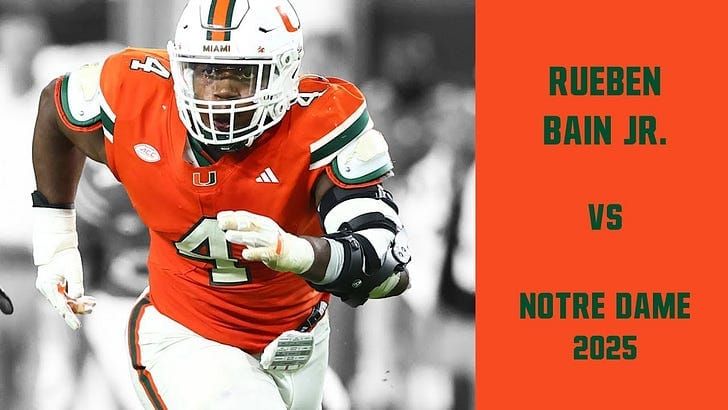
Rueben Bain, Edge, Miami
Watch Bain on the last two plays of Miami’s 2025 victory over Notre Dame, starting at about the 6:48 mark on this cutup. On the penultimate play, Bain wins so thoroughly in his first three steps off the line of scrimmage that he dispatches Notre Dame tackle Aamil Wagner (an experienced team captain) with a little swat, torquing around him to force a hurried throw from CJ Carr.
On the final play of the video, Bain times the snap perfectly. Wagner throws his arm out in an “Oh s**t!!!” gesture and takes an awkward step backward to try to nudge Bain away with his inside shoulder. Bain tosses Wagner aside and is only denied a sack because teammate Akheem Mesidor gets there first.
Those plays neatly summarize Bain’s game: first-step explosiveness; some dip/swim moves that work because he’s on his blocker’s body so suddenly; power, physicality and orneriness; plus a motor that seems to rev higher on critical situations.
(You may have noticed the Winter Soldier brace on Bain’s elbow if you watched that cutup. He played with it for much of 2025. Bain was limited by hamstring issues in 2024 but never missed any time with an arm injury. He called the brace a “comfort thing.”)
Bain finished third in the nation with 76 pressures. In the 2025 playoffs, he recorded three sacks and a blocked field goal against Texas A&M, then 11 pressures (!) plus a sack against Ohio State, then four pressures against Ole Miss, and finally four pressures, 2.5 tackles for a loss and a sack against Indiana. He got better as the season went on and the games got bigger.
Bain recorded just three sacks through Miami’s first 11 games. Consistency could be an issue. He doesn’t always win the NHRA race at the snap, and is much more blockable when he doesn’t.
Bain is also just 6-foot-2, with arms just under 31 inches long. His arm length became a hoary talking point in the endless runup to this year’s less-than-scintillating draft. Bain’s lack of length is worth considering when comparing him to David Bailey. The fact that Bain recorded fewer pressures in more games, and didn’t apply much pressure in the first half of the season, should also be considered when comparing Bain to Bailey.
I think Bain’s arm length does contribute to the blockability that’s often evident on film. It doesn’t disqualify him from being a Top Ten pick or double-digit sack producer in the NFL. Bain’s just stuck at the one position in this draft where there’s enough depth to nitpick.
Bain was involved in an auto accident in which one of the passengers in his car died. Here are the details, as reported by Ollie Connelly, who broke the story at The Read Optional:
Bain, then a sophomore at the University of Miami, was driving on Interstate 95 in Miami at 4 am on 17 March 2024 when his vehicle struck another car before careering into concrete barriers on both sides of the highway, according to police crash records reviewed by The Read Optional.
One of four passengers in Bain’s car, Destiny Betts, a 22-year-old college student from Georgia who was visiting Miami for spring break, suffered incapacitating injuries and was rushed to the Ryder Trauma Center from the scene. She never regained consciousness. Betts died on 13 June 2024, after spending almost three months in a coma.
A second passenger was hospitalized with injuries. Two other University of Miami players were in the car at the time of the crash — linebacker Wesley Bissainthe and Nyjalik Kelly (who later transferred to UCF), both teammates of Bain at Miami and both eligible for the 2026 NFL Draft.
The police crash report states that Bain “operated his vehicle in a careless or negligent manner.” Following the collision with the second vehicle, Bain’s car — owned by a company named Miami Sports 27 Inc — struck the east concrete wall before being redirected into the west concrete wall, where it came to rest. It was later towed after sustaining disabling damage.
No field sobriety test was administered at the scene.
Not to editorialize too much, but … no field sobriety test was administered at a crash which occurred at four in the morning, on St. Patrick’s Day, during spring break? I get the impression that a teensy bit of high-level string-pulling was involved.
The Bain story was effectively buried until last week, when Connelly excavated it. Some NFL insiders took a break from tut-tutting one of their colleagues about journalistic ethics to inform us that teams have known about Bain’s crash for a long time, which of course means that the insiders either also knew or had the means to quickly find out if there was a character issue involving one of the draft’s most talked-about players. But the scoop wasn’t apparently worth the blowback.
From an NFL standpoint, the question is whether the crash represents a pattern of dangerous behavior, vehicular or otherwise. What chance do we have of finding out when it takes two years to uncover a deadly crash? Jalen Carter was drafted with the ninth pick in the 2023 draft despite similar recklessness. Bain may slide a little. He may or may not have learned his lesson. I think he can be a really good NFL player. I just hate the fact that some boosters and agents can hide a story like Bain’s for two years, and that the most powerful/influential people in my own industry are likely to go along with it to get along.
Cashius Howell, Edge, Texas A&M
I will admit to often starting my draft evaluation journey by watching a prospect’s YouTube highlight reel. This admission will likely get me kicked out of the Internet Ball-Knowers Guild once and for all, even though I’m a co-founder. But a January review of a sizzle reel is a quick way to acquire some basic walking-around knowledge of defenders I may have watched for about nine seconds on autumn Saturdays.
A highlight reel can, in fact, contain lots of information. If it’s two minutes long and shows the same sack from three angles, that’s telling you something. If it’s mostly footage of big plays against Prairie Dog A&T, that’s also informative. But if it’s nearly five tightly-edited minutes of SEC offensive tackles whiffing on blocks like they are trying to hit Sandy Koufax’s curveball, that’s also enlightening.
Howell, per the notes I made in mid-January, has what veteran draft evaluators call a Great Googly-Moogly highlight reel. It includes highlights from his two-sack game against LSU, his 2.5-sack, six-pressure game against Mississippi State, and the Utah State game where he recorded three sacks on three consecutive plays. It’s worth watching, because it’s worth a few thousand words.
You will notice that Howell has a freak-nasty dip move that leaves quality offensive linemen grasping at nothing. He has other outstanding pass-rush moves, but I made a solemn vow on my father’s grave to rid the streets of Gotham of draftniks who spend long paragraphs stringing together swim-rip-tug-fluck pass-rusher jargon. Suffice to say that Howell is a bendy man with almost teleportational lateral quickness. He’s not tall or long-armed. But he can extend to swat the arms of quarterbacks that he cannot wallop.
Howell weighed 253 pounds at the Combine but probably played at below 240 pounds. He had some too-quiet games against opponents like Notre Dame and Miami. He can get erased if his first move doesn’t work. He’s an older prospect who turns 23 in April, though with age comes a track record of success: Howell recorded 9.5 sacks for Bowling Green in 2023. (Also, 23 isn’t particularly old by the standards of 2026 prospects.)
The best draft evaluators focus on what a prospect does consistently and well, rather than nitpicking his flaws. Howell frequently beats quality blockers with measurable athleticism and moves.
I was tempted to rank Howell above Rueben Bain, but I will take Bain’s playoff sacks over Howell’s Utah State sacks. Otherwise, Howell appears to have double-digit sack upside and should at least be a situational gremlin in the NFL. There haven’t been many college defenders in the last decade who have put together a more entertaining/impressive greatest hits montage.
Zion Young, Edge, Mizzou
Young is more of an anvil than a hammer. He’s a low-center-of-gravity dive-bar bouncer who gets pressure through power, an initial burst and hard work. He’s a very good point-of-attack defender who stands up his blocker, can shed to make the tackle and doesn’t let tight ends push him around. Young recorded 16 tackles for losses on running plays in 2025.
Young is not a bendy-twitchy dude. Mizzou teammate Damon Wilson was the speed rusher of the combo, and Young will probably be most effective as the rugged complementary edge at the NFL level. But Young could be a difference maker for a team like the Lions that needs an ornery brawler who does the dirty work and punishes opponents who devote too much attention to the superstar on the opposite side of the line.
Malachi Lawrence, Edge, UCF
Lawrence possesses every single tool in Hank Hill’s garage. He’s tall, fast, quick in every way that matters (off the snap, laterally, etc.) and fluid. He has some Gene Kelly dance moves to get around blockers. He hustles to drag down scramblers and make plays in the open field. He’s fun to watch.
Lawrence recorded 36 pressures in 2025. His pressure rate of 16.3% is not terrible, but it does not match his tools and the bottom-of-the-power-5 competition he faced. The Knights spent a lot of the last two years getting beaten up by Big 12 opponents, and Lawrence might not have gotten as many meaningful pass-rush opportunities in 48-9 and 41-21 losses as the raw totals at Sports Info Solutions suggest. Still, it’s important to temper excitement about splashy tape and traits with some sobering data.
There was a fourth-down play against Kansas State in September where Lawrence initially got wired to the right tackle (with the help of a chip by the running back), ripped himself free just as Avery Johnson began to scramble, then chased Johnson over the meadow and through the woods as the play descended into recess mayhem. Johnson appeared to slip past Lawrence after backpedaling halfway to Smallville, but Lawrence remained in the quarterback’s blind spot and swatted the ball away as Johnson cocked to throw.
I developed a little draft crush on Lawrence after watching that play, because I can imagine him thwarting some miracle play by Patrick Mahomes or Caleb Williams. That may not be a technically-precise scouting impression, but I don’t work for an NFL team. Don’t yuck my yum.
Derrick Moore, Edge, Michigan
Moore spent four seasons at Michigan. He recorded 5.0 sacks for the 2023 National Champions, though much of his production came at garbage time. He recorded 10.0 sacks and led the Wolverines with 41 pressures in 2025.
Moore is a stand-up edge rusher who wins with his first three steps. He either beats his blocker to the edge and hangs a sharp right to get to the quarterback or uses a power move to topple his still-backpedaling opponent. That’s it: a pure, unadulterated outside move, made possible by ideal quickness and length. That’s the scouting report.
Moore has a poor reputation as a run defender. He played just 184 run snaps, so coach Sherrone Moore may have agreed with that assessment.
Teams should be wary of a college senior relegated to rotational/situational duty, especially for a major program that wasn’t enjoying its best season. But Moore is worth drafting based on his tools/production combination, and he’ll contribute sacks right away if he wins a role for an already-solid defense.
Akheem Mesidor, Edge, Miami
Mesidor ranked third among power five defenders with 64 pressures. Teammate Reuben Bain finished second with 76. Miami played more games than most teams, of course, which contextualizes the high pressure totals a bit. Mesidor’s pressure rate in 2025 (15.3%) is higher than Bain’s (13.9%) because he played fewer snaps. Early in the 2025 season, Mesidor often out-produced and upstaged Bain as a pass rusher.
Mesidor turned 25 on Easter Sunday. He spent two seasons at West Virginia and four at Miami. He underwent foot surgeries at both schools, on both feet. He’s shorter and squattier than the prototypical edge rusher. He’s relentless, possesses great lateral quickness and can win leverage battles. But 2025 may have been Mesidor’s “man-among-boys” season, with an assist from an elite-prospect partner in Bain.
Some analysts consider Mesidor a defensive tackle, or at least list him among the linemen instead of the edges. He’s too small by about 25 pounds to be anything but a situational 3-tech inside. Mesidor fits best as a rotational edge.
I don’t trust the tape when it comes to Mesidor: the age, injuries, background and measurables suggest a rugged role player, not a star.
T.J. Parker, Edge, Clemson
At about the 1:13 mark of this T.J. Parker highlight reel, you will find a highlight which does not feature T.J. Parker. At all.
That’s Clemson teammate Will Heldt strip-sacking Furman’s quarterback. Unless Parker and Heldt suddenly exchanged uniform numbers before the game. And, er, ethnicities.
Parker recorded 11.0 and six forced fumbles in 2024. He recorded just 5.0 sacks last year. Heldt recorded more sacks (7.0) last year, and out-pressured Parker 47 to 44.
Parker recorded 49 pressures in 2024. The fact that his pressure rate didn’t change much suggests that his 2024 big play totals were an outlier.
Parker is built like a Todd McFarlane drawing. He’s quick, tough and alert away from the point of attack. He dropped into coverage now and then and can handle flat-zone responsibilities. He’s not an elite first-step winner. He lacks sexy moves. He made one or two splash plays during Senior Bowl drills, then disappeared; it was almost a microcosm of Parker’s last two years in Clemson.
Parker’s 2024 production placed him in the first-round picture before the 2025 season began. I fear he may still be higher on media draft boards than real draft boards based on reputation. The mixed-up highlight reel above illustrates the problem: Parker wasn’t even the best pass rusher on his team in 2025. He’s a Day Two draft prospect with limited upside.
R Mason Thomas, Edge, Oklahoma
The “R” in Thomas’ name stands for nothing and therefore does not come with a period. His parents weren’t pirates. He doesn’t need to add an imaginary extra letter to his name for the purposes of joining some filmmaking union. (Fun fact: the “J” in Michael J. Fox stands for “Andrew.”) Thomas’ family just came up with a fun new way to cause formatting chaos. Let’s just bring on the names with numbers and ASCII symbols now. I survived l337speak. I’m ready to write scouting reports for R M@$1 T#0&s.
Thomas may be best known for dragging a Tennessee tight end – I believe it was Mike Kitselman – about 20 yards en route to a touchdown after a fumble recovery. Unfortunately, Thomas pulled a hamstring on that play and missed some time.
Thomas is an undersized disruptor with some rule-of-cool highlights. He’s at his best when jamming a fist into a blocker’s chest and steering him. Thomas is often the first player off the line of scrimmage, and he hits the ball carrier or quarterback like he’s diving into a pool. He had an impressive two-sack game against Texas, though what could have been a big tackle for a loss turned into a long gain when Tre Wisner ripped through Thomas’ arm tackle in the backfield.
Thomas’ pressure rate (13.9%) isn’t spectacular. Sooners coaches were careful to rotate him, even when healthy. Size limitations will limit his NFL role. But Thomas has enough quickness and juice to be scary on the right team and in the right role.
Keldric Faulk, Edge, Auburn
Faulk is a 276-pound Renaissance statue of a defender with an A++ character reputation and just 2.0 sacks in 2025.
Faulk also recorded just 31 pressures in 294 pass rushes. Teammates Keyron Crawford (also a 2026 prospect) and Xavier Atkins (an underclassman) outproduced Faulk as a pass rusher, so this is not a case of a defender getting all the blocking attention while playing for a weaker program. Faulk is simply not very quick and lacks ideal base strength. He’s pretty smooth technically, but when he wins, it’s usually due to an athletic mismatch against a blocker not destined for the NFL.
Faulk doesn’t turn 21 until September. He played both 3-tech and edge at Auburn and can probably start his career as a useful rotation lineman. A big, young, versatile, coach’s dream-type defender is likely to stick in the NFL for years and could develop into a special player. But Faulk is really high on some media boards. Sometimes, we can get carried away with the projections and intangibles and lose sight of the fact that an edge rusher finished fifth in sacks on a five-win team.
Romello Height, Edge, Texas Tech
If Jack Skellington were a standup edge rusher, he’d look a lot like Height: a lanky, leggy, twitchy rubber-band man whose pass-rush moves operate according to cartoon physics.
Height’s pass-rushing arsenal features rips, dips, head fakes and just about anything else you can imagine. Sometimes, he gets almost two-dimensional and knifes past his defender. Other times, it looks like someone pushed all the buttons on the PS5 controller at once, and there are arms and legs everywhere. Height could end up on the ground, or extending like a shot-blocking forward on the wing, or lassoing the quarterback with his arms. There were a few times against Arizona State where I swear he did all three on the same play.
Height, who turns 24 right around when this feature should be published, portalled from Auburn to USC to Georgia Tech before getting scooped up in Texas Tech’s 2025 NIL shopping bag. He shared the Red Raiders line with David Bailey, a more traditionally sized-and-shaped defender. Coaches made sure to keep Height away from head-on blockers as often as possible as a stand-up Wide-9 rusher. If Height is forced to set the edge as a run defender, the edge might wind up in the media parking lot.
Height weighed 234 pounds at the Senior Bowl but reached 239 pounds at the Combine. He probably played at under 230 pounds. Height may never reach 250 pounds without sacrificing the quickness that makes him special. He’s rather old to be trying to change his body shape.
Height will probably max out as a nickel-package rusher; he showed just enough awareness in some coverage reps to make him useful there.
Joshua Josephs, Edge, Tennessee
Toolsy McTraitsface. Josephs has 34.5-inch arms and moves like a small forward. He wins with lateral quickness, using impressive footwork to dust blockers. He forced three fumbles in 2025. His arms make him a potential ball-stripping, shot-blocking weapon.
Josephs weighed 242 pounds at the Combine; that may be his max weight. Tennessee coaches lined him up split so wide that he sometimes looked like a slot cornerback, and they rotated him carefully. He doesn’t offer much as a point-of-attack run defender.
Josephs is so toolsy that he could end up leaving the board early in the second round. He could develop into a real sack monster in a system that allows him to stand up in a wide-9 alignment and just chase quarterbacks 20 times per game. But Josephs could also end up just another lanky, undersized backup.
Lebbeus “L.T.” Overton, Edge, Alabama
Overton should be better. He’s a former five-star recruit who started for two years at Alabama after portalling from Texas A&M. He’s a thumping 276-pounder. But 20 pressures in 235 pass rushes in his senior season? Not great.
Overton lacks initial quickness and pass rush moves. He wins with pure strength and grrrr, plus fine athleticism for his size. He sets the edge well and shows promise as a run defender.
Overton fits best as a rotation lineman who could play on the outside on early downs but move to 3-tech in some pass rush packages. It’s not clear how much upside he has after four college seasons of limited sack production. He may get overdrafted based on his recruiting status and program pedigree.
Anthony Lucas, Edge, USC
Lucas recorded 3.0 sacks in 2025. One of those sacks came when Nebraska’s backup quarterback fumbled a loose shotgun snap and flopped on it. So you know we have reached the traits-and-projections section of this list of edge rushers.
Lucas moved all over the USC line, sometimes playing 3-tech at a trim 253 pounds. He has the body type of a young Jadeveon Clowney: a barrel chest, extend-o-arms and other Create-a-Player traits. But Lucas lacks ideal quickness and fancy moves. He’s not a brawler. He recorded just 27 pressures and four tackles for a loss in 2025, resulting in a scant sizzle reel.
Lucas has Day Two tools but Day Three stats and film. He’ll start his career as a rotational lineman. Some team may draft him too early and try to unlock him.
Gabe Jacas, Edge, Illinois
Jacas recorded 11.0 sacks in 2025. Two of them were unblocked sacks. A few others were hustle-and-chase sacks. Jacas recorded just 37 pressures. His pressure rate of 12.9% ranked 110th in the nation.
Jacas was most effective as a stand-up rusher who either tried to beat his blocker around the edge or worked inside on stunts. He’s not bendy, tricky or lightning-quick. He’s a heads-up defender on screens and options, and he played the point of attack well against the run. He was feisty and hard to handle at the Senior Bowl.
Jacas started for the Illini for four years. His pressure production went up every year. He’s not a double-digit sack threat in the NFL, but he’s a safe pick who can contribute to a defensive line rotation.
Nadame Tucker, Edge, Western Michigan
Tucker started his college career in 2020. He played for two different jucos before spending three years as a bit player on the bench at Houston before exploding with 13.5 sacks last year at Western Michigan. He turns 26 on Father’s Day.
The preceding paragraph painted a pretty clear picture of an athlete peaking as a full-grown adult playing at the midmajor level, didn’t it?
Tucker has some tasty film. His 20.0% pressure rate is very good, but not good enough to get me excited about a 25-year old one-year MAC conference wonder. If it was 25% and/or he ran that 4.73-second Combine forty at 274 pounds instead of 247 pounds, I might be tempted to rank his as more than a Day Three scratch-off ticket.