Five Signature Moments from Rams History
You can probably guess what #1 is. But what Moment truly signifies the 2020s Rams? And will Jim Everett stumble onto the list?
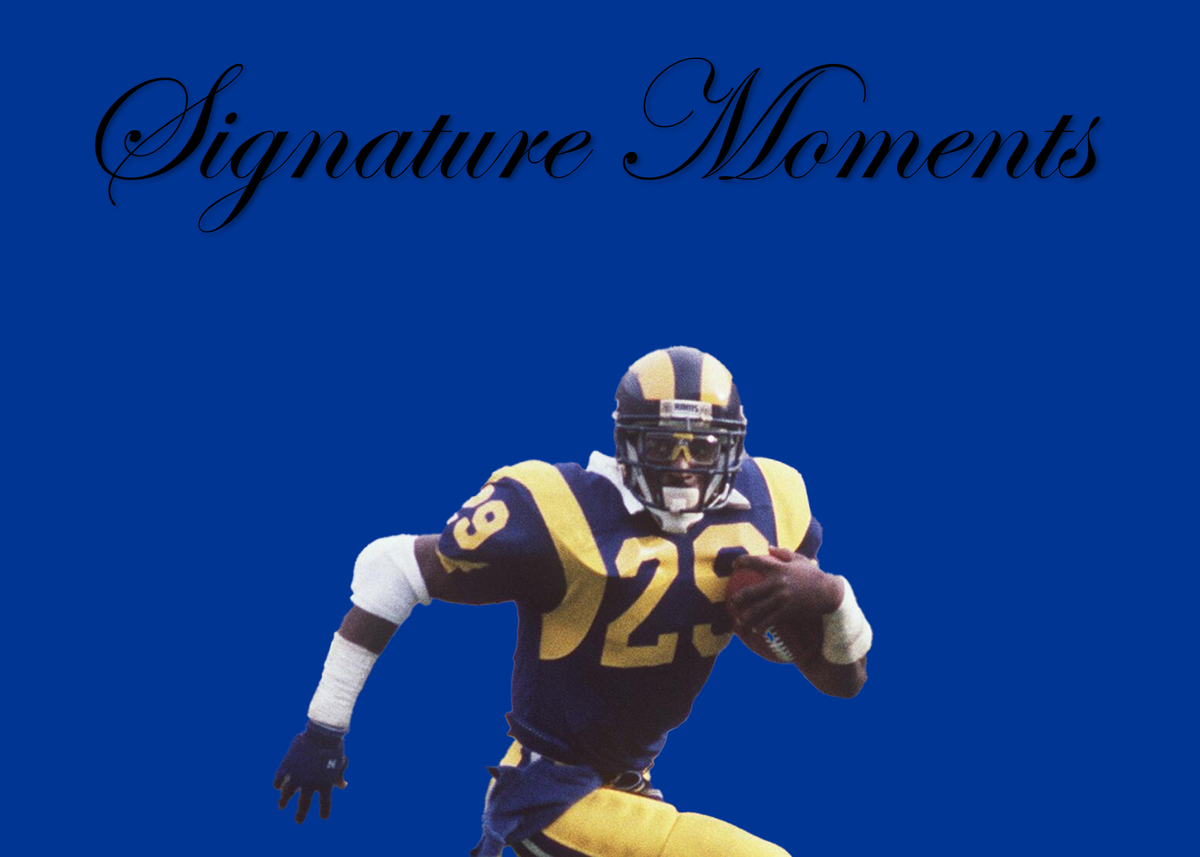
The Cowboys may be America’s Team, but the Rams are Hollywood’s team. And what could be more distinctly American than Tinseltown itself?
The Rams went Hollywood not long after they left Cleveland for the West Coast in the late 1940s. Their quarterbacks married the world’s most glamorous women. (Yes, Bob Waterfield and Jane Russell were high school sweethearts. But still ...) Their 1950s roster, like the cast of a matinee serial, was populated by men like The Flying Dutchman and Crazy Legs.
The Rams embraced the gritty New Hollywood in the late 1960s and 1970s, but their tough guys ended up portraying prairie preachers. They bottomed out in the 1990s, went back to the sticks, then reinvented themselves as the Greatest State Fair in the Midwest, don’t miss it for the world.
Now, the Rams are back in Los Angeles as paradigm-breaking bitcoin billionaires, stylishly predatory boomtown know-it-alls that you either love or love to hate. They don’t always win – like modern Hollywood productions, they often end up victims of their own excess, with disappointing final reels – but they know how to command your attention.
Rams history, in other words, is rather unruly and hard to narrow down into a handful of signature moments. It’s hard to even do the last eight years of Rams history justice. Heck, the last six months have been a lot. So let’s start with the present, which is something of a golden era for the Rams, then frame the rest of the story as a series of Hollywood flashbacks.
#5: Beach Drafting Bingo and the F**k ‘Em Picks Parade
When you close your eyes and picture the 2020s Rams, what do you see? Perhaps Aaron Donald twisting Joe Burrow to the turf at the end of Super Bowl LVI. Or Matthew Stafford surgically slicing up some defense with the help of Puka Nacua or Cooper Kupp. Maybe you picture Sean McVay posing like Alexander the Great in a headset on the sideline, or Stafford and the Rams coming up just short in playoff losses to the Seahawks or Eagles.
But you might also picture McVay and Les Snead swanning around a Barbie Dream House after trading all their draft picks away.
The infinity pool glistened in the coastal sunshine. Flames in the fireplace accented the immaculately staged modern living room. And sleek desks, computer monitors and TV screens filled other airy rooms in the sprawling Malibu house where the Rams plan to conduct the NFL draft.
The only missing on-site element Tuesday for a predraft news conference?
Coach Sean McVay and general manager Les Snead.
On Monday, both were exposed to a person who had COVID-19, McVay said, so the scheduled in-person event at the showcase venue was conducted with McVay and Snead answering questions from their homes virtually.
“Just following the protocols,” McVay said on a videoconference call. “We wanted to be smart and, hopefully, as long as we remain asymptomatic and our tests come back negative … we’ll be able to have fun.”
The Rams — for the fifth consecutive year — do not have a first-round pick in the draft, which begins Thursday in Cleveland. Barring trades, the Rams’ picks are No. 57 in the second round, No. 88 and No. 103 in the third, 141 in the fourth, 209 in the sixth and 252 in the seventh.
McVay said he and Snead still plan to conduct the draft in Malibu if they remain asymptomatic and continue to test negative.
“As long as that’s the case, we’ll be able to get it going on Friday,” McVay said. “Don’t expect much action from us on Thursday unless we maybe trade up into the first round, which, knowing Les and the Rams, you never know.” – Gary Klein, L.A. Times, April 27, 2021.
Yes, the Rams Draft Party House was at least partially a COVID thing; coaches and GMs got a taste for drafting from home in 2020, and the Rams ran with it. Still, renting out a tricked-out beach house – with the eager assistance of a corporate sponsor, of course – was a brash bit of football sacrilege. How dare the Rams turn the oh-so-serious draft war room into a swingin’ bachelor pad?
The Rams paid for their impudence with a Super Bowl nine months later. Snead leaned into the bit by wearing a F**k ‘Em Picks tee-shirt to the parade. “Does the man make the meme, or does the meme make the man?” quipped Joe Rivera at The Sporting News.
In fact, the meme made the team. The Rams have stayed atop the standings, as well as one step ahead of any cap consequences, since that 2021 draft-day spring fling. Their beach houses have become as much of a tradition as the annual blockbuster trades that turn Rams draft weekends into glorified vacations.
Snead and McVay might not really have traded for Myles Garrett last month while watching the sun set over the Pacific from the side of a sparkling infinity pool with a pitcher of mojitos close at hand. But it’s very easy to imagine that they did.
#4: "We Will Rally Around Kurt Warner"
The St. Louis Rams' chances for a turnaround season took a major hit when quarterback Trent Green tore both ligaments in his left knee Saturday night, knocking him out for the year.
"It's scary," Rams coach Dick Vermeil said. "The whole sideline, you could feel it within every football player on the team, and we're all concerned."
The Rams' backup quarterback is Kurt Warner, who has played in one game as a reserve in his career, a mop-up role in the season finale last year at San Francisco.
"It's tough to really be excited to be the starter in this situation," Warner said. "I'm just going to try to fill his shoes the best I can." – AP Story, August, 1999.
Trent Green’s injury, and Kurt Warner’s ascendance, wasn’t much of a story at the time. Neither quarterback was very well known, and the Rams had stunk for all of the 1990s. Dick Vermeil was not a living legend, but a coaching retread who had spent years in the college broadcast booth. Green's injury took place at the end of the preseason. It made about as much news as a Jacoby Brissett injury would make if it happens next month.
Dennis Quaid played Vermeil in the Warner biopic American Underdog, and we should pause for a moment to note that two major American actors have portrayed Vermeil in sports inspirationals. (Greg Kinnear played Vermeil in Invincible.) The press conference scene at the end of the following clip may be a wee bit exaggerated, with dozens of well-dressed reporters shouting and waving as if Quaid's Vermeil was about to pardon Richard Nixon. I attended St. Louis Rams press conferences; their press pool consisted of about eight people, many of whom dressed as if they also carried a bindle on a stick. Vermeil’s quote – “We will rally around Kurt Warner, and we will play good football” – was just an ESPN soundbite, met by most fans with an indifferent shrug.
From such humble origins sprang the Greatest Show on Turf, a whirlwind of touchdowns and vibes that swept briefly and recklessly across the NFL. The Rams rose from nowhere to win the Super Bowl, a grocery clerk from Podunk became an American underdog, and the NFL entered the thrills-per-second Internet era. Then Vermeil vanished in a pool of bubbles and tears, Warner got injured but rose again, and the Rams made it back to the Super Bowl, only for Tom Brady and the Patriots to steal their crown, forever. If you blinked, you missed it. Fortunately, no one dared to blink during the Greatest Show on Turf.
We’ll revisit the 1999 Rams at the end of this feature. A quarter-century later, they sound like a tale told by a corny screenwriter: heartland hokum from Hollywood hacks hoping that it will play in Peoria. But it all happened. And it was stranger, as well as more beautiful, than any fiction.
#3: The Phantom Sack Menace
Jim Everett had agreed to view videotape of that play --the phantom sack in the 1990 NFC championship game--that defining moment for those who think the Rams’ foundation for success now rests on a shaky quarterback.
The Rams provided the VCR and the office, and upon arrival, Everett closed the doors.
“Leave the tape recorder on,” Everett said. “I want all this on the record.”
A week earlier, an easygoing Everett had accepted this invitation without a fuss. But the quarterback, who some might consider skittish in the pocket, was on the offensive.
“What we’re doing is going back 3 1/2 years to a point in a period of time,” Everett said. “What I want to know is how much research has been done? How many other films have been watched? What’s the score when this happens? What period is it?
“You want me to explain about one section, one period, one moment in time. Call it fair, call it unfair, I don’t really care to be judged on one section. I think every pro has had great moments and has had down moments. I’m not requiring you to do the highlights of Jim Everett’s career--that’s bull, too.
“All I’m asking before we would ever watch this, is yeah, people have said this and people have said that, but how did we make it to that game? How did we get there? How did we win the game before it? How did we win the two games before it? Those type of questions I ask before we get to that.
“What kind of things were happening all around us? What kind of things--which you don’t have the answers for and ones I won’t talk about--were happening with my personal life?”
The videotape was cued to that play and Everett sat directly in front of the television. But the VCR remained off.
“Right now, I’m about ready to set all the Ram records,” Everett said. “I’m the best passer the Rams have ever had. I don’t know about watching this film right now. I’m sitting here, and that’s why I want this to be on the record right now. – T.J. Simers, L.A. Times, September 3rd, 1993.
Who in the Rams PR department greenlit the interview quoted above? What did Everett think he was going to accomplish by rehashing the Phantom Sack with Simers, a notorious shit-stirrer? You can hear Simers cackling between the lines in the quotes above as Everett demands a hundred feet of rope and ties his own noose. You should follow the link and read the whole interview. It’s as cringe-inducing as the Phantom Sack itself, a portrait of shattered confidence and a catastrophically-ruptured ego.
Before the Phantom Sack, Everett was one of the NFL’s hottest young quarterbacks, and the Rams had been a playoff-relevant franchise for most of the previous 25 years. But the Phantom Sack, punctuating a 30-3 loss to the 49ers in the NFC Championship Game, was like a movie that bombed so badly that it both ruined a film franchise and got the leading man kicked out of Hollywood. The Rams exiled themselves to St. Louis a few forgettable years later. Everett became the NFL’s Jared Leto, a former hunky Oscar winner relegated to playing villainous buffoons in kiddie movies.
The Phantom Sack marked the end of an era of Rams football. It also helped jumpstart the era of the national sports gadfly, and of clowning on quarterbacks as a content model. Every C.J. Stroud who stinks up a playoff game now lives in the world that Everett manifested by tumbling untouched to the turf on that January afternoon in 1990. Yet, even 35 years later, no one has ever looked as bad as Everett did in that fateful moment, nor reacted as poorly afterward.
#2: The Fearsome Foursome Spills Johnny Unitas
“The Rams’ defensive line is unmatched in pro football, as far as I’m concerned,” said [Colts guard] Sam Ball, who admits he was “thrown into deep water” against [Deacon] Jones in only his third game as a starter.
“They’re not only big, but fast and agile,” [Colts tackle Bob] Vogel said of the Rams. “You block them again and again, and they keep coming. And, they're tall enough to knock down passes even when you block them.”
“They concentrate on breaking down the passing pocket,” said [Colts center Dick] Szymanski. “They don’t blitz much, but they stunt on the line and confuse the running game.”
[Colts guard Dan] Sullivan said that the Rams were hard to chart because of the tackle-tackle and tackle-end games they play to confuse the blocking and get to quarterback John Unitas.
“They want someone to get to No.19 (Unitas),” Sullivan said, “so they create action in front of us in hopes of picking one of us off.” – AP Story, December 14, 1967.
The Fearsome Foursome sacked Johnny Unitas seven times in a 34-10 blowout at the end of the 1967 season to clinch the NFL’s Coastal Division and send the Rams to the playoffs. Unfortunately, the term “sack” had not yet been added to the national lexicon; Rams defensive lineman Deacon Jones would soon popularize the term, enriching the English language. So the Rams, per the game stories of the time, “spilled Unitas for a loss” or “caught” him seven times.
The situation was this:
The Rams had a 10-7 lead but the Colts were coming. A couple of plays before, Unitas had thrown a 34-yard pass to John Mackey and now Baltimore had a second-and-six on the Los Angeles 27.
Unitas dropped back. He spotted Lenny Moore on the right side and cocked his arm. Somebody had hold of John’s leg as he brought his arm back and somebody else hit him as he released the ball.
As a result, the ball had nothing on it. It floated lazily downfield, looking like the football equivalent of a Rip Sewell “Eephus pitch.”
Ed Meador intercepted it and returned seven yards to the Los Angeles 19.
The gentleman hanging onto Unitas’ leg when he threw the ball was the estimable David [Deacon] Jones, all-pro defensive end.
“I made my usual charge outside,” Jones said. “They were down near our 20 so we figured it was going to be a quick pass. I had to make a fast move.
“I got by my man and there was Unitas. I couldn't really hit him the way I wanted to … I was turning his leg, doing everything I could to get him down. Now, of course, I’m happy I didn’t get him down.” – Charles Maher, Los Angeles Times, December 1967,
The original Rams version of a Fearsome Foursome (other teams used the nickname before them) consisted of Jones, Merlin Olsen, Lamar Lundy and Rosey Grier. Roger Brown replaced Grier in 1967. Their defensive line transformed the Rams into perennial contenders in the late 1960s. The players themselves parlayed their stardom into acting careers and pop-culture prominence. (My mother, who knew nothing at all about sports, knew that Grier used needlepoint to relax.)
The Foursome swapped out members throughout the 1970s. They joined the Steel Curtain, the Purple People Eaters and the Cowboys’ Flex Defense, not to mention Denver's Orange Crush, Atlanta's Grits Blitz and Baltimore's Sack Pack, to pummel the NFL into a decade-long offensive drought. "Sack” became a household term, a badge of honor for a new generation of superstar defensive linemen, and (finally, in 1982) an official statistic.
A revamped version of the Foursome, headlined by Jack Youngblood, Fred Dryer, Larry Brooks and Mike Fanning, propelled the Rams into Super Bowl XIV, 12 years after Jones and the others spilled Unitas over and over again.
Alas, the original Fearsome Foursome never reached the Super Bowl in their heyday. Vince Lombardi stood in their way after the 1967 season. Tom Landry and Bud Grant barred the gates through most of the 1970s. So the Rams earned a reputation as tough, ornery spoilers who did to your quarterback what the barbarians did to Rome.
A little of that fearsome DNA remains with the franchise to this day. Just ask Byron Young, Braden Fiske, Cobie Turner and a newcomer named Myles Garrett.
Honorable Mention: Dickerson Overruns the Cowboys
This countdown felt naked without Dickerson, a larger-than-life figure from an era when a running back could lay a legitimate claim to being the NFL’s greatest player.
The Rams and Cowboys used to constantly meet in the playoffs. The Cowboys prevailed in 1973, 1975, 1978 and 1980. The Rams won in 1976, 1979 and 1983. But even when the Rams won the battles, they would eventually lose the war, and America's Team (then as now) usually controlled the narrative.
The 1985 season felt different. The Cowboys were in decline. The Rams appeared to be on an upswing. Dickerson, coming off a record-shattering 1984 season, was extending their 1970s brand of rugged old-school football into the MTV era. The Cowboys looked like they were running in wet cement when trying to chase Dickerson in a 20-0 divisional-round shutout.
Saturday, Eric Dickerson propped up a few cherished records in front of him and plowed through them like so many pins in a bowling alley.
The very words, two hundred forty-eight yards, on thirty-four carries, will taste sweet on his lips for years to come.
And how happy it makes Dickerson that he was the one chosen to wreck a page in the Cowboy media guide. “I respect Dallas, they’ve always been a great football team, but I never have been a fan of Dallas,” Dickerson said. “Some might think that’s funny because I’m a native of Texas. But, as a kid, I always used to say that I’d love to play against the Dallas Cowboys.”
On Saturday, though, he rather toyed with them. There were two touchdown runs – one up the heart of America’s Team for 55 yards with 14:39 left in the third quarter and another 40-yarder around right end early in the fourth.
It was enough to send Coach John Robinson into poetic bliss.
“He played as great a game as I’ve ever seen a man play,” Robinson said. – Chris Dufresne, L.A. Times, January 5th, 1986.
Dan Marino was setting new passing benchmarks at the time. Joe Montana was rewriting expectations. The Bears and Giants were rising to prominence as spiritual successors to the Fearsome Foursome. But maybe, with Dickerson as their drivetrain, the Rams could finally enjoy the success that kept eluding them in the 1960s and 1970s.
It wasn’t meant to be. The Bears trounced the Rams 24-0 in the next round of the playoffs, then shuffled off to the Super Bowl.
Dickerson, a dedicated capitalist and a bit of a diva, would win one more rushing title for the Rams before forcing a trade to the Colts. It soon became clear that giving any running back 400 carries was no way to run a championship-caliber offense. For a few hours, however, Dickerson and the Rams looked like they were riding the wave of the future, even though they were really closing a chapter on the past.
#1: The Tackle
As its nickname suggests, The Greatest Show on Turf was a circus. It arrived suddenly, left us breathless for what felt like a summer evening, then vanished in a cloud of sawdust.
Most of us encounter the circus (or carnival, county fair, whatever) in childhood and remember it as a sugary blur of almost hallucinatory stimuli. That’s how we remember the 1999-2001 Rams, even if we were adults: a roller coaster, fun house, tunnel of love and cotton candy binge, all rolled into one.
Picking out one Marshall Faulk run or Kurt Warner pass would be like singling out one trapeze stunt or lion-taming feat. Faulk, Warner, Isaac Bruce, Torry Holt and the others overwhelmed the senses, as well as their opponents. Their Signature Moment was, in many ways, their entire fleeting collaboration.
Yet the spectacle of the 1999 Rams would feel hollow – and might not even be that well remembered – if not for that perfect minor-key end-note of determination and grit: Mike Jones’ championship-saving tackle of Kevin Dyson at the one-foot line.
Jones, Carter and cornerback Todd Lyght usually play on the left side of the Ram's defense and they always have a rallying cry. During the Super Bowl they decided the one of them had to make the big play of the game. In the second quarter, Carter sacked McNair for a 6-yard loss. Early in the third quarter, Lyght blocked a field-goal attempt. Standing on the sideline before the final series of the game, Jones jokingly told Carter that it was his turn to make a play of magnitude.
Like the other Rams defensive players, Jones was tired. And his ankle "was killing me." A Titans lineman had accidentally stepped on Jones' ankle midway through the fourth quarter. But Jones never left the field. And now came the final, pivotal moment.
As Dyson catches McNair's pass, about 3 yards separate him and Jones, who closes the gap quickly. Dyson doesn't even take two full strides before Jones lunges at him.
"When I reached out and grabbed you," Jones says, "you're going one way and I'm going another. I knew I got a good wrap on you initially with my right arm. I try to bring my left arm around and your momentum swings me all the way around."
When he is swung around, Jones clamps his left hand on Dyson's left leg, just above the knee. It might just as well be a steel trap. Dyson's leg his snared, his forward progress stopped. As if that isn't enough, Jones falls on the back of the leg.
"When you first hit me, I thought I could run through the arm," Dyson says. "I'm thinking, 'If I can get through this ... ' Then all of a sudden my feet stopped."
"You're in if you can get that left leg up because you're going to fall forward," Jones says.
"That's what I needed — one more step," Dyson says. "I couldn't get that left leg moving."
"When I tackled you, I knew you were already down because I had my hand on your leg," Jones says. "I was at about the 3-yard line and I knew you weren't 7 feet tall."
"The middle of the field was so open," Dyson says. "If you weren't there, I would have walked into the end zone ... Even when I was going down, it seemed like that end zone was so close."
"It was, " says Jones, laughing. Dyson laughs too. But with a bit less gusto. – Dennis Dillon, with Mike Jones and Kevin Dyson, The Sporting News, July 3, 2000.
If Dyson scored, the 1999 Rams would have been just another flashy team that fell short: the 1990s Bills, but with less staying power. The Rams needed to prove that they were more than great showmen to become champions.
Warner and Bruce combined for a 73-yard catch-and-run touchdown to break a 16-16 tie with 2:12 to play in Super Bowl XXXIV. That touchdown would have been an extraordinary moment under ordinary circumstances. But Steve McNair, Dyson, Derrick Mason and the rest of Jeff Fisher’s Titans were persistent; in fact, their persistence may have been their only championship-caliber attribute. They matriculated down the field, nine yards at a time, aided by some penalties. For want of a few more inches of forward progress, McNair would have been John Elway, and his grueling battle down the field might have usurped The Drive. But Fate had other plans.
Jones’ tackle provided the perfect capstone to professional football in the 20th century. It distilled decades of tactical evolution and ever-increasing popularity into one moment of sublime sports drama. Everything went as planned for both teams – the play calling, the blocking, the throw, the catch, the coverage, the tackle – and success came down to two athletes battling over one more upright second, one more moment of leverage, a charge for another half a yard.
Football would soon grow even flashier, its biggest plays buried under replay reviews and Byzantine rules, its strategies more inscrutable, its signal-to-noise ratio more cacophonous; the Greatest Show on Turf was already pointing the way to that future with its pinball offense and made-for-TV mythology. But for a moment in January of 2000, there was a receiver, a linebacker, a catch, a tackle, a lunge, a signal, and a celebration. No flags. No replays. No seventh-guessing. Simple, swift, and unforgettable. Amen.
The 49ers are up next. Until then, here's Deacon Jones in his Chargers years for Parkay margarine: