Bijan, Bhayshul & Beyond
If you love RBs, you are bound to love these heaping helpings of stat breakdowns for Bijan, CMC, Kenneth Walker and others!
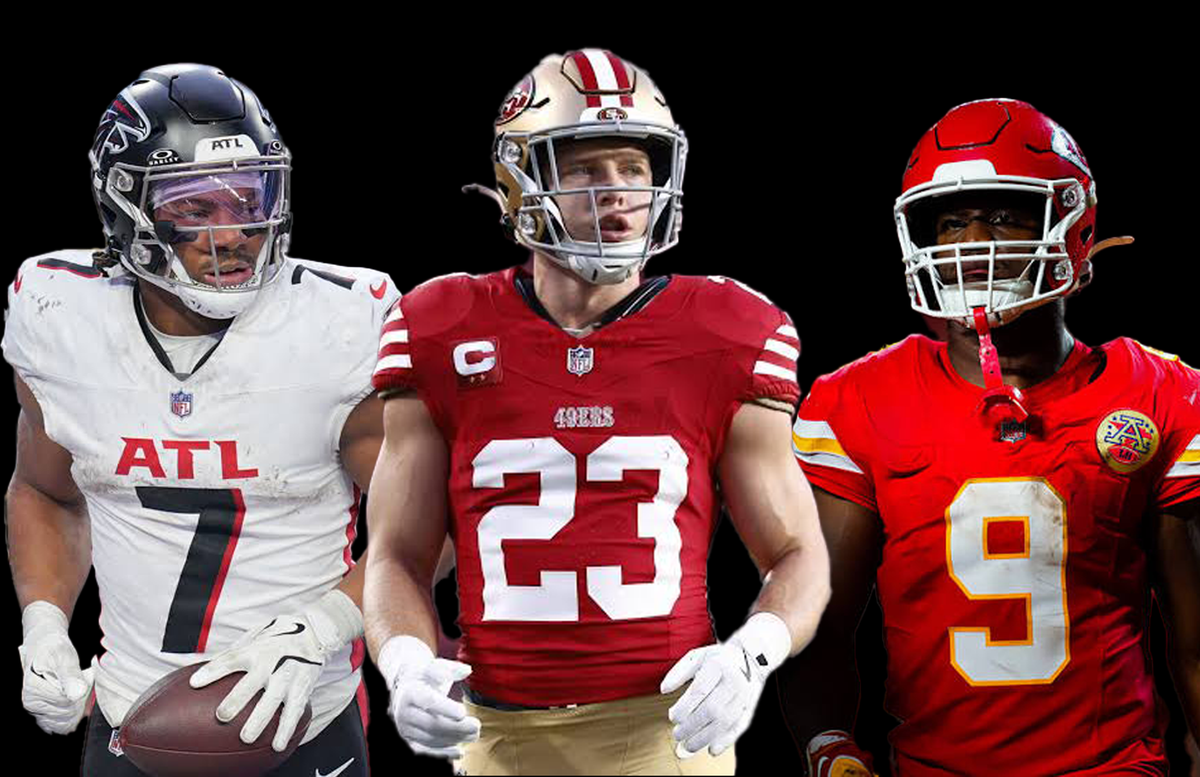
What could be more fun than watching the NFL’s best running backs do their thing: Bijan Robinson’s jump cuts, Derrick Henry’s stiff-arms, Kenneth Walker’s balletic button mashing?
Well, how about a deep dive into the stats of the NFL’s best running backs? That sounds fun, right?
Let’s take a closer look at Bijan, King Henry, Walker, Jahmyr Gibbs and others through a variety of statistical/analytical lenses. How many tackles are they breaking? How many yards are they generating after contact? How much are they being helped by their schemes? Are any of them getting overworked? What are Bhayshul Tuten and Chuba Hubbard doing on this list?
Answering some of those questions can be tricky. Consult four different stat providers, and you may get five or six different answers. I collected the data from this feature from Pro Football Reference, FTN Fantasy, Pro Football Focus and Sports Info Solutions. It was like asking a priest, a rabbi, a minister and a bartender opinions. I ended up ignoring most of the (non-official) Pro Football Reference data. But using multiple sources helped paint clearer pictures.
I also didn’t cover the following running backs:
Jonathan Taylor, Colts: We all know he’s good. In fact, he leads the NFL in rushing DYAR. But no one cares about the Colts.
Blake Corum and Kyren Williams, Rams: Interchangeable scheme-dependent rushers.
D’Andre Swift and Kyle Monangai, Bears: See Blake Corum and Kyren Williams.
We’re focusing on running backs who are at or near the top of both leaderboards and the standings. Got it?
Let’s proceed in reverse order of their total scrimmage yards.
("PFF" = Pro Football Focus. "SIS" = Sports Info Solutions. "FTN" = FTN Fantasy. "PFRef" = Pro Football Reference. "YAC" = Yards After Contact in this feature. "CMC" = Christian McCaffrey. The minimum carry total for all rate stats is 50 unless specified.)
Chuba Hubbard, Carolina Panthers
- Scrimmage Yards: 511 (19th in NFL, only 5 games played)
- Yards Per Touch: 5.1
- DYAR: 131 rushing (2nd), 48 receiving (9th)
- Success Rate: 47.8% (7th)
Avoided Tackles
- PFF: 18 rushing, 5 receiving
- SIS: 14 rushing, 6 receiving
- PFRef: 10
YAC Per Attempt
- FTN: 2.12 (20th)
- SIS: 3.0 (8th)
- PFRef: 2.1
Per FTN, Hubbard averages 1.11 yards before contact per attempt, 22nd in the NFL. That figure is a reminder that Hubbard plays in a rather ordinary offense that has dealt with line injuries throughout the season.
Hubbard also has just two rushes of 20+ yards through Week 6. In fact, Hubbard’s longest career run was just 38 yards, back in 2024! There is nothing fancy about Hubbard. He just grinds out yards after contract and avoids negative plays. Hence the gaudy DYAR figures.
The Panthers are always trying to replace Hubbard, who started his career as Christian McCaffrey’s change-up back in 2021. Miles Sanders, fresh off a 1,200 yard season with the Eagles, was supposed to take over as the Panthers' featured back in 2023. The Panthers drafted the already-injured Jonathon Brooks in 2024. Last season brought One Month Wonder Rico Dowdle. Fantasy experts spent this offseason talking up Brooks, who made it through nine whole September carries before returning to his MRI machine the way Dracula returns to his coffin.
And here’s Hubbard, chubbing along as the workhorse runner for a winning team. He’s not Bijan, but he’s earning every dime of that second contract he signed in 2024.
That said, the Panthers could use a change-up back with breakaway capabilities. (I fear that just by typing those words I caused Brooks to fall off a ladder.)
Bhayshul Tuten, Jacksonville Jaguars
- Scrimmage Yards: 514 (18th in NFL)
- Yards Per Touch: 4.8
- DYAR: 60 rushing (15th), 78 receiving (tied for 3rd with Ashton Jeanty)
- Success Rate: 42.6% (12th)
Avoided Tackles
- PFF: 25 rushing, 4 receiving
- SIS: 24 rushing, 2 receiving
- PFRef: 8
YAC Per Attempt
- FTN: 2.90 (4th)
- SIS: 3.1 (7th)
- PFRef: 2.5
Tuten’s longest run of the season netted just 20 yards, though he had a 44-yard touchdown against the Bengals nullified by a penalty. Add one carry for 44 yards to Tuten’s rushing total and he would jump from 13th to 8th in the league in rushing yardage. His yards per carry rate would also leap from 4.1 to 4.5.
I hand-counted three nullified Tuten touchdowns this season, though I may have missed a few among the Jaguars’ bazillion catastrophic penalties. On the plus side, Trevor Lawrence slid at the one-yard line to stop the clock with eight minutes left against the Patriots, giving Tuten a much-needed freebie. (Lawrence is the Anti-Dan Quinn, or perhaps the Ultra-Jayden Daniels).
Tuten has breakaway traits but is more of a grinder who avoids negative plays and finishes his runs with an extra yard or two of forward progress. He has also caught 13 of 14 targets in 2026, netting six first downs or touchdowns.
FTN Fantasy has a metric called Rush Creation Point (RCP), which is basically the ratio of yards after contact to yards before contact. Tuten’s RCP rate is 70.4%, meaning over two-thirds of his rushing yardage comes after a defender has hit him.
RCP is broadly a Good RB/Bad Offensive Line stat. Here are the NFL leaders:
- Omarion Hampton, Chargers: 78.5%
- MarShawn Lloyd, Packers: 73.8%
- Tyler Allgeier, Cardinals: 73.2%
- Woody Marks, Texans: 73.2%
- Braelon Allen, Jets: 71.7%
- Bhayshul Tuten, Jaguars: 70.4%
Tuten is the only running back on the list above whose offense has been fully functional all season. That suggests untapped potential. So does the fact that Tuten is bound to break a 40-yarder or two in the weeks to come, and not all of them can get called back.
Christian McCaffrey, San Francisco 49ers
- Scrimmage Yards: 540 (14th in NFL)
- Yards Per Touch: 5.1
- DYAR: 127 rushing (3rd), 51 receiving (8th)
- Success Rate: 51.8% (1st)
Avoided Tackles
- PFF: 9 rushing, 6 receiving
- SIS: 8 rushing, 7 receiving
- PFRef: 2
YAC Per Attempt
- FTN: 2.57 (10th)
- SIS: 2.5 (20th)
- PFRef: 1.5
If CMC weren’t already famous, he’d be easy to overlook or undervalue. His raw statistics and eluded tackle metrics look ordinary. The devil is in the details of the data: a high success rate, lots of receiving value. Fortunately, everyone knows what CMC does for the 49ers offense.
McCaffrey is probably in his decline phase. His longest plays from scrimmage this season (one run and one reception) netted just 16 yards. He is averaging just 6.8 yards per reception, the lowest figure of his career. Kaelon Black is getting carries in high-leverage situations, and Kyle Shanahan would usually rather eat a bee than hand off to a rookie running back. But CMC remains the drivetrain of the 49ers offense, and he’s still one of the best running backs in the NFL when it comes to keeping his offense on schedule.
Derrick Henry, Baltimore Ravens
- Scrimmage Yards: 598 (9th in NFL)
- Yards Per Touch: 4.3
- DYAR: 62 rushing (14th), 18 receiving
- Success Rate: 42.0% (16th)
Avoided Tackles
- PFF: 16 rushing, 2 receiving
- SIS: 16 rushing, 2 receiving
- PFRef: 5
YAC Per Attempt
- FTN: 2.21 (16th)
- SIS: 2.8 (11th)
- PFRef: 2.1
Henry leads the NFL with 130 carries. He has 23 carries with one or two yards to go for a first down or touchdown; Javonte Williams of the Cowboys leads the NFL with 25 runs in such situations. Henry has picked up 8 first downs and two touchdowns on these short-yardage carries. (Note: touchdowns are counted as first downs by most sources, so Henry is generally listed as having 10 first downs on these carries.)
Henry’s conversion rate of 43.5% is the worst in the NFL among the 22 players who have 10 or more short yardage carries. Josh Allen leads the league with a conversion rate of 92.9% (13-of-14). Jacory Croskey-Merritt leads all running backs at 90.0% (9-of-10). Jahmyr Gibbs, who isn’t exactly a battering ram, is 16-of-20 for 80%.
Henry has scored four three-to-four yard touchdowns, so let’s not write him off as washed up in short-yardage situations or anything. If Henry got stuffed on third-and-short, most of us would probably give him the ball again on fourth-and-short. But most metrics indicate that Henry has become rather ordinary, at least by workhorse-runner standards. He turns 33 in January. He had to start declining at some point.
Even in decline, Henry remains one of the Ravens’ most potent weapons, which is why it was so frustrating to see him rush just 16 and 17 times in the two Ravens losses (Saints and Browns), even though the Ravens held the lead for most of both of those games.
James Cook, Buffalo Bills
- Scrimmage Yards: 716 (6th in NFL)
- Yards Per Touch: 5.6
- DYAR: 121 rushing (5th), negative-3 receiving
- Success Rate: 50.4% (2nd)
Avoided Tackles
- PFF: 17 rushing, 0 receiving
- SIS: 14 rushing, 0 receiving
- PFRef: 8
YAC Per Attempt
- FTN: 2.15 (20th)
- SIS: 2.5 (17th)
- PFRef: 1.8
Cook leads the NFL with 61 carries against 8-plus man boxes, averaging an anemic 2.2 yards per carry in such situations. But those carries include 11 rushes inside the 10-yard line and 13 with the Bills leading in the fourth quarter. Factor in all the times when the Bills are in a three-tight-end package, and you get a sense both of how situational “stacked boxes” can be and why Cook’s per-carry rate might be deceivingly low: the smallish sample includes some 1-yard touchdowns, as well as several kill-the-clock plays.
Per Pro Football Reference, Cook leads the NFL with 3.6 yards before contact per rush. Per Sports Info Solutions, he has been stuffed for no gain or a loss on just 11.1% of runs; only Tony Pollard has a lower stuff rate among running backs with 50-plus carries.
The numbers paint a picture of a very good runner in an outstanding situation. Josh Allen requires the defense’s full attention. The Bills have one of the best offensive lines in the NFL. Ray Davis and Ty Johnson do all the work on passing downs.
Cook has thrived for years under these circumstances, give-or-take some recent ball security issues. But a lesser back might do just as well.